Well, so how’s Istanbul? Our intrepid traveler has some thoughts.

Istanbul has long been at the top of my list of places I’ve wanted to see. The Bosphorus Strait, which bisects the city, also serves as the dividing line between Europe and Asia.

bosphoros

Ships ply the Bosphorous. Across the strait is Asia.

That seems interesting. The city has been the capital of both the Roman and Ottoman empires. Must be important. These days, it is overwhelmingly Muslim, and you can count on the call to prayer at 5:00 am or so to wake you up unless you’re a very heavy sleeper or you’ve remembered to put in your earplugs. At the same time, you can easily get a drink. It seems that you see just as many women in jeans as headscarves. What’s going on here? I’ve always wanted to know. For my entire adulthood, I have wanted to experience this amazing stewpot of history and culture.

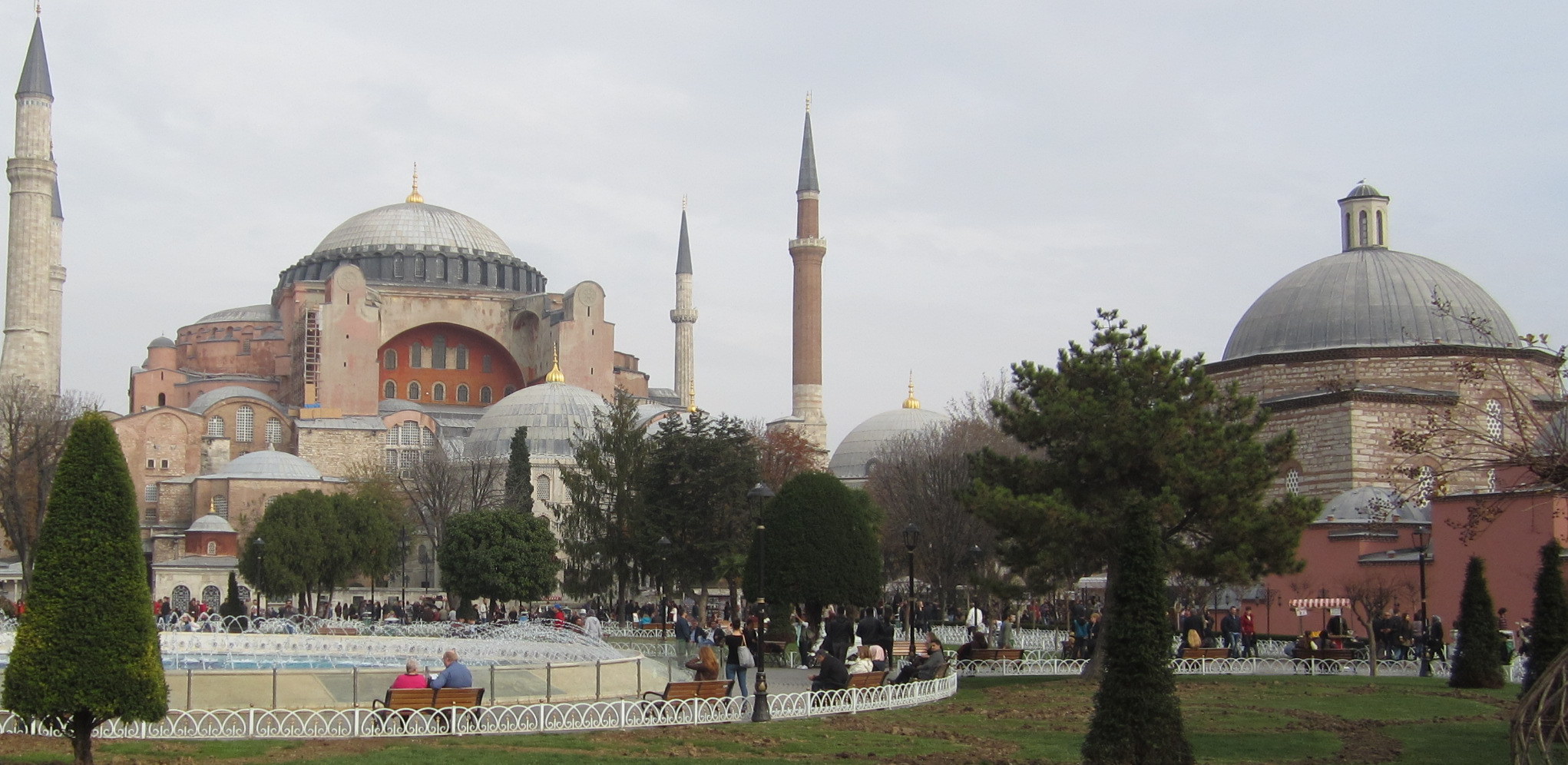
There are three buildings that everyone associates with Istanbul, and for good reason.

The Hagia Sophia is maybe the most famous of the three.

Inside the Hagia Sophia.

Inside the Hagia Sophia.

It began its life as a church, was converted into a mosque, and is now a museum. It was built in less than six years by 10,000 men, many of whom, I suspect, would have preferred to do something else.

The Blue Mosque is an extraordinary artistic and architectural achievement, and welcomes millions of visitors of all faiths every year while clearing the place out several times a day so the observant can pray.

Blue Mosque

The Blue Mosque

The Topkapi Palace reminds you that until the early twentieth century, a sultan ran an empire right here, complete with a harem full of eunuchs and concubines, among other anachronisms.

These three important structures are within five hundred meters of each other.

How can you not be fascinated by a culture such as this? On the other hand, is it possible to meet such outsized expectations?

Well, probably not.

In between all the history and all the east-meets-westyness, Istanbul is an onslaught of sales without marketing.

Walking down the Grand Bazaar helps me understand what a cocktail waitress at the Tailhook Convention must have felt like.Or maybe a nice Midwestern kid off straight off the bus at the Port Authority. Janine and I have a running joke about the shopkeepers who venture out into the street inviting you back to their shop, just to look. “C’mon, honey, let’s go back to my place. We’re just gonna talk.”

I have written in the past about the sheer terror that a tourist feels when trying to buy something in Morocco. Well, if Turkey’s not any worse in this regard, it’s certainly not any better.

There are thousands of carpet shops in Istanbul, and I would be willing to wager that if you ask about the price of ANY carpet in ANY one of these shops, you will be quoted a price that is outlandish and obscene. This is exhausting. If you ask me, if Istanbul wants to become a truly great city, it has to cut this out. It has to treat its visitors like guests, not marks.

On the other hand, if you are lucky and intrepid (and my dear wife is both) you can find stuff that is unusual and maybe even unique, and you won’t have to sell a kidney to pay for it. For example, Janine, who has made pilgrimages to flea markets in Rome, Athens, and now Istanbul, found a seven story market called the Horhor antique flea market in which we succeeded where many others fail. Mind you, we had to take a tram out of the city center and then stumble our way through a nondescript semi-residential neighborhood in the rain to find the place. Once we arrived, we discovered that we were the only customers in the place. In Istanbul! On the fifth floor, amid a graveyard of lamp parts and other detritus, we settled on an old Turkish lamp that will assume a prominent place in our apartment, if we can figure out a way to get it home.

IMG_2363

Our Horhor lamp. (The blue one)

We didn’t buy a lamp, we bought a chapter out of Homer and a story for the poor sap who looks up at the lamp back home and says, “That’s nice. Where did you get it?

Next time: We meet some of the archetypes of Turkey – let’s call them the Turquetypes.

Have you ever been to a Turkish bath? Yup.

How do you visit Turkey and not go to the Turkish bath? Well, I suspect lots of people manage, but they would be missing out on the opportunity to strip naked and be ordered around by a man in a loincloth for a couple of hours.

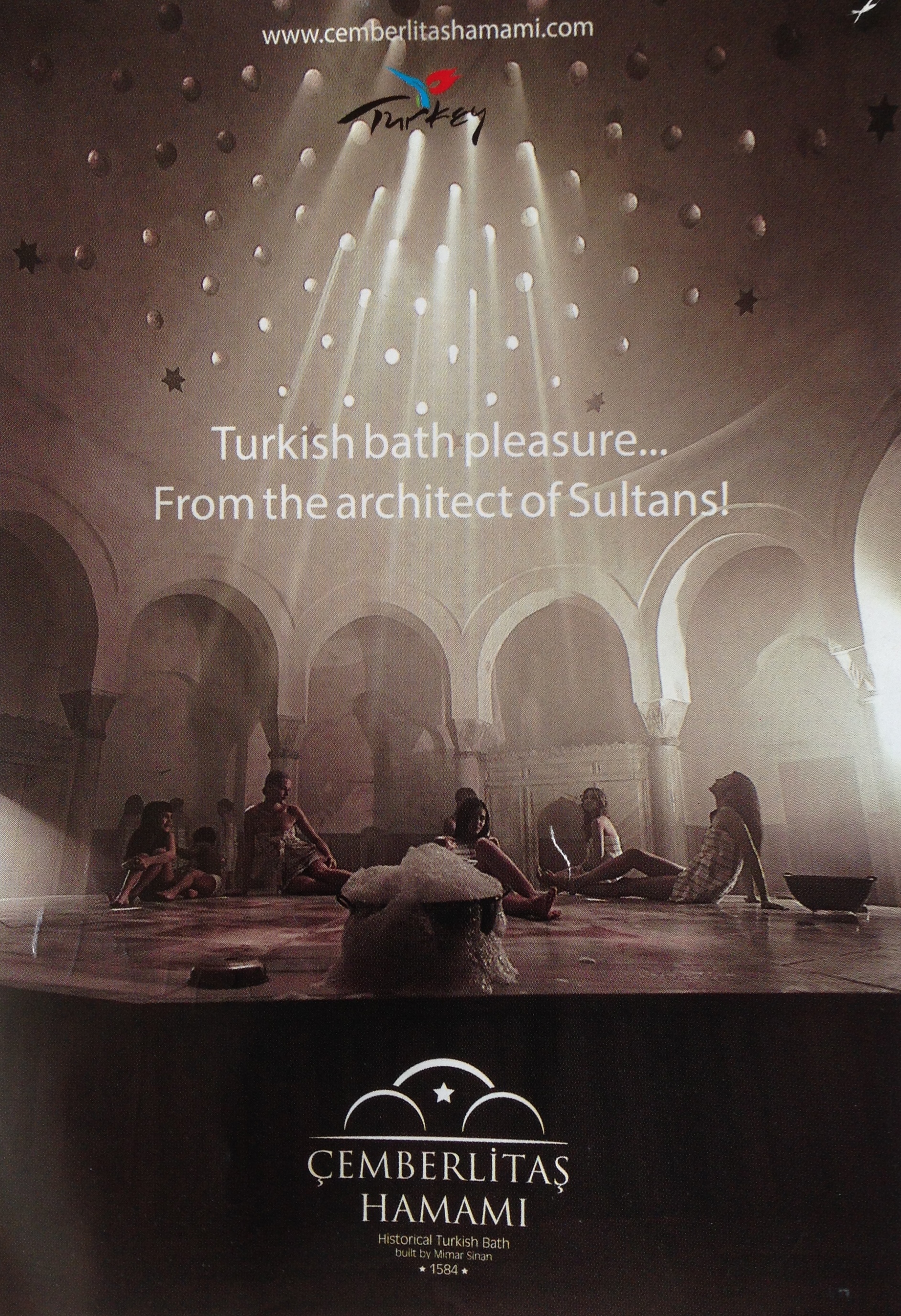
The brochure for the Çemberlitaş Hamami says that the bath was commissioned in 1584 by the wife of Sultan Selim II. There are gauzy photos of bath salts, soaps on ropes, and beautiful people (mostly women) reclining with beatific expressions wearing strategically draped coverings.

2 hammam

The hammam beckons…

How could you resist the sheer, unctuous ecstasy of a five hundred thirty year old Turkish bath built by a sultan’s wife? I couldn’t. Not to mention the history. I yearned to lie on the very marble reclined upon by sultans and such.

I was all in. Besides, travel is terrible on your body. You sleep on weird beds with all sorts of crazy pillows. The one I’m using now has the size and texture of an anvil. Then there’s all that lugging of luggage and the airplane rides and the walking and schlepping and such. Sometimes you just need to recline on a five hundred thirty year old piece of marble, sweat out the stress of the day, and be massaged back to wholeness. Besides, according to the brochure, a visit to a traditional Turkish bath even “increases the happiness hormone.” Yes! That’s what I need! I’m a most happy fella, but I’ll always sign up to increase that hormone.

Janine agreed. She wanted more happiness hormone too.

Better still, it was a chilly, drizzly day in Istanbul – perfect for a bath.

We descended the stairs into the hammami and were greeted by a woman who handed us small cardboard boxes with scrubbing mitts inside. Janine also received a pair of black underpants. We were then sent to our respective sections. The lounging ladies with shimmering skin and faraway eyes go to the right. The chiseled gents with the six pack abs, strong jaws, and good haircuts go to the left.

Upon entry to the men’s section, I was immediately struck by the lack of soaps on ropes. There was also no piped in strains of Enya or seashore to calm my frazzled nerves. I was beginning to get the feeling that this experience would not involve essential oils either.

Nope, I was sent upstairs to remove my clothes and wrap a little cloth around my waist. I spent a little time experimenting with different ways to make sure that the cloth would stay in place, because to get to the men’s hammam, you have to walk back through the lobby. I sucked in my gut as best I could and made my break for the men’s spa.

Once inside, a fellow gestured toward the shower, and I dutifully performed my ablutions. After that, I joined the group of well-fed gentlemen who were laid out in the center of the room like tunas at a fish market. The hammam is an impressive room. There’s a massive round marble slab in the middle and a high domed ceiling with tiny windows letting in a bit of light. I could be in the sixteenth century except for a single bare lightbulb that hung down from to top of the dome. It’s pretty wet in here and it’s just a regular light bulb with no weatherproofing or anything, I thought. How could that be legal?

Oh, and what’s that I smell? After consulting my mental olfactory catalogue, I determined that the room smelled vaguely of pee. Five hundred and thirty years of it, I guessed. If this is aromatherapy, I’ll pass.

I reclined on the slab for a few minutes more, pondering the light bulb and the pee when a felt a tug on my toe. I looked up to find a fellow with a weird glint in his eye clad only in a cotton sarong gesturing for me to follow him. All of a sudden I wondered if I was part of some Stanford-funded psychological experiment. If you take a man’s clothes and put him in a strange setting and then have some wild-eyed Turk tug on his toe, will he acquiesce like a docile lamb? Yep.

The fellow led me to another part of the room and says, “lay down.” I did, of course.

My Turkish friend then took the scrubbing mitt I was issued when I arrived, which I had been carrying around like a baby blanket, and used some kind of abrasive matter to remove a thin layer of skin from most of my body. When he finished with one part of me he barked another command. “Turn over,” “sit up,” “lay down.” It was like Turkish Simon Sez.

I couldn’t decide if I was in a Turkish bath or a Turkish prison.

Then he attempted to break the tension with a little conversation. “Where from?”

“America,” I offered. He grunted. That was it. The small talk was over. I decided that he was collecting demographic information for a study.

When the scrubbing subsided, he ordered me to sit back up, at which point he began dumping water over my head. Then he commanded me to lay down again, and I decided that I was simply in puppy training class.

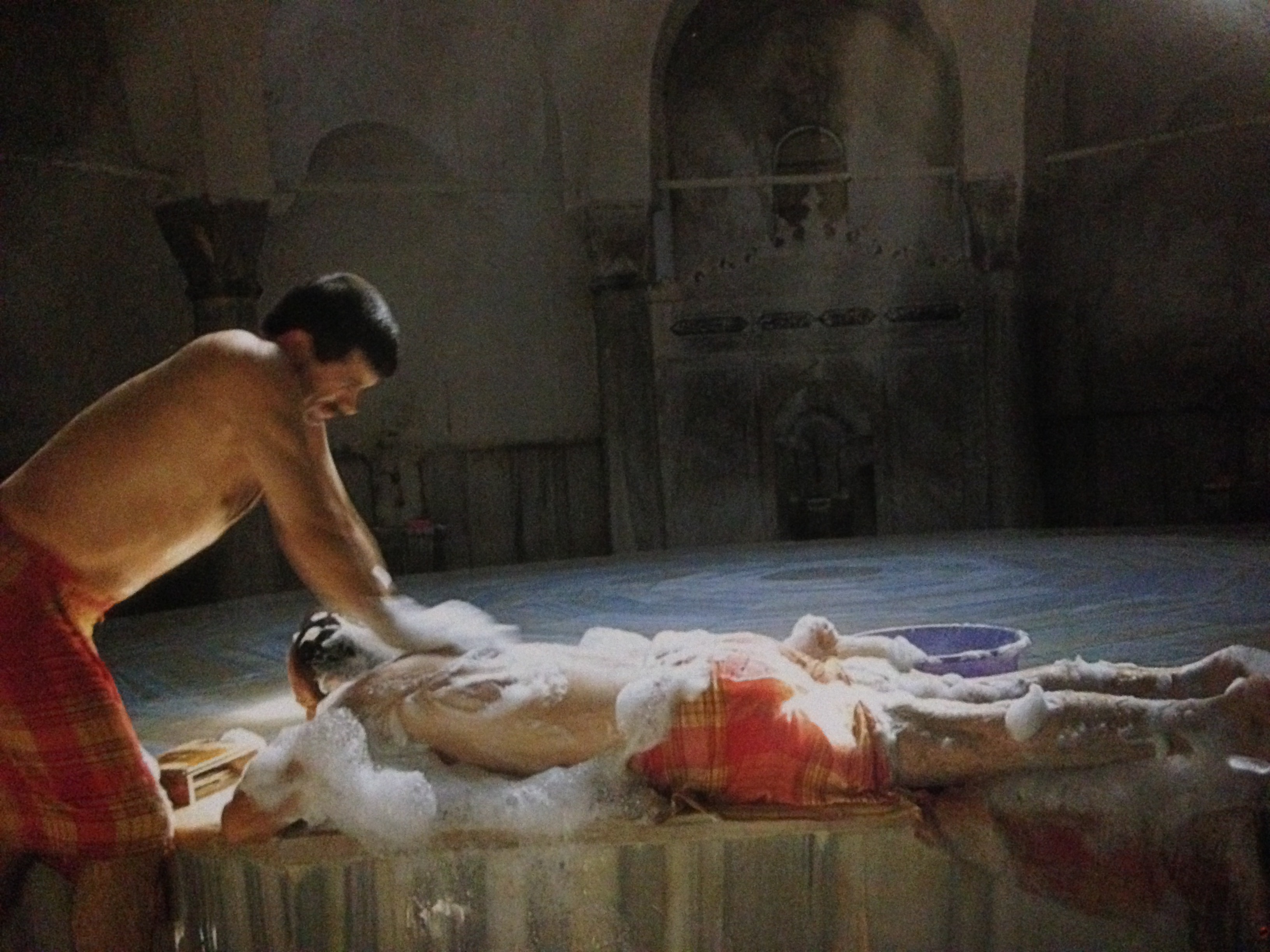
I closed my eyes and pondered my life for a moment, when I felt a whispy, soft cloud of something that felt like powder puffs or cotton candy. I cracked one eye open to see that I was now covered in big, fluffy clouds of soapy froth. I don’t know if they have the world’s largest kitchenaid in the next room, but my buddy has produced a soft, luxurious lather. He lathered me up this way and that. I must say it was kind of nice.
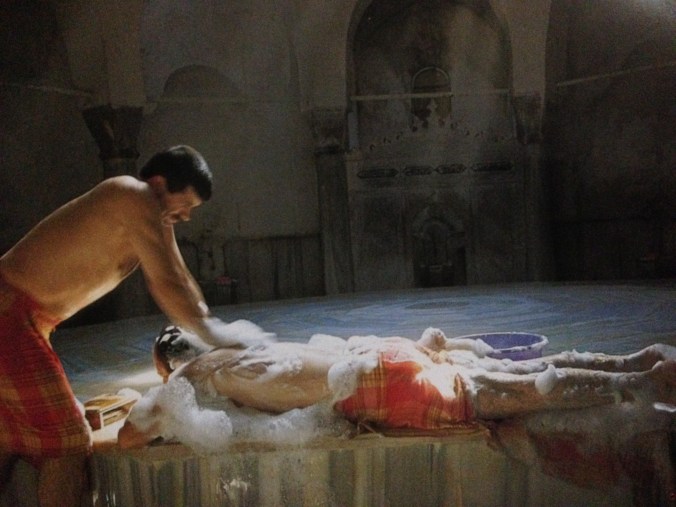
That's not me, but it might as well be. But you get the picture.

That might as well be me. Foamy, frothy fun.

Before I could enjoy myself too much, I was ordered to sit up again and my friend began throwing buckets of water at me like I was on fire.

There was a brief lull. Part one, it seemed, was over. My attendant had one more bit of communicating to do, however. He began making a series of intimidating gestures that made me understand that if I would ever be allowed to retrieve my clothes that he would appreciate a tip. Those gestures included pointing at me, rubbing his fingers together, pointing at his eyes and mine, which is a joke in the rest of the world, but clearly not here, and then pointing to the only other thing he was wearing, a little plastic tag with the number ten on it. Got it. Give money to Mr. Ten because he’s watching me.

When this little exchange ended, he pointed back to the slab and said “lay down,” which I did, of course. I guess the point is to break the customer down before you build him back up, like the army or the New York public schools of my youth. The effort has succeeded. I have been broken like a fresh recruit at West Point.

A few minutes later, there was another tug on my big toe, and a slightly denser, older fellow, Mr. Thirty Two, who was also only wearing a sarong (Janine reported that the masseuses wear black bikini tops and bottoms), led me into a room full of massage tables that looked more or less like the McDonald’s of massageries. I guess you could call it an actual sweat shop!

Mister Thirty Two was a little less guttural than his colleague. The conversation was familiar, though. “Where from?” “California,” I said. “San Francisco!” he replied. How did he know?

Mister Thirty Two rubbed me with oil this way and that, keeping a respectful distance from my personal effects. I appreciated that. After half an hour or so I was released to the shower. As I was showering, some guy started banging on the shower stall shouting “Hallo! Hallo! Woman!” This one had me stumped. Was he calling me a woman? Was he telling me that there’s a woman in the shower? I opened the shower and he pointed toward the lobby. “Woman.” Ah, I think he was telling me that Janine was waiting for me in the lobby. I peered out into the lobby. There were a number of European looking women, but none that I recognized. “Not my woman,” I told the fellow, and retreated to the marble slab for a final round of basting.

I don’t know if my happiness hormone had been increased, but after all that, I must admit that I was feeling pretty good.

There is something profoundly intimidating about being ordered around, nearly naked, by a series of guttural, minimally dressed and even more minimally communicative Turkish men, but as I emerged into the Istanbul evening cleaner, shinier, minus a small amount of dermis, I smiled. The folks back home will enjoy this one, I thought.

The turtle makes a break for it, and other tales of derring do in Athens

After a week in Athens, I now feel that I am something of an expert on Athenian life and culture. My deeply considered thoughts are thus:

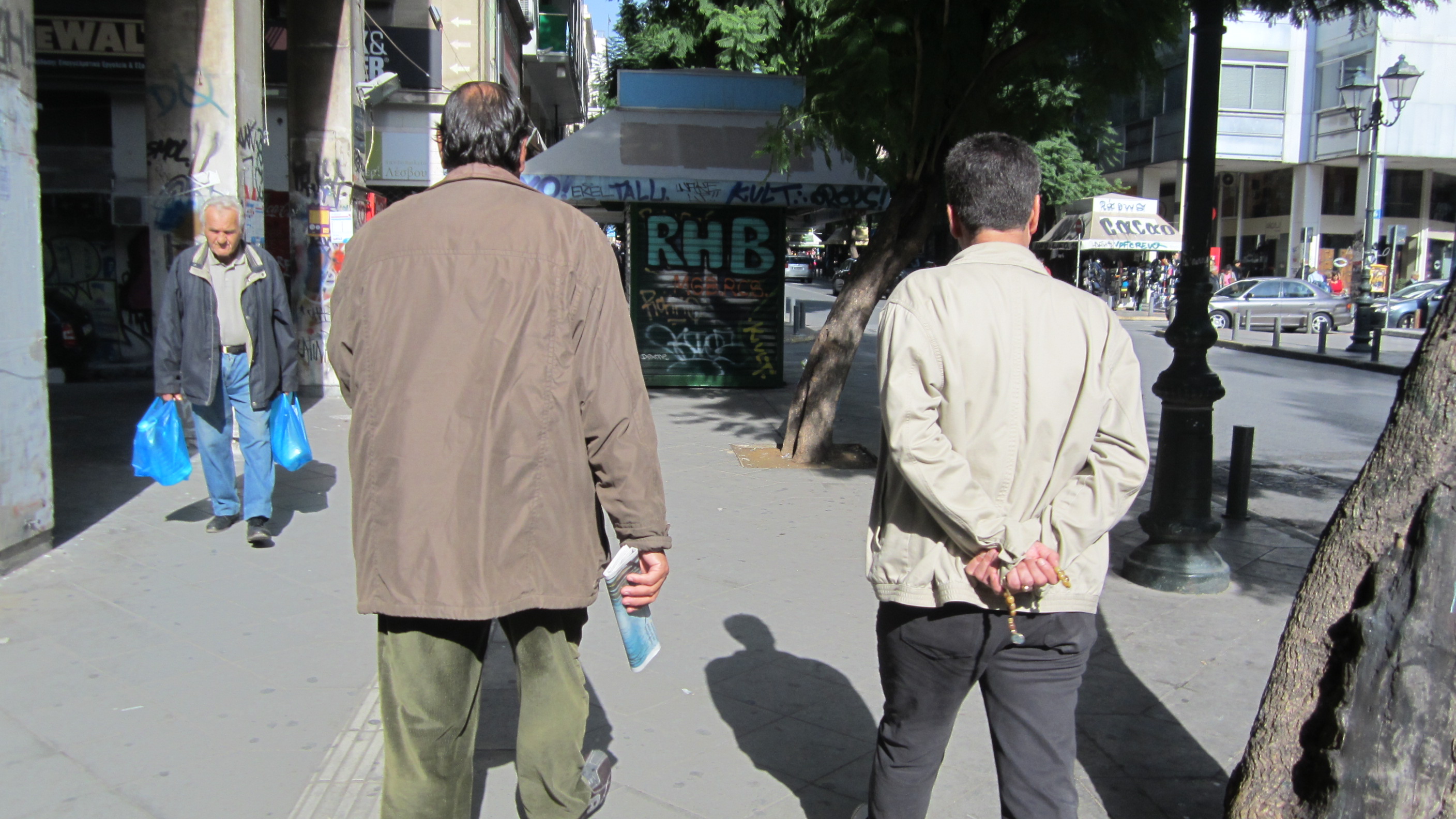
The worry beads look like fun. I’ve seen a lot of men working strings of beads this way and that. They spin them around, they play with each little bead. Each guy seems to have his own special ritual. I want a pair, but I will surely drive my wife crazy. Is this a guy thing? Do guys worry more than women? Who knows? I do know that I picked up a set for my mom, and I’m sure she’ll put them to excellent use.

Cold guys with worry beads.

Worried guy.

Worrisome, this worry bead thing.

Worrisome, this worry bead thing.

People seem chilly. Not socially, just physically. It’s been in the upper sixties and people are dressed for a space walk. The other day it was sunny and warm, and one guy was wearing a long sleeve shirt, a hoodie sweatshirt, and a puffy coat.

They smoke a lot here. Good heavens, the people smoke like chimneys. It is technically illegal to smoke inside restaurants and bars, but those laws are less heeded than the jaywalking laws in New York, or the helmet laws in Uganda. It’s best to get a table on the sidewalk and try to sit upwind of the rest of the city.

The service was gracious and lovely. People were friendly, they made us feel welcome, and they spoke excellent English. I do my best with Italian, French, Spanish, and Japanese, but Greek is a bridge too far. Thankfully it was not remotely a problem. Thanks, Greece, for learning my language!

I’m hooked on souvlaki. It’s filling, it’s delicious, and it’s dirt cheap. These are the grilled meat sandwiches served on pita bread and covered in substances that will give you dragon breath for a week. Here in Athens one becomes a connoisseur rather quickly. On our first day, I sought out (surprise, surprise) some place that I read about that is purported to have the finest souvlaki on the planet or somesuch (CRAP, CRAP, CRAP, I just remembered that I read about that in the New York Times as well. I am as shallow and lazy a traveler as they come. Damn.) No matter, we couldn’t find it. I dragged Janine through this plaza and that and we just couldn’t seem to find the joint. I also flatly refused to sit down at one of the touristy souvlaki places on Monastiraki Square. It would defeat the purpose to pay ten bucks for a souvlaki. It would be like paying twenty bucks for a pizza…oh, wait, never mind.

We finally settled for a little joint right off the square. The stuff they put on the vertical spits are called gyros (which is Greek for “stuff they put on a vertical spit,” I think), and you can have chicken or pork. I love the concept of chicken on a spit. They just stack a bunch of boneless whole chickens and run a spike through them and cook them forever. The fat drips down and seasons the meat and the result is incredibly juicy and chickeny. But the pork’s great too. Then there’s that weird lamb and beef paste that you see everywhere in New York. That seems sketchy, although I also like sketchy. Or you can get a skewer of beef or pork. Let’s face it, they’ll grill up their thumbs if you ask nicely and it will be delicious. Then they put it on a pita bread, but not that flaccid, emaciated excuse for pita we get in the states. In Greece you get a substantial, swarthy, vigorous Frisbee of bread that soaks up the juices and keeps things more or less intact. Then they add mystery spices, lots of raw onion, sometimes tomato, and depending on what meat you pick they add that garlicky yogurt sauce called tzatziki that makes your children’s breath back home in the U.S. bad even though you’re here and they’re there. And just for kicks they throw a couple of French fries on top. French fries? I find this to be the strangest part of the procedure, but who am I to argue? The thing is, if you eat it at 1 you won’t be hungry until the restaurants open at 8 or 9. All that for 2 euros. What’s not to like? We’ve had three souvlakis so far, including one at the joint I had been looking for in the first place, and they’ve all been slightly different but absolutely delicious. What a country.

Cheap, fast, and delicious. Souvlaki!

Cheap, fast, and delicious. Souvlaki!

Okay, I’ve been told that there are things to do in Athens other than eat, and that may be true.

In addition to eating ourselves into food comas, we have been attempting to do some historical stuff.

Acropolis Museum

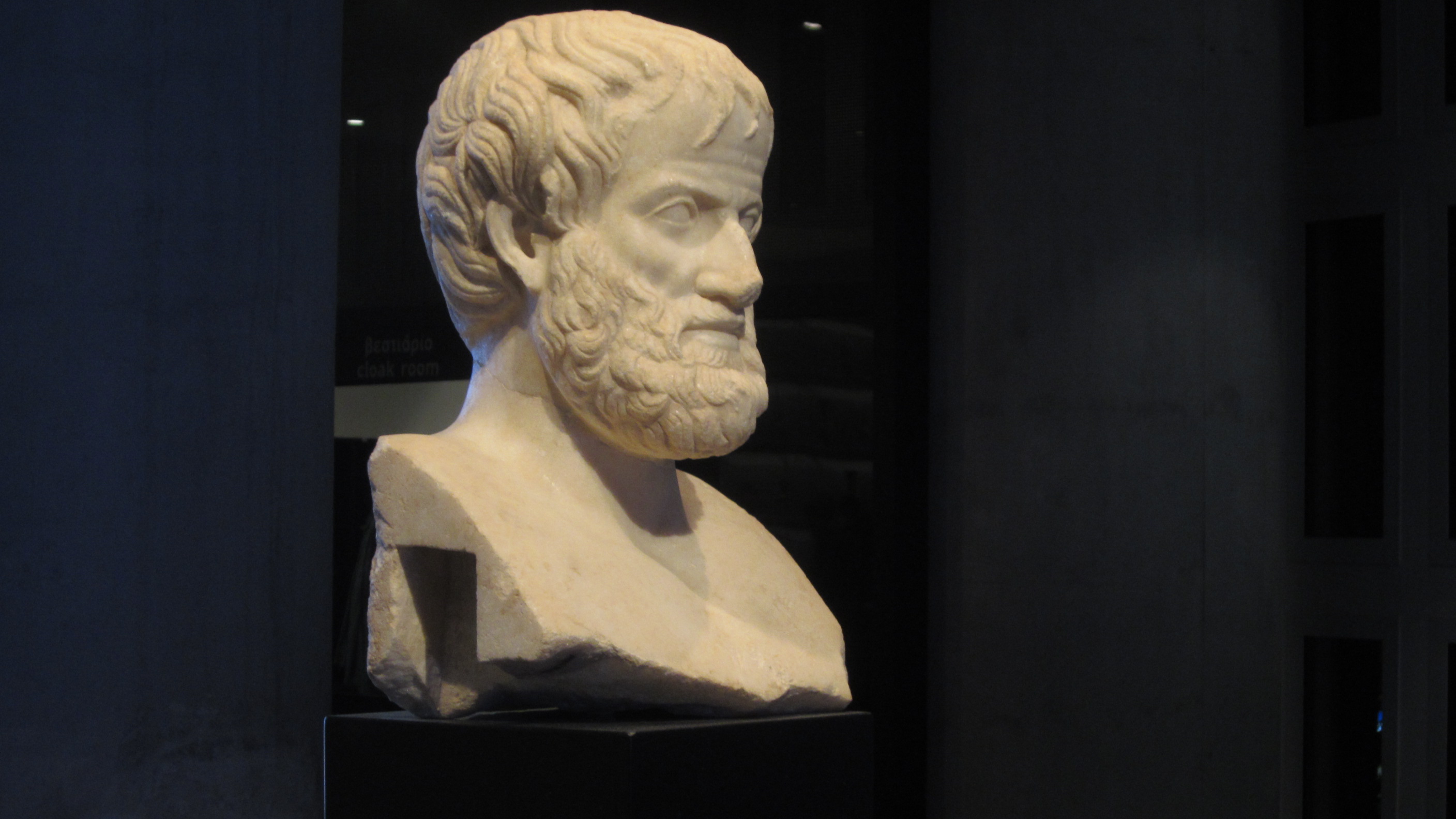
We decided to begin our tour of Athenian culture and history at the Acropolis Museum. This is an absolutely smashing museum, which opened in 2009. It sits just below the Acropolis (the site on the top of the hill that overlooks Athens) and has a great view of the Parthenon (the famous temple that dominates the Acropolis). The museum is modern and bright and takes a lot of the fussiness out of looking at old pieces of marble. It showcases a wide variety of artifacts recovered from the slopes of the Acropolis, it has some splendid sculpture, and it even has an extraordinary bust of Aristotle that was just discovered in 2005 when they were excavating the site of the museum itself.

Can you believe they just found this perfectly intact bust of Aristotle in 2005?

Can you believe they just found this perfectly intact bust of Aristotle in 2005?

There are other wonders – early in the process they realized that the museum was sitting on a valuable archeological site in its own right (people have been living in this neighborhood for the past six thousand years) so they built the structure on top of the diggings in a way that would allow the research to continue and which would let visitors observe the ongoing work. It’s nifty.

The dig under the Acropolis Museum

The dig under the Acropolis Museum

Finally, they have transferred the marble friezes from the Parthenon to the new museum in a full sized presentation of the Parthenon’s exterior. They are replacing the actual Parthenon with exact replicas, which may offend some. It’s a tough call. If you leave them out there they will be damaged by the elements and could be destroyed by earthquakes and such. Moreover, you can now look at these amazing sculptures up close in a controlled environment. But taking them away isn’t so great either. I’m not sure it matters. We’ll all be dead before the scaffolding comes down up there. Maybe our grandchildren will get to see a cleaned up Parthenon site. On the other hand, maybe not.

The actual Acropolis and the Parthenon

Armed with some context, we hiked up the hill the next day to see the place itself. It was nearing sunset, which made the visit even more lovely. Walking in the place of all that history is really something, but the story of how this amazing site has been plundered and mangled is quite depressing. The temple complex, which was constructed in 443 BCE, was pretty much intact until the 17th century, when bad things started to happen. In the mid-1600’s the entrance monument, called the Propylaia, was badly damaged when the gunpowder the occupying Turks were storing there exploded. Later, they largely dismantled another structure, the Temple of Athena, to shore up the hill’s defenses. Then, the Parthenon itself was bombarded by the Venetians in 1687. The final blow came when the Turks allowed Lord Elgin of England to walk off with many of the marble sculptures that surround the upper face of the structure. The Elgin Marbles, as they came to be known, are still on display in the British Museum. If you ask me, they should have hoisted Elgin up by his marbles, and the British should return the sculptures. The British position, as near as I can tell, has been, “Nanny nanny boo boo. We’re taking your marbles and you should go home.” Give back the marbles, Britain.

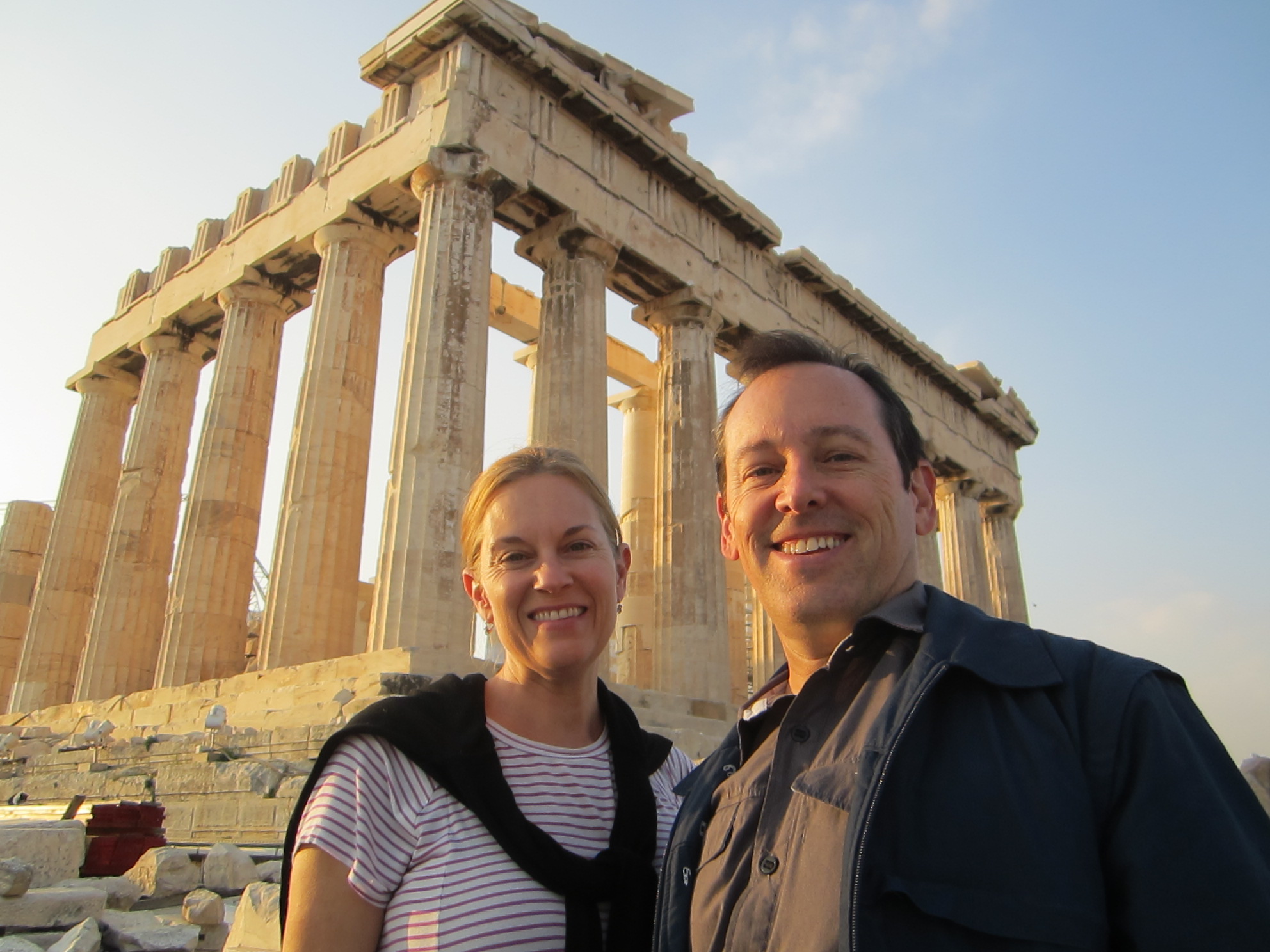
The loving couple at the Parthenon.

The loving couple at the Parthenon.

National Archeological Museum of Athens

The next stop on our archeological history tour was a visit to the archeology museum in downtown Athens. By this time you might imagine that we were maxing out on archeology, but in fact we were starting to get the hang of this stuff. There were thirty three galleries of statues, many of which I first saw in my textbook when I took my one and only art history class back in the 20th century. Despite all this truly impressive art and history, the highlight of the visit might have been the bold determination of this box turtle, which escaped the inner courtyard and was making its way into the exhibit without a ticket.

Turtle without a ticket.

Turtle without a ticket.

The Temple of Olympian Zeus

We wrap up our tour of old stuff with a visit to the Temple of Olympian Zeus, a massive site in the middle of town. There’s no museum, not much explanation, just a bunch of columns (including one that fell in a storm in 1852) and a few excavated outer sections. The lack of fuss is part of the charm, though. We shambled in late in the day, paid our two euros, and basically had the place to ourselves.

Temple of Olympian Zeus. Who thinks they should pick up the column? I'm on the fence.

Temple of Olympian Zeus. Who thinks they should pick up the column? I’m on the fence.

We had a number of other fun adventures, most of which involved food or cocktails. We wandered the central market and looked at the sheep’s heads and piles of fish and then had a nice market lunch. We hit a few rooftop bars for our pre-dinner cocktail. (Is the economy rebounding? Maybe, the cocktails were almost as expensive as they are in New York.)

My favorite dish of the visit was at Melilotos, where we returned for a second visit, proving that I can choose good, cheap, and reliable over different once in a while. The dish that made me sing was meatballs in tomato sauce with tagiatelle. What? Italian food in Greece? Well, it was Italian with a twist – the meatballs were made with cinnamon and mint and I can’t stop thinking about them.

Today we are off to Istanbul. What should we do? Where should we eat?

And finally, my favorite picture so far:

Having fun with my selfie stick.

Having fun with my selfie stick.