Salty, Sweet, Sour, and Stinky – Let’s Hear it for Bangkok!

Bangkok is one of the great food cities in the world. On what seems like every street corner, you will find some little food stand in which somebody is tossing together some outrageously delicious morsel for what you would spend on a pack of gum back home. It’s true that there’s some small chance that some of it could kill you, but chances are that it won’t. What’s not to like?

I’ll admit that they dish up some mighty strange stuff on the street. You will see all manner of dried fishes, parts of animals in which you can neither identify the part nor the animal, and heaven knows what else. And then there’s the question of hygiene. It’s not like the board of health is hanging big letter grades right there on the sidewalk. On the other hand, they cook the stuff right in front of your eyes and crank those woks up as high as they go, likely killing the little beasties that might send you to the rail. Now that I think of it, the one time I got really sick when traveling (excepting, of course, the pristine yakitori place that served me raw chicken on purpose) was in a pub in England. That little raw chicken episode probably just toughened me up for the tasty streets of Bangkok, right? Right!

I was ready to tackle the great cuisine of Thailand. So how many of these monuments to glorious street food did we patronize? Er, um, none.

It’s shameful, I know, but before my membership in the gluttony hall of fame is revoked, I am here to tell you that we still ate really well in Bangkok, even if I fall a notch or two in the esteem of the great world eaters.

Yummy looking street food that we didn't eat.

Yummy looking street food that we didn’t eat.

Thailand was not originally on our itinerary. We were going to pass through here on our way to Burma, but when our dear friend (and faithful blog reader) John told us that he  wanted to meet us in Thailand for his birthday, we jumped at the chance. We’ve been here before, but this trip through Bangkok has reminded me that there’s something to be said for revisiting a place that you’ve already enjoyed. For one thing, we were last here almost twenty years ago, and while I remember liking the city for all its frenzied charms, the memories were fuzzy little blots at best. Why not give Thailand another go?

And I’m glad I did! I’d forgotten how much I like it here. In the dim recesses of what’s left of my mind, I know we had fun here once upon a time, but now I remember why. Bangkok is one of those places that’s just funky enough to be endlessly fascinating while still being easy to travel in. The food is crazy good. You can get an hour long foot massage for eight bucks. There’s now a pretty convenient elevated train, which, while it doesn’t go everywhere, still gets you around. Taxis are really cheap and the cab drivers are usually friendly, honest, and mellow (although one cab driver risked all our lives in what seemed to be an attempt to get us to our destination quickly, even though we’d have been quite happy if he’d taken his time). There are lots of really cool temples and other cultural things, but to be honest, I’d be happy if there was nothing more than food and foot rubs.

Let’s begin with my shameful admission that we didn’t eat street food. On our first night in town, I thought we’d keep things simple and stay close to our apartment. I scoped out a place that seemed almost too good to be true, and I’m happy to report that it wasn’t. It’s a restaurant called Soul Food Manhanakorn and it is run, improbably, by a former American food writer named Jarett Wrisley. I am not qualified to say whether having an American food writer open a Thai restaurant qualifies as heresy or not, but I frankly don’t care. It serves craft beer, whimsical cocktails, and takes street food to the next level. They use as many organic ingredients as they can, and like many other places we seem to wander into, the joint would probably feel pretty at home in Brooklyn or the Mission, and I consider that a compliment.

Onto the food…over two meals (yet again, we found a place that we loved and went back – sue me) we had: little wraps of butter lettuce and pork jowl into which you could add an assortment of Thai yummy things like toasted peanuts, fried shallots, tamarind jam, and other jazz like that; a fiery, limey pomelo salad with prawns that I will dream about for years; Issan chicken wings; a classic green papaya salad topped with deep fried chicken skin (!!); that classic wide noodle called pad see ew topped with smoked pork jowl; deep fried okra; and a vegetarian red curry that would make you forget that there’s a big pile of pork jowl sitting in the kitchen waiting to be eaten.

Pomelo salad and fried okra with a crazy good sweet spicy dipping sauce.

Fried okra with a crazy good sweet spicy dipping sauce (L), and pomelo salad (R).

This food was everything I love about good Thai food, which is so hard to find in the states – it finds the perfect balance between spicy, sour, and sweet, and gives you that funky goodness that fish sauce brings to the party. Thai restaurants aren’t known for their service, but when I mentioned to the hostess that we had been there twice in four days, she tried to buy us a round of drinks and dessert. Sadly, we had run completely out of steam by that point, but it’s the kind of little touch that makes you love a place down to your toenails.

Soul Food Mahataran - a fun, funky joint that would be at home in Brooklyn or the Mission.

Soul Food Mahanakorn – a fun, funky joint that would be at home in Brooklyn or the Mission. Don’t worry that it looks empty – they were just about to get hit with a big second turn.

We weren’t done with this fancy food. For John’s birthday, we thought it would be fun to see just how much luxury we could squeeze out of Bangkok. The last time we were here we stayed in a guest house in the backpacker ghetto off Khao San Road. It’s more or less the Bourbon Street of Bangkok, with souvenir shops, cheap restaurants, and (I am told) clubs that appeal to baser sensibilities, let’s just say.

This time, we could afford a slightly elevated experience. We made a reservation at a place called the Siam Hotel, which is several miles up the Chao Praya river, the thrumming, exciting waterway that splits the city, and whose waterbuses also provide cheap sightseeing transportation options. If you make a dinner reservation at the Siam Hotel, however, they send a boat to pick you up at the main dock downtown. We scurried down to the dock at the appointed time and there came the boat, which whisked us half an hour upriver to a glorious little boutique hotel and restaurant made out of old teak timbers. We had cocktails on the deck overlooking the river, and a lovely dinner, but the food could have been lousy and we’d still have been thrilled.

Our sunset boat ride on the Chao Praya on the way to the Siam Hotel.

Our sunset boat ride on the Chao Praya on the way to the Siam Hotel.

So, no, I haven’t been eating squid testicles or lamb’s eyeballs or fish paste that was fermented in some ninety year old guy’s underpants. We aren’t staying in a backpacker’s flophouse, just a good old-fashioned airbnb apartment (it’s not too fancy, mind you, but it’s a far cry from the actual cage we once slept in at a Kuala Lumpur “guest house” in the 90s). No, we’re older and wiser and once in a while it’s nice to shoot the moon, even if shooting the moon only costs you what an impromptu midweek dinner in the Village does. Here’s to middle age!

Next time – I finally get to take a cooking class, we get thrown out of a bar, and I throw in a little gratuitous sightseeing for those of you who are sick of reading about food.

11 Things I really love about Japan

Now that I’m warmed up, herewith are some of the many things I love about Japan.

1. Vending machines with hot and cold liquids. Pretty much wherever you go, you can buy a can of hot coffee (which makes a very good hand warmer in the winter) or cold tea, coffee, soda, or any number of mystery drinks – out of the same machine. In the winter, there are more hot drinks than cold ones. In the summer, it’s the opposite. It’s amazing! They also sell this stuff called Calpis, but for export markets they changed the name to Calpico, presumably after someone told them that their beverage sounded like cow piss in English. Here in Japan, it’s still Calpis. Who’s gonna know? Oh, vending machines also sell this stuff they call “genki” drinks. Genki is one of those hard to translate words that means healthy, cheerful, and full of vigor. If you’re feeling logy, these genki drinks are supposed to pep you up. And no wonder, after a time I discovered that the two main ingredients are caffeine and nicotine. So you’re genki until you have a coronary.

Ah, vending machines. The blue items are cold and the red items are hot. How civilized!

Ah, vending machines. The blue items are cold and the red items are hot. How civilized! (I confess I resisted trying “Green Shower” tea on the top row, which sounds like it’s marketed to fetishists.

2. Google maps. They work like a charm. This is particularly important because they really don’t have street addresses in Japan. Your mail is sent to the third block of the third sector of the such and such neighborhood of your city. When we used to take a cab home from the train station, we’d tell the driver to take us to the street next to the noodle shop near the Fukudaya department store and he knew exactly what we meant. Here in Japan, Google Maps also works perfectly with the public transit systems, unlike, say Melbourne. You can find out when the bus or train comes, what the best connections are, and how much it costs. Japanese buses used to be mystery vehicles, but with Google Maps they make perfect sense. This is huge.

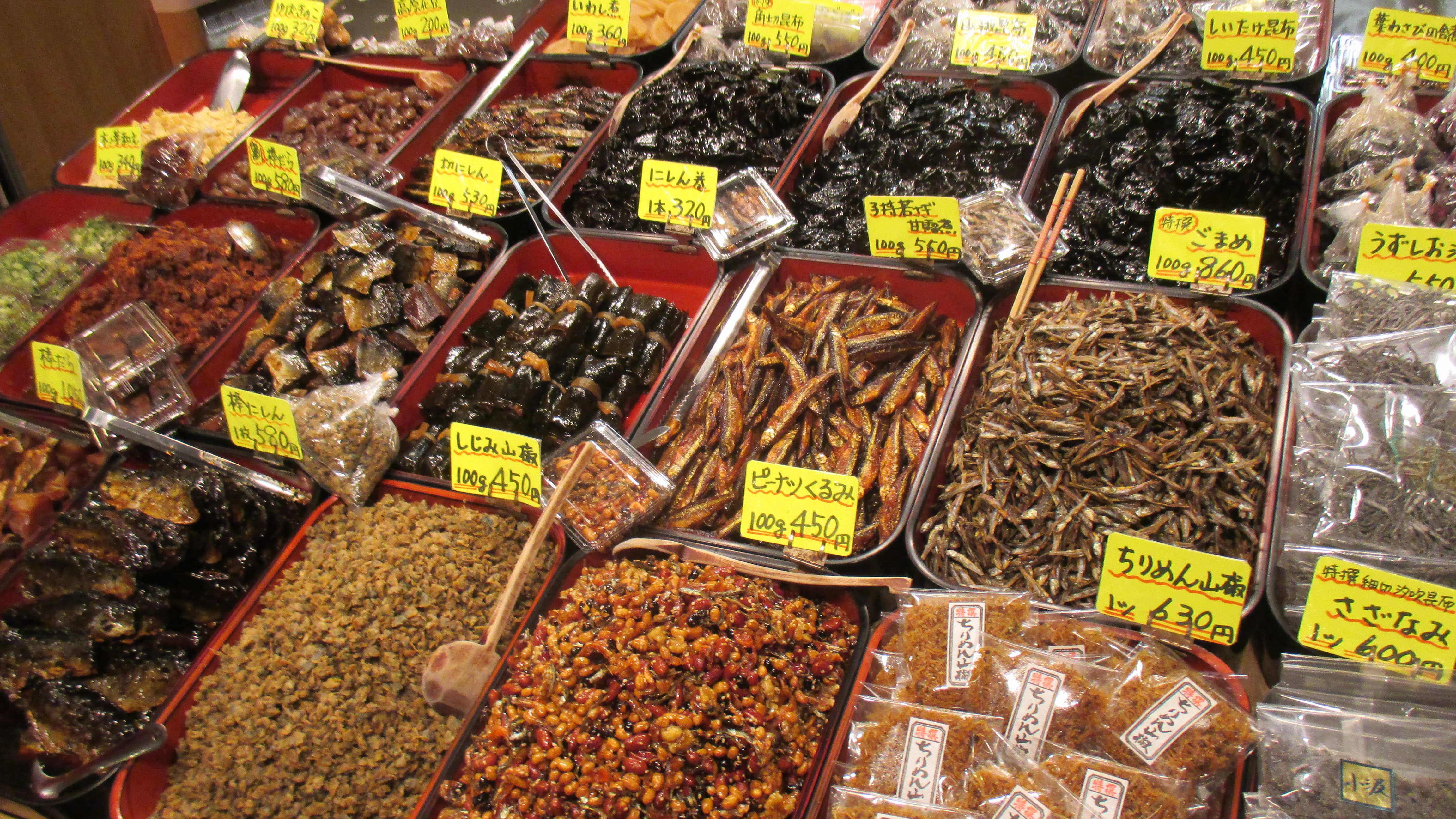
3. The Nishiki market in Kyoto – this may be the best food market in the world. The food is, well, perfect, and they have pretty much every good thing that the region has to offer. More than that, though, they encourage you to sample everything, they don’t seem to mind if you take pictures, and they don’t vibe you if you don’t buy anything. You could have an excellent free lunch here.

Some of the wonders on display at the Nishiki Market in Kyoto.

Some of the wonders on display at the Nishiki Market in Kyoto.

4. Similarly, the Tsukiji wholesale fish market in Tokyo just has to be seen. We lived in Japan for two years and visited Tokyo a dozen times and never got our act together to see Tsukiji, which will leave its funky digs in 2016 for a modern operation in the suburbs, much like the Fulton Fish Market did a few years ago. Tsukiji is the central trading post for Japan’s fish industry and it’s a wonder to behold. Apart from the famous early morning tuna auction, it moves more than half a million metric tons of fish a year and it said to be the biggest fish market in the world. And this is no tourist show. We stood and watched two guys butcher two massive tunas that the fish monger told me were worth between three and four thousand dollars each.

Two guys butchering a pair of $4,000 tunas at the Tsukiji Fish Market in Tokyo.

Two guys butchering a pair of $4,000 tunas at the Tsukiji Fish Market in Tokyo.

After gawking at all the fish, we wandered to the outer market, where there are food stalls and cookware shops. We tucked into a sashimi breakfast and I finally bought the chef’s knife of my dreams. The owner of the shop had my initials engraved in the handle, which made me tingly all over.

5. As you may have already figured out, the food is amazing almost wherever you go, and it’s not as difficult as you may think to figure out what to eat. Many places just present a plastic version of their menu in the window or a menu full of photographs, kind of like at Denny’s, except good. All you have to do is take the waitstaff outside and point at what you want. If they don’t have plastic food, just ask them what’s good and they’ll steer you in the right direction and they won’t sell you the most expensive thing – they’re crazy honest. Oh, and no tipping! I mean it. They’ll chase you down the street if you leave extra money on the table, or so I’m told.

6. Did I mention that people are honest here? The other day, as I was making my way up to Utsunomiya, the town we used to live in, the train stopped and everyone got out. Disoriented, I grabbed my shopping bag full of gifts for our old friends and scampered off the train. Another train pulled up to complete the journey, and just as I was about to board I realized that I had left my ipad on the last train. (Just writing this has produced a cold sweat.) Frantic, I had the presence of mind not to get on the train, and instead I ran upstairs to the ticket window, where I was told to check with someone back on the track I had just come from. By this time I’m beginning to leak bodily fluids (how sad that we become so attached to our technology, but whatever), and I spied a metal building that said, helpfully and incongruously, “lost and found” in English. I knocked on the door, but there was no answer, so I knocked again. And again. After what seemed like several minutes, but which was probably only thirty seconds or so, the door opened and I explained that I had left something on the train. The fellow asked me what it was and I said that it was an ipad. “Oh, he said. Here you go,” and he handed it over. Just like that. I resisted the temptation to hug him.

7. 7/11 in Japan is a great restaurant. You can get any number of dangerously yummy things at the 7/11 for a couple of bucks. There are rice balls stuffed with salmon, sour plums, and any number of other things (Although the packages are usually written in Japanese, natch, so from time to time we get a surprise). That reminds me of the time that I made a miso and jelly sandwich for lunch because I thought I’d bought peanut butter. Oops.) The 7/11 sells a divine carrot and burdock root salad, a dizzying array of pickles, sushi, steamed Chinese pork buns, a salty, umami bomb soup of root vegetables called oden, and all manner of beer and wine. You can also get a pair of gloves for $2.40 and an umbrella for 80 cents. It’s heaven on a street corner. And who says Japan is expensive??

Some of the delectable delights at 7/11.

Some of the delectable delights at 7/11.

8. Japan has now joined the modern world of banking. You can now use your ATM card to get money at the post office or the 7/11. In the old days, I think there was one branch of Citibank in Tokyo that would give you money from a U.S. account. If you traveled here and you didn’t bring cash or traveler’s checks (remember them?), you had to go to a bank and do a bank withdrawal from a credit card. Not only that, but the ATMs used to close for evenings and weekends! When we lived here, we had a Japanese bank account, but once had to hitchhike down a mountain because we ran out of money and all the ATMs were closed for the weekend. No lie.

9. The taxi drivers wear coats, ties, and white gloves. They drive with precision and care. As I said, they know where they’re going. They have a gizmo that allows them to open and close the passenger door automatically. The cabs are neat and clean and comfortable. Amazingly, the taxi rate has not changed in the twenty years we’ve been away, although it was expensive then and it’s expensive now.

10. I like bowing. It’s fun. It shows that you care. I suppose it’s just second nature – people even bow when they’re talking on the phone. Gas station attendants will run out into the street to stop traffic when you leave the station and they will bow as you go. If two cars come to an intersection at the same time and one cars yields to the other, the driver who received the courtesy will bow to the other. In his car. In what country have you ever seen car bowing? When the department stores open in the morning, an army of clerks dressed like the cast of the tv series Pan Am with neat little skirts and pill box hats line the entrance and bow in unison.

11. It’s actually a pretty easy country to visit. Janine has said that Japan may be the most accessible really, really foreign place you can think of, and I agree. People are almost always friendly and helpful, even if they don’t speak much English (and they usually don’t). One evening we even ventured into the district in Shinjuku called Golden Gai, where there are several hundred tiny little bars (some have as few as six stools). These little places are scary because they seem so intimate and unapproachable, but we thought it was worth a shot. We were in search of a quintessentially Japanese drinking experience, and what we got was a hole in the wall joint off a skinny little alley run by a friendly woman who greeted us warmly and showed Japanese professional wrestling videos all night. It was impossible to avert the eyes.

And so there you have it, friends. This was by no means an exhaustive list of things I love about Japan, just eleven that came to mind. We say farewell to Japan reluctantly. As often happens, we quickly discovered that we didn’t have nearly enough time to do the place justice, even though we’d already spent two years here. Every moment in Japan seemed full of wonder, good food, and something ridiculously foreign, even though we actually sort of understand the place.

If you haven’t been, go. You certainly won’t forget it.

Serendipity in Kyoto (caution – this post includes a reference to cod sperm)

It seems to me that good travel experiences require one of the following three things – a willingness to take risks, some modicum of planning or research, and dumb luck. If you get two out of three, you’re in great shape. If you manage all three, you’re golden.

On our first night in Kyoto, we hit the jackpot. After what seemed like hours of wandering down the many dark alleys of the internet, Janine found a ryokan that would take us. Ryokans are basically traditional Japanese inns. We would have gone for one of those fancy pants places in which kimono-clad women appear out of nowhere to bring you your slippers, some shakuhachi master is tooting his flute beyond some hidden paper screen somewhere, and they serve you a meal that takes forty two hours to prepare and eleven hours to eat, but everyone was booked. It’s probably all for the good, because those places ain’t cheap.

Instead, Janine found a perfectly nice joint, called the Ryokan Sawaya Honten on the outskirts of town, but within walking distance of a number of cool temples. We had a nice, big tatami room, and they served a nice Japanese breakfast (not for everyone, to be sure, but when in Rome and all that sort of thing). What they didn’t serve was dinner, and when we arrived we were hungry. The nice fellow at the desk gave us a map of all the places to eat in the neighborhood, pointing out his favorite – a place that serves kaiseki dinners – basically, multi-course affairs that can be pretty elaborate.

We wandered around the neighborhood and we just couldn’t find what we were looking for, which made a lot of sense, because we had no idea what that was. Finally, almost out of desperation more than anything else, we peered through the window at the kaiseki place. It was really lovely inside – there was a row of stools in front of a beautiful long wooden bar and a tiny room in the back and not much else we could see. A chef was meticulously plating some interesting looking dish for the lone couple at the bar. It looked intimidating, but we were hungry. It also looked delicious. And it looked really expensive. We poked our heads in sheepishly, almost apologetically. These kinds of situations make me kind of nervous. We needn’t have worried. “Hello! Welcome! Come in! Two for dinner?” the nice lady said.

“Yes,” I replied in Japanese, “two people for dinner.” My Japanese is about kindergarten level, but I can muscle through simple transactions like these. The chef wasn’t expecting even that and was visibly startled at my response. This always confuses me. People speak to you in Japanese and are surprised when you understand them. Howzat?

Anyway, the chef, a relatively young looking fellow, seemed charmed and he handed us a menu and explained that there were three dinner sets,with the first one starting at about forty five bucks. Seriously? I asked the nice fellow to please bring us the cheapskate set and he didn’t seem to mind.

Well, forty five bucks bought us nine absolutely impeccable courses of some of the most beautiful fish and vegetable combinations I’ve ever seen. There was a box that had some squid, a thingy of mixed chopped tuna, a shot glass of kelp swimming in some kind of sweet liquid, a little grilled fish, a small bowl of raw fish with pearls of barley, and a gooseberry. It sounds weird, but it was glorious. There was a bowl of fish consumme with a round fish cake dumpling – it was basically a Japanese gefilte fish soup, if gefilte fish soup could make you sing and dance.

Japanese fish dumpling soup - not like grandma used to make, unless your grandma is an audacious 38 year-old Kyoto chef.

Japanese fish dumpling soup – not like grandma used to make, unless your grandma is an audacious 38 year-old Kyoto chef.

There was another clear fish soup that was served in a teapot, and we poured it into little tea cups that we sipped from. We had a tuna sashimi that was pink and unctuous and fatty and so tender that if you had no teeth or gums you could just snort it through a straw. I suspect it might not pass muster with the Monterey Bay Aquarium, but I will find some way to make my penance later. Oh, and we had house-made tofu topped with a sesame cream and a dollop of sea urchin. It may be one of the best single dishes I’ve ever had. It was perfect in its simplicity and like nothing I’ve ever tasted.

Tofu with sesame and sea urchin. Simple, glorious perfection.

Tofu with sesame and sea urchin. Simple, glorious perfection.

There was more sashimi, steamed fish, and a bowl of slithery white fishy stuff that I really liked that I later found out was cod sperm. Somewhere along the way, we added sake to the mix, and the chef poured us these glasses of flawless sakes that tasted like melted glaciers, then pointed out that the guy who made the sake was sitting right next to us, and he turned out to be a terrific guy as well. It was a party! – serendipity the likes of which we may not experience for a while. The chef started the restaurant when he was twenty seven years old, and he’s been at it for eleven years. I can’t imagine what kind of nerve it took to open a place with this kind of audacity in a city like Kyoto at such a young age, but I’m glad he did. If you’re ever anywhere near Kyoto, run, don’t walk, to Rakuzen Kakinuma. When we left the restaurant, it was like we were leaving an old friend’s house. The staff ran out into the street to say goodbye, and I think they meant it. We liked it so much we brought our friends Paul and Megumi back the next night to recreate the magic, and I swear it was even better the second time.

And so let that be a lesson to us all. Janine’s good research found us a nice place to stay, but there’s no way in hell we would have found this restaurant without wandering the neighborhood and simply poking our head in. It’s on nobody’s list. It has a total of one review on Trip Advisor. But taking the first bite of our first dish is one of the most memorable moments of our trip. So that’s our lesson for the day, kiddies. Bon appetit.

Next time – Some of the many things I love about Japan.