I Heart Athens! Who knew?

Raise your hand if you’re a big fan of Athens. I know, right? It’s hot, it’s noisy, and as Yogi Berra probably didn’t say, nobody goes there anymore because it’s too crowded.

Well, the hip, happening bars are crowded, that’s for sure. And so are the very good restaurants. It’s crowded in a good way. Now that summer’s over, the only tourists here are the childless and the Dutch.

I’m not entirely sure why we’re here in the first place. Janine always wanted to go to Greece, but she really wanted to go to the islands. Having decided that beach season is over, we plugged Athens in for a week anyway, just because.

We have been delighted by the warm reception. After Greece’s brush with economic death, Athens feels like that girl who has finally been asked to dance and she responds with, well, let’s call it enthusiasm. People have been friendly and welcoming. I have to confess that by contrast more than a few Italians seemed like they were doing their best impersonation of Parisians.

We arrived with no expectations whatever. Would we be able to communicate? In most of Europe we seem to be able to get by just fine, but Greek is, well, Greek.
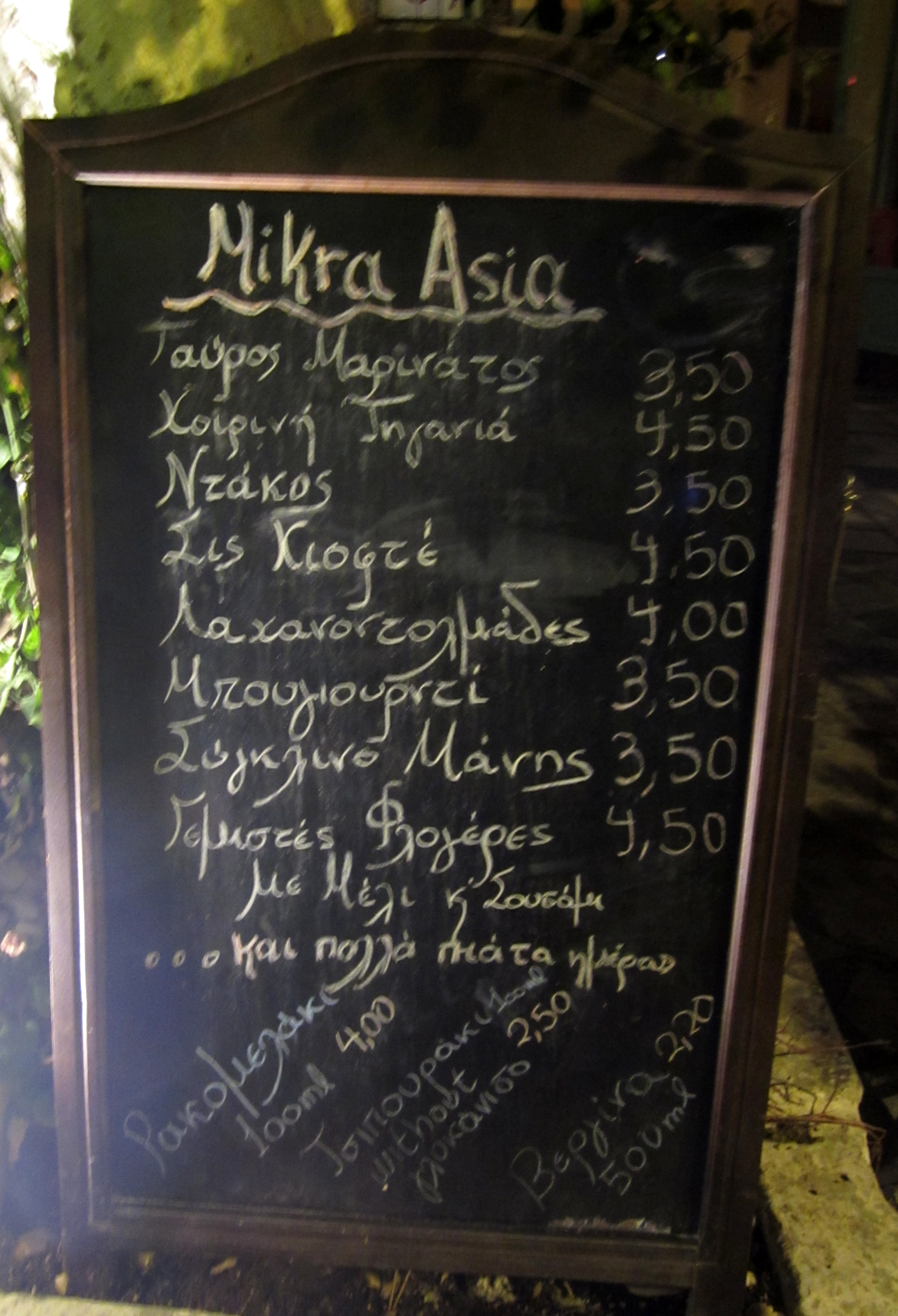
What looks good to you, honey?

What looks good to you, honey?

We needn’t have worried. Pretty much everybody in this part of town speaks English better than we do. I had assumed that we would like the food, but I didn’t realize how much. Greeks know how to eat (although they’re not sure when).

Our Greek arrival party started ominously, when a dour woman answered the door to the apartment we rented. The apartment is right off Monastiraki Square, which is not as touristy as Plaka (which boasts pedestrian alleys all selling the same I Heart Greece t-shirts), but more conventional than Gazi, where you find the techno clubs and gay bars.
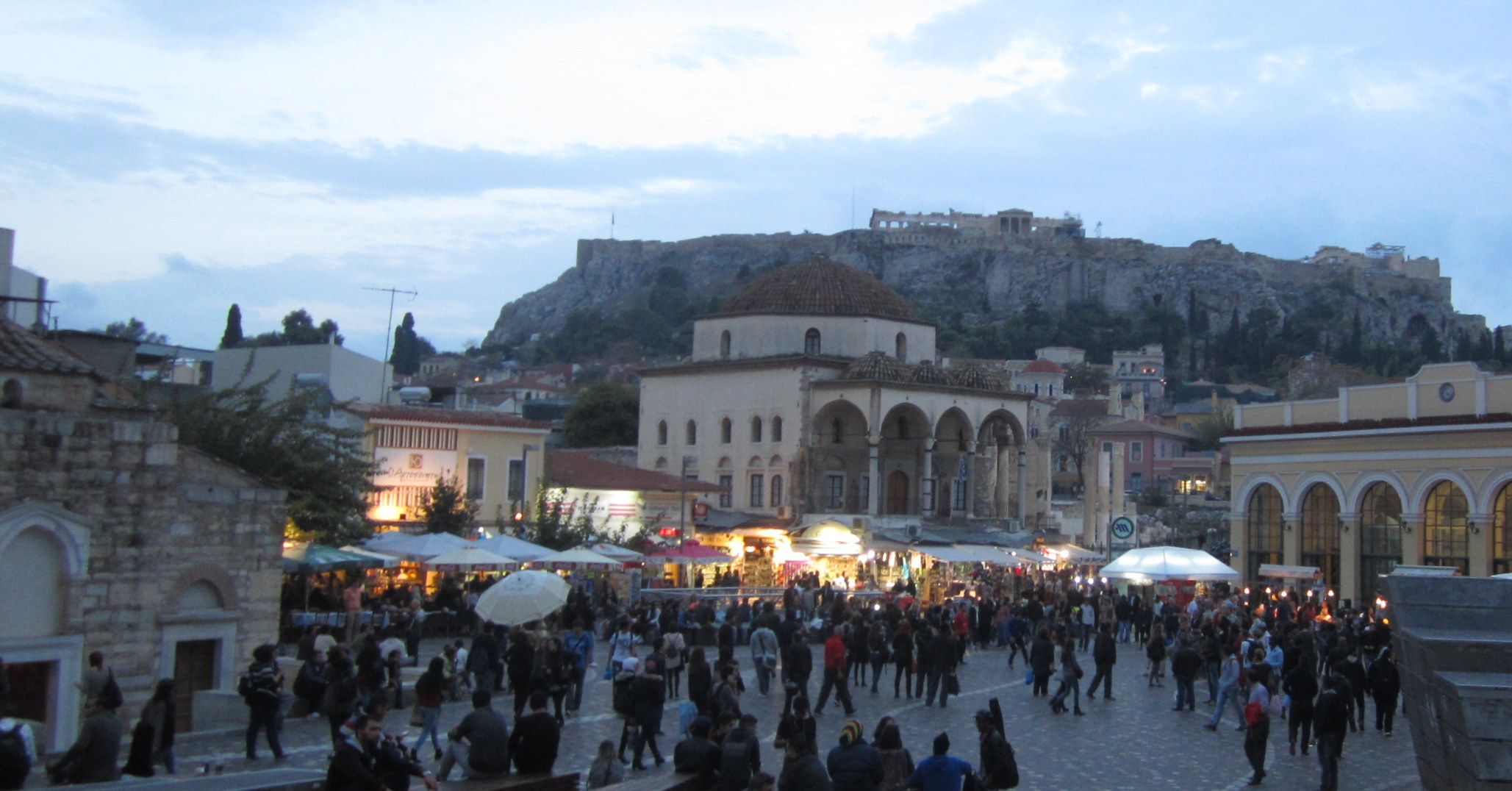
Athens!

Athens!

Our landlady Valentina, a serious woman in her fifties, started to warm up as she pulled out a map and gave us the lay of the land, telling us where to go and what to do. She also wanted to make sure we felt safe. “In Athens, you don’t worry from nothing,” she reassured us, although she reminded us to leave our passports in the room. Trust everyone, but cut the cards, as the saying goes. Why does every city think it has the best pickpockets?

Often, the first night in town sets the tone for the visit. For us, it’s the most unstructured time of the trip. I usually haven’t found the out of the way restaurant in the hip neighborhood yet (more on THAT later). Most of the time, you just want to get your bearings and find something to eat. Sometimes this results in the lousiest, most touristy thing you do. Other times, you hit paydirt. On our first night, we made a trip to the supermarket, and then started wandering in search of a meal. At first, the pickings were looking kind of slim. We were in a fairly commercial part of town and nothing was open. Then, all of a sudden we found ourselves on this charming plaza full of restaurants and cafes in which happy, hip young people were tucking into plates of fish and meat and bowls of other stuff. Things were looking up. We approached one of the restaurants, called Melilotos, and were greeted by a fellow who seemed genuinely happy to see us. I wanted to hug the menu. Everything looked good. We settled on a very fresh salad and a roasted boneless chicken leg coated with some nifty blend of Greeky spices and stuffed with greens and just a bit of greek cheese. For four euros, we had a half a liter of a light, fresh, white that was everything I love about Mediterranean wine. I think the whole thing was thirty bucks. This was a very good start.

On our first full day in town we did one of the most touristy things you can do – we hopped aboard the hop on, hop off bus. I actually like these things. They’re an amusement park ride of whatever city you’re in. You sit and watch all the attractions go by. Sure, you can hop off and do something, but doesn’t that really defeat the purpose? The goal, as far as I’m concerned, is to sit and do nothing, but feel like you’ve actually accomplished something. If you’re really ambitious, you make a few mental notes of places to return to. This also was very much in keeping with our sightseeing philosophy – try to walk the thin line between boredom and exhaustion.

A perfectly good view from the hop on hop off bus.

A perfectly good view from the hop on hop off bus.

After we finally hopped off, we settled into what has become our evening ritual – cocktails at a bar or café, preferably on a nice plaza, and then dinner.

I should note that Athenians eat really, really late. Like Madrid late. We have pushed the cocktail hour later and later and we are still the first ones in the restaurant at 8 or 8:30. Anyway, we had our cocktail at a fun little place around the corner called Bar Osterman, and headed off to dinner. (I herewith make a very shameful disclosure – I discovered all three of the establishments we patronized this evening in an article in the New York Times. I am now the middle aged, post-yuppie who outsources his travel advice to the New York Times.)

Our division of labor generally proceeds thusly – Janine is the expert in selecting our lodgings and does so with verve and panache. I make restaurant recommendations and I am the navigator. For dinner, I had selected a place called Manimani, at which you can get a “modern taste of hearty Peloponnesian cuisine” according to, yes, the New York Times. Armed with Google Maps, which has changed the modern traveler’s life, we set out for the restaurant. Things didn’t go quite according to plan, however. Google Maps seemed confused, with the little blue arrow twitching this way and that. Janine wasn’t fully invested in the selection of the restaurant in the first place, nor did she particularly feel like walking the twenty minutes the Google told us it would take to get there. When this happens, she either starts walking slower or she just pulls up, like a steeple chase horse who refuses the jump.

By this point, my confidence in the whole endeavor was flagging, but I was not ready to throw in the towel just yet. I was a one-eyed Sherpa with diminished lung capacity and a bad back, but I was determined to lead the summit push. After much backtracking, we arrived at our destination, but something was obviously wrong. There was no hip, New York Times-recommended hotspot, just an empty storefront. “I think we’re on the wrong street,” Janine offered, unamused. Thank heavens. We redirected to the proper street, where we found…another empty storefront.

Oops, I was looking at the wrong number. There it was, little more than a staircase with a very small sign leading to the restaurant above. There was still hope.

Once inside we were welcomed like old friends. We had no reservation but were seated at the last two-top in the place. We had a great meal with more ridiculously cheap but delicious Greek wine. The highlight was a perfectly roasted lamb on a celery root puree.
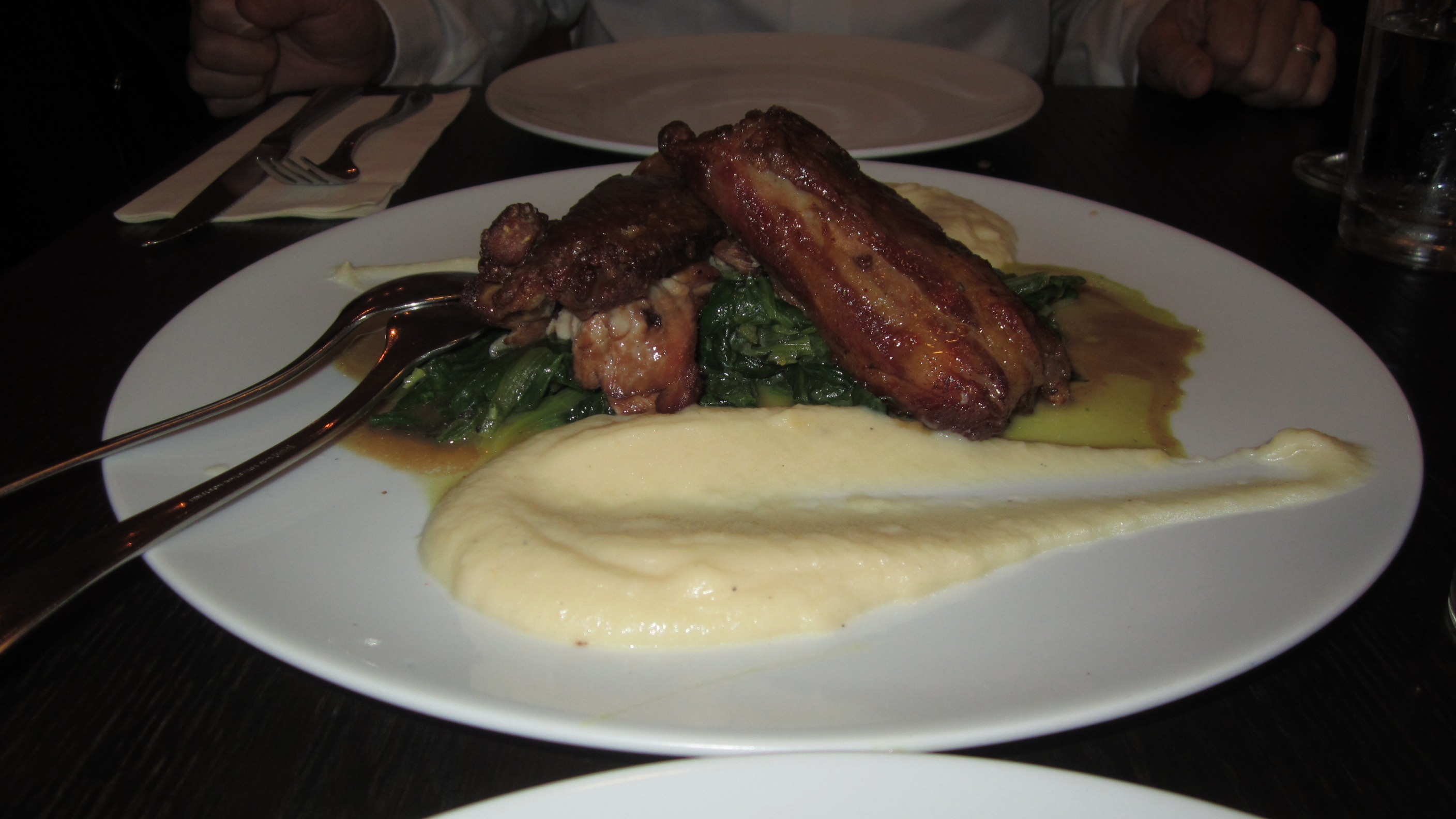
Roasted lamb on celery root puree. Even Janine admitted it was worth the shlep.

Roasted lamb on celery root puree. Even Janine admitted it was worth the shlep.

Our server wrapped up the meal by bringing us a complimentary little bottle of mastiha, a grappa-like boozy thing from the island of Chios, wherever that is. It’s hard to describe, but it smelled like a pile of raked leaves on a fall day and tasted like I imagine the bark of a tree would taste like if you fermented and distilled it. But in a very good way. I love a meal that ends with a bit of free tasty hooch that I’ve never heard of. Janine forgave me.

We ended the evening with a nightcap at a very cool spot next door to our apartment called Six d.o.g.s, a place that would be quite at home in Soho. It has a gallery space, a club with live music, and a courtyard bar packed with hip young people. We sipped our drinks, took in the vibe, and couldn’t believe that we were in Athens, of all places. I heard about it, you guessed it, in the New York Times.
Ciao, Italia, we hardly knew ya.

Hoo boy, are we tired. Rome is really, really fun and really, really tiring. Did I mention that we’re tired? Oh, and we’re full. Monty Python full. But happy.

After buying jewelry and eating pizza on our first night in Rome, we tried mightily to take advantage of as many recommendations as we could. Herewith are some highlights:

Villa Farnese

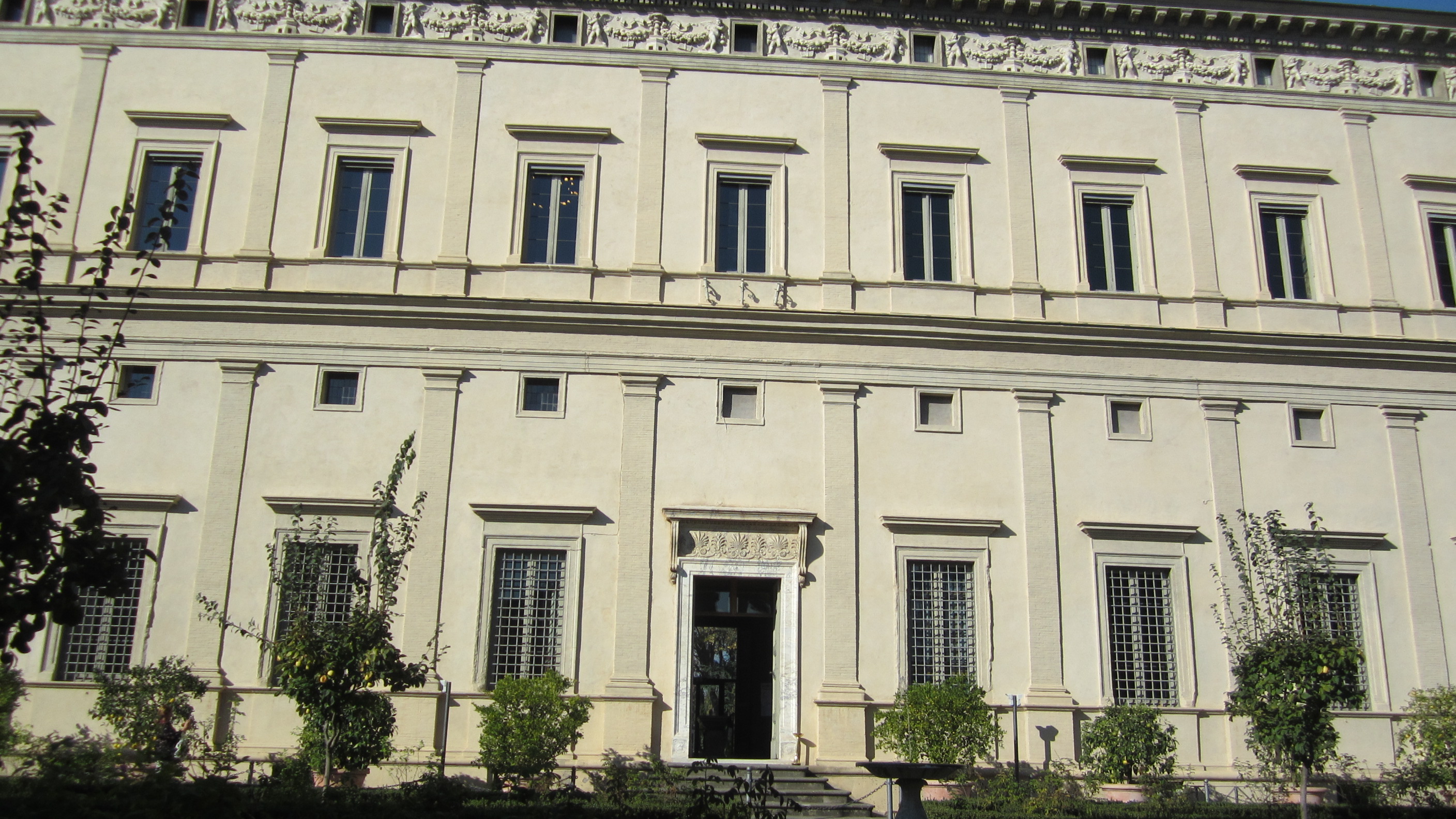
Villa Farnese. Cultural and convenient!

Villa Farnese. Cultural and convenient!

This was on nobody’s recommendation list, but this medium-sized palazzo in Trastevere had something very, very important going for it – it was just outside our front door. There are days when we just can’t seem to get ourselves out the door in the morning, and by the time we do it’s afternoon. Then we feel a little bad that we’re not being more efficient with our time. On such days we try to grab the closest bit of acceptable culture that we can. Villa Farnese more than fit the bill. The palazzo was built between 1506 and 1510 for a fellow named Agostino Chigi, who was a banker from Sienna and the treasurer of Pope Julius II. The house was acquired in the late 1500s by the great grandson of Allessandro Farnese, who was Pope Paul III during the mid-1500s.

Yes, kiddies, this was during the good old days, when Popes had mistresses and children and they ordered hits on their enemies and who knows what other nonsense. While I’m wandering off on this digression, permit me to take another detour. The reason all this Farnese business is interesting to us is that part of our routine these days is to watch at least one episode of the Netflix show Borgia each evening. (Thank heavens for the geek who invented the virtual private network, or VPN, which tricks Netflix into thinking we’re in Cleveland.) At first it was what passed as preparation for our visit to Rome, but now it’s just junk food – full of sex, violence, and opulence, the visual salt, sugar, and fat that keeps binge watchers satisfied. It has some of the worst acting I’ve ever seen, but if the wifi falters on any given night I start to get the shakes. To make matters worse, we’re watching the bad Borgia – the one with some guy from Philly playing Pope Alexander, not Jeremy Irons. This is the Costco pork rinds of binge television.

Where on earth was I? Oh, yes, Villa Farnese, which is not to be confused with the more important Palazzo Farnese across the river, which is now owned by the French government and is no longer open to the public. The Villa, while something of a lesser establishment, nevertheless has a really wonderful collection of frescoes, including a famous one by Raffaello.

Rafaello's famous cherubs.

Raffaello’s famous cherubs.

We also practically had the place to ourselves, which is always a challenge even in the so-called off season in Rome, and came away feeling that we had satisfied the cultural tourism gods.

Do not try this at home, gents.

Do not try this at home, gents.

The Vatican

What can you say about the Vatican that hasn’t been said? There are seven kilometers of galleries and it’s the fifth most visited art museum in the world. I’m also kind of a baby when it comes to museums. I have a short attention span, the dust makes my sinuses run, and after a few hours I’m ready to eat. Nevertheless, you can’t come away from the Vatican museum without being impressed or overwhelmed. You’ve got your Michelangelos, Caravaggios, Titians, Berminis, Raphaels, and basically all the Renaissance art and Greek sculpture you can imagine. And then there’s the Sistine Chapel, which is all it’s cracked up to be. After weighing all the good advice about how to procure the services of a guide, we ended up going the official route – for thirty euros you can get tickets to the museum and join a group led by an official Vatican guide. I suppose you pays your money and you takes your chances, but our guide was amazingly enthusiastic and quite terrific. Two thumbs up for the Vatican.

Santa Maria degli Angeli e dei Martiri

Our friend Hubert recommended this really interesting church, which began its life as a Roman bathhouse and was converted to its present use by Michelangelo in 1563. This wasn’t a bathhouse like in an Al Pacino movie, though. It is said that the Baths of Diocletian could accommodate three thousand Romans at any given time. In fact, the church, which is massive, was built just from a portion of the bath complex, the frigidarium, the cold bath. There was also a caldarium, which was a pool heated by a big furnace, as well as other pools and rooms and spaces where Romans could be Roman together.

20141102_144356[1]

The church also has a nifty meridian – a long line built in the floor that is aligned with a hole in the roof that serves as a giant sundial calendar. I wasn’t particularly good at math or science, and I’m always mystified at feats of genius like these.

Finally, the thrifty part of me always loves the free churches. 🙂

Gallery Borghese

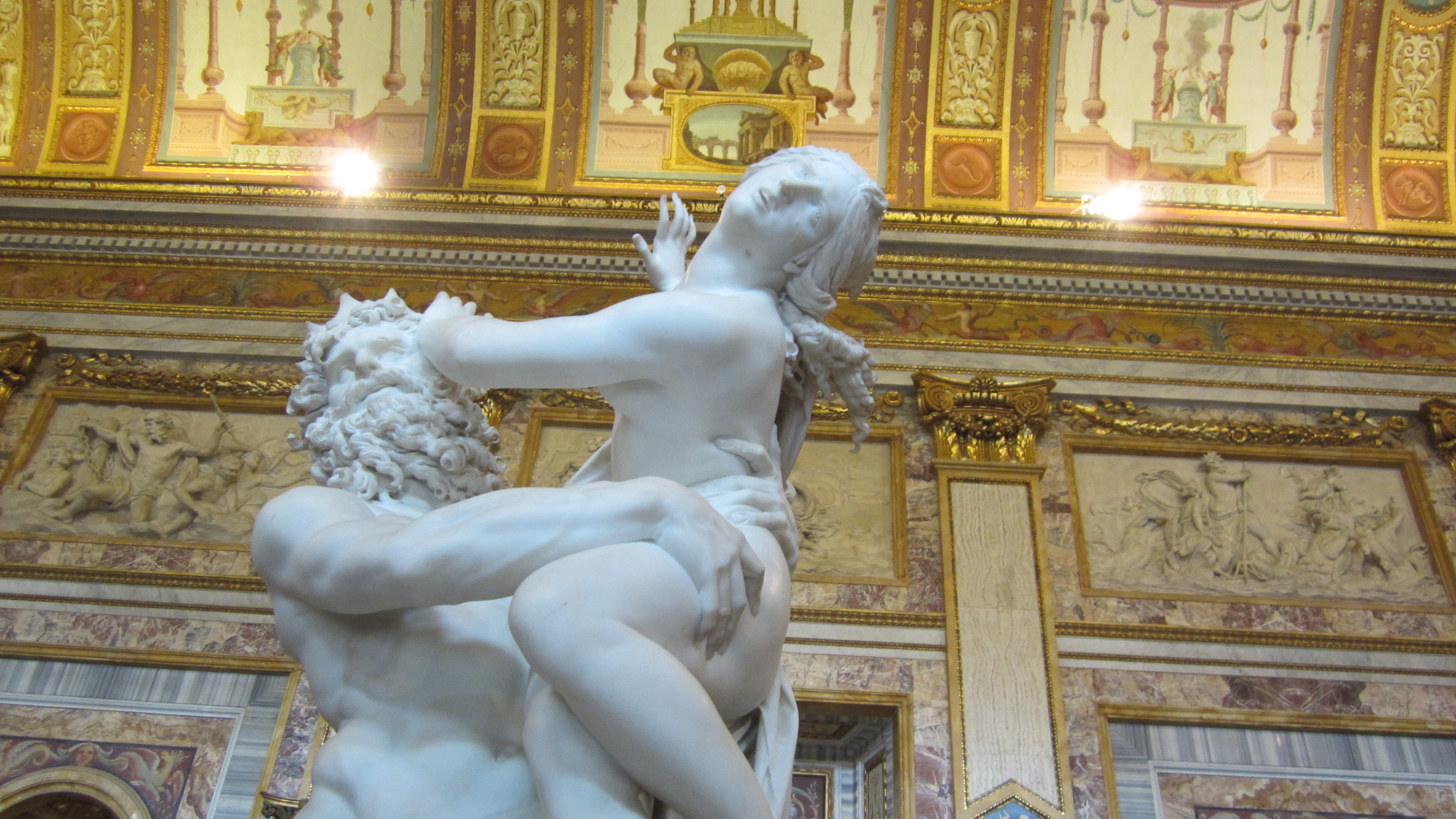
Our friend Hillary recommended the Gallery Borghese, a palazzo built to house the art collection of Cardinal Scipione Borghese, who was Pope Paul V’s nephew. After the pope’s election, Scipione was made secretary to the pope and the head of the Vatican government. Borghese used the position to make himself and his family very wealthy, and he spent some of his booty on art. In other words, the Borghese family made the Borgias look like the people on Duck Dynasty. And hoo boy did they collect art. The place is stuffed full of paintings and sculpture, the highlights of which are extraordinary sculptures by Bermini, who makes marble look like silk. They do a decent job of managing the crowds there by selling two hour tickets and then clearing out the gallery at the end of the period, like they do at baseball doubleheaders these days.

A pretty good Bernini.

A pretty good Bernini.

That’s it, you ask? Um, yup, basically. We were also invited to spend our last two nights in Rome at the very nice digs of a friend of a friend, which was delightful. We were also invited to crash a reception. Thanks to our very efficient packing, we were ready for such an occasion – Janine looked lovely in her cocktail ensemble, and I even had a jacket and tie in my bag of tricks.

Of course, we also had to eat, and I include a couple of quick reviews.

Ditirambo Ristorante

This place sits just off the Campo de Fiori near our apartment in Trastevere. We waltzed in without a reservation, got the only available table, and were treated to a gracious and quite delicious meal. We started with a simple salad of shaved fennel, oranges, and pomegranate. Our primi was the classic Roman pasta tonnarelli cacio e pepe. It’s as simple as gets – they make a sauce out of cheese, black pepper, and the starchy salty water the pasta cooks in, and this version was spectacular. They call it tonnarelli because the pasta, which is basically a fat spaghetti, looks like a tuna. (The Italians are so evocative. There’s a pasta called orecchiette, or “little ears,” and a dish called strozzapretti, or “strangle the priest.”) The main was a splendid suckling pig – roasty, crispy, and just the right amount of fatty. Dessert was a lovely sponge cake topped with a poached pear with a dandy pasty crème on the side. The service was gracious and lovely and the food was terrific, and with a bottle of delicious pinot nero from Alto Adige, the whole thing came to less than sixty euros. Go there.

Hosteria da Corrado

Our host in Trastevere recommended this one. There are various levels of fanciness in Italy – ristorante, trattoria, and the homey osteria. In many of them, like Hostaria da Corrado, there’s no menu. You sit down, somebody rattles off maybe two or three choices for a starter and a main (in Italian, natch), and you’re off to the races. We had another classic roman dish rigatoni all’amatriciana, which is a tomato sauce made with cured pork jowls (close your eyes and it’s just really good bacon), and a thin pan-cooked steak that they hammer to a medium well, but which was fatty and salty enough to be somehow perfect. This is cooking like you wish your grandma did, and you have the benefit of watching locals come and go. The owner knew each of his customers (except us and one other brave table) by name. it was a little slice of Roman life.

Ristorante Compagnucci

Finally, we end on a meal that kept on going. Ristorante Compagnucci is a neighborhood place out by the Appian Way that was recommended by a friend. We made the minor mistake of just asking them to bring us what they thought was good without placing any volume limits, and the food just kept coming. Fried anchovies, more pasta all’amatriciana, octopus and green bean salad, and some kind of fish. It was all great, but way too much (how DO people eat this much this late?) although the highlight of the evening was the server. Her family owns the restaurant, and she only works there once in a while. Her English was good, and we struck up a very nice conversation. The short version of the story is that we invited her and her family to visit us if they make it to San Francisco. Such is the way of travel.

And that’s Italy. There’s so much to do in Rome, much less Italy, that I always leave feeling exhausted but strangely unrequited. I have seen the Sistine Chapel, though, which was the goal in the first place. And we ate pretty well.

Next up – Athens, and then Istanbul. If you have suggestions, please weigh in!

From Sicily to Rome – Pick Your Metaphor

Moving from Sicily to Rome is quite a shock. I’m struggling to come up with the best metaphor. If Sicily is an old Fiat 500, Rome is a Maserati. No, that’s not right. Maybe Rome is Sicily’s more accomplished sibling. In Noto they charge 2 euros to look at some random ceiling. In Rome, you go to the Pantheon. Anything you can do, I can do better.

Except relax. We started our tour in Sicily to decompress, and we did that. Sicily was a charming, sunny (mostly), and yummy (usually) way to ease into our world tour.

Anyway, the metaphor doesn’t matter. But after spending almost three weeks in what we might charitably call a laid back atmosphere, we are now in the midst of the thrum of one of the world’s great cities. On our first night, we wandered about Trastevere, which is one of those Rome neighborhoods with windy streets, like Forza d’Agro or Ortigia, except it has people in it. And not just people, but hip people, wearing fashionable fashions and soul patches and shoes that cost more than twenty bucks. And street jazz. What passed for a crowd in Forza was a bus full of Dutch people.

We arrived on a Saturday night, and even though it was All Saint’s Day, a holy day of obligation, in Trastevere the people seemed obligated to get a drink. The bars and restaurants were jammed, which meant that they were open. This was good, because we were ready for human contact and we were hungry.

Hip, Happening, Trastevere

Hip, Happening, Trastevere

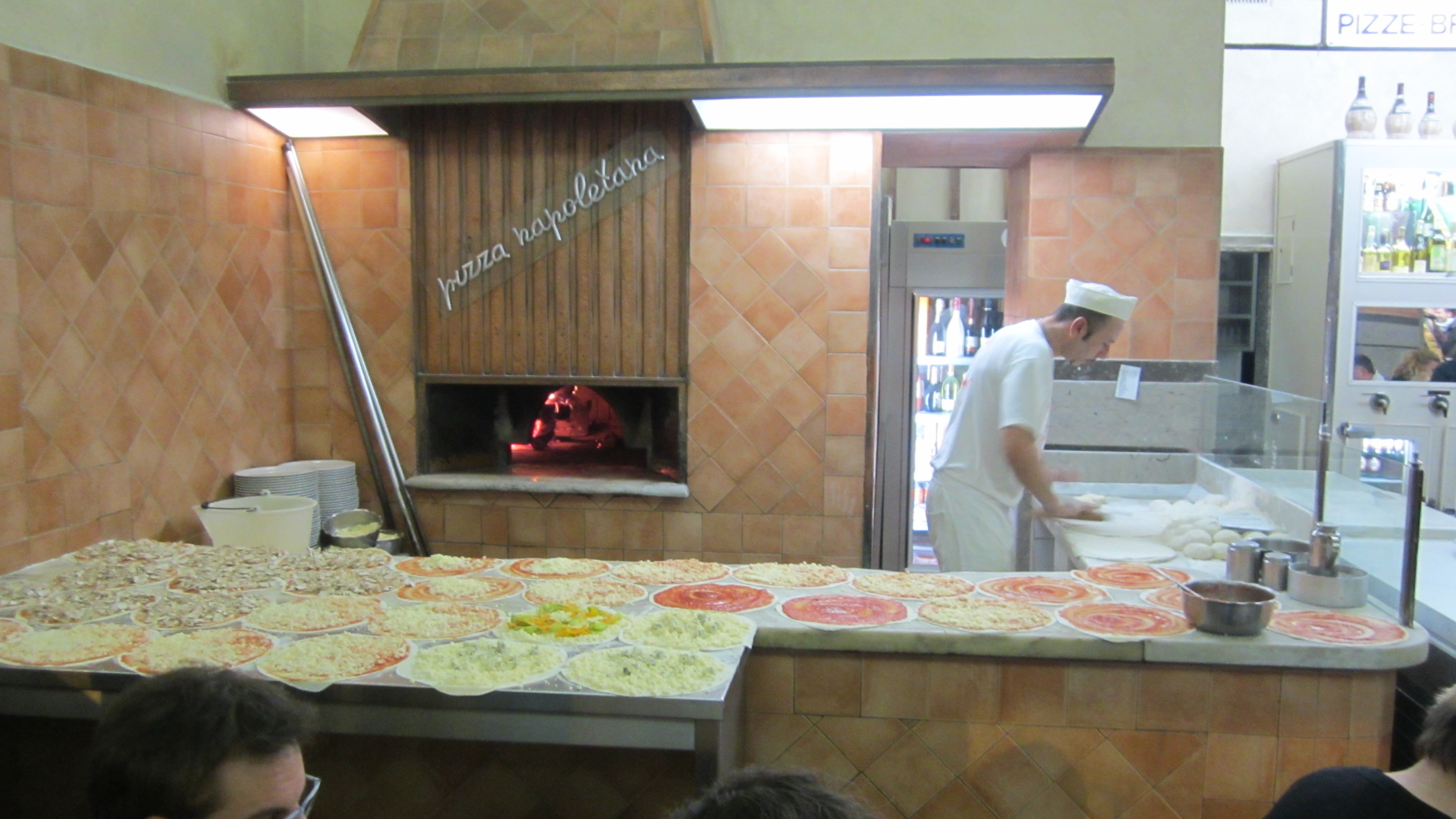
Our first stop was Pizzeria Ai Marmi. This felt like the Katz’s Deli of pizzerias. It was jammed full of people tucking into pizza and platters of beans and sausage and other homey stuff, and it was staffed by an army of guys who looked like they’ve been doing this very intricate dance for decades. Now I know, I know, pizza is a Naples thing, but Romans are entitled to pizza too. I also assume that there is no shortage of other excellent pizzerias in Rome, but our host recommended this one as his favorite and that was good enough for us. We were lucky enough to be seated just across from the pizza making operation, and it was like watching Nijinsky, Baryshnikov, and Nureyev dance a pas de trois. Or baseball’s famous double play combination, Tinkers to Evers to Chance, turn two. One guy rips little pieces from a huge mound of pizza dough and forms balls with them and then uses a rolling pin to turn them into disks thin enough to read the paper through.

Rolling out the dough

Rolling out the dough

He then arranges about thirty of them ever so nicely onto a big marble counter. At that point, his partner applies the toppings based on the orders arranged on pieces of paper on a pegboard on the wall.

Ready to go in the oven

Ready to go in the oven

Then the oven guy, who has been stoking a blazing wood fire, transfers the thirty or so pies to the oven using the longest pizza peel I’ve ever seen. By the time he gets the last one in, the ones that went in first are ready to come out. They go right onto plates and onto the counter.

Out of the oven and off to the tables

Out of the oven and off to the tables

Sitting ten or so feet away, the smell of the pile of steaming pizzas made me quite emotional, but you know how I am. By this point, the waiters had lined up, ready to get the pizzas to their tables within seconds. We watched this process repeat about every ten minutes. That’s three pizzas a minute. And how was the pizza? Perfect. The sauce was tangy, the cheese was creamy, and the crust was thin, chewy, and crunchy all at once. We also had a bowl of beans and sausage in a very spicy tomato sauce. Damn. Dinner and a show.

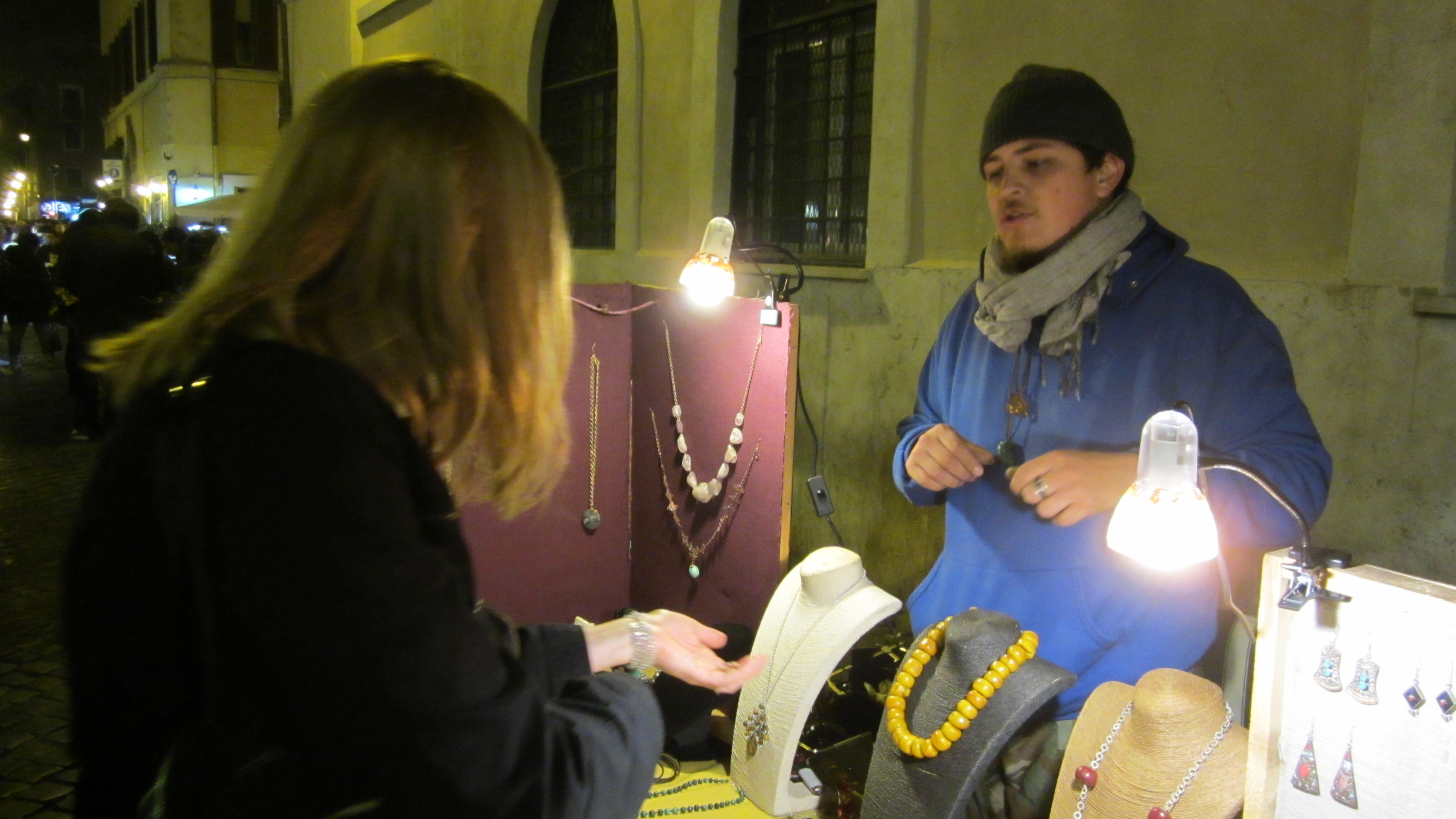
On our way home, we strolled through the piazzas and alleys of Trastevere, and Janine paused every two or three feet to regard the arts and crafts on offer from various sellers. She was taken by one jewelry stand, and we struck up a conversation with a fascinating fellow who was turning out bracelets and necklaces in front of our eyes. Was it my imagination or was he speaking Italian with a Mexican accent? Sure enough, he was from Monterrey, Mexico, so we switched from my hideous Italian to my merely lousy Spanish. What a fantastic and fascinating guy. Ivan is only thirty, but he’s been in Rome for six years, and he makes a point of traveling throughout the continent to buy materials and learn about other places. He talked about how the poor education system and failed political institutions in Mexico has made it impossible for him to succeed there. His travels have taken him to Turkey, Morocco, Serbia, and even Afghanistan, among other places. He’d love to visit New York or Japan, but he can’t get a visa to either place. It’s too bad – they could use his ingenuity and creativity. We exchanged notes on places we’ve visited and he gave us some suggestions that now has us rethinking how we’ll spend time in Turkey. We must have talked for twenty or thirty minutes and we had his undivided attention, which might have cost him a few sales. Janine bought a necklace and a bracelet (we are for the most part limited to purchases that are very portable), and of course she now has a story to go with them. Good luck, Ivan. It was really great to meet you.

Ivan, a true Renaissance man

Ivan, a true Renaissance man

Thanks to all for your excellent suggestions for things to do in Rome. We are doing our best to get to as many as possible, although we were stupid and only allowed for five nights. What were we thinking?

In the next month or so, we have Athens, Istanbul, Cairo, and either Marrakech or Fez in our sights. It’s too many places and not enough time, but we just can’t help ourselves. Seven months isn’t nearly enough time to see the world. If you have suggestions or thoughts about any of these places, please feel free to weigh in. The crowd is a dandy travel agent.