Eating Through Prague With Our Culinary Concubine

Everybody says go to Prague. Friends, acquaintances, enemies, whatever. Nigerian email scammers offer to let you in on this great opportunity to hold their eleven million dollars, and then they extol the virtues of Prague as a vacation destination. Babies in their strollers give it two tiny thumbs up. So?? How’s Prague? Does it meet these outsized expectations? Yep. Prague is pretty damn good.

What’s so good about Prague? Where do I begin? Pick an architectural style and Prague has it in spades – gothic, renaissance, baroque, Art Nouveau, Deco, and even some entertaining but hideous Cold War communist structures. With the exception of a bombing raid that was meant for Dresden but hit Prague, the city made it through World War II almost entirely intact. You could do nothing but wander the old streets, look at the buildings, and be pretty happy.
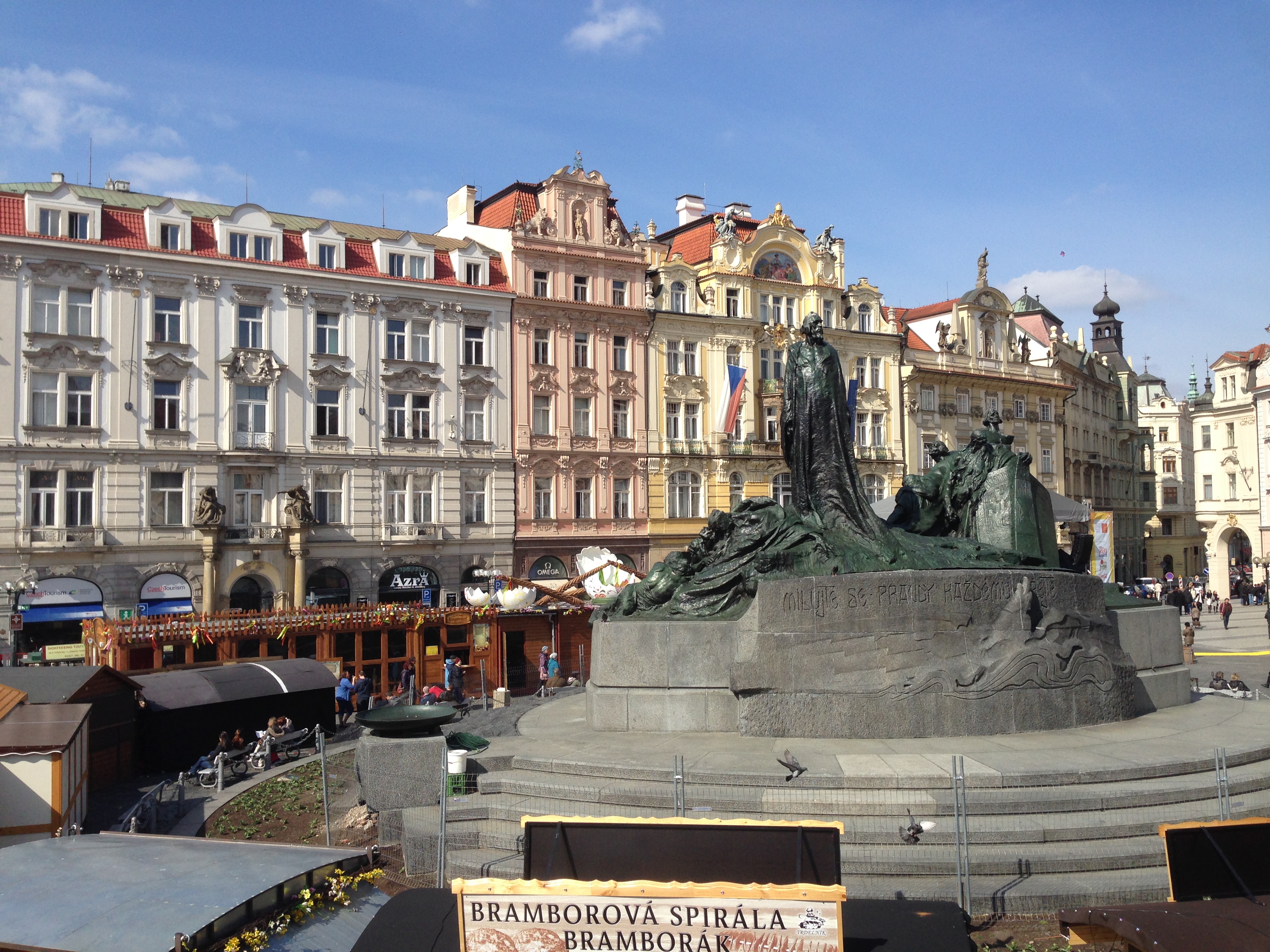
Typical cliche architecture in Prague.

Typical cliche architecture in Prague.

The Czechs got culture – there are two really beautiful opera houses which also put on classical music concerts, ballet, and theatre. (Remember how I’ve been saying that all the cool old opera houses we’ve been visiting look like something out of Amadeus? Well, Prague is so styling that they have the opera house that the movie Amadeus was filmed in. Take THAT, Buenos Aires and Budapest!)
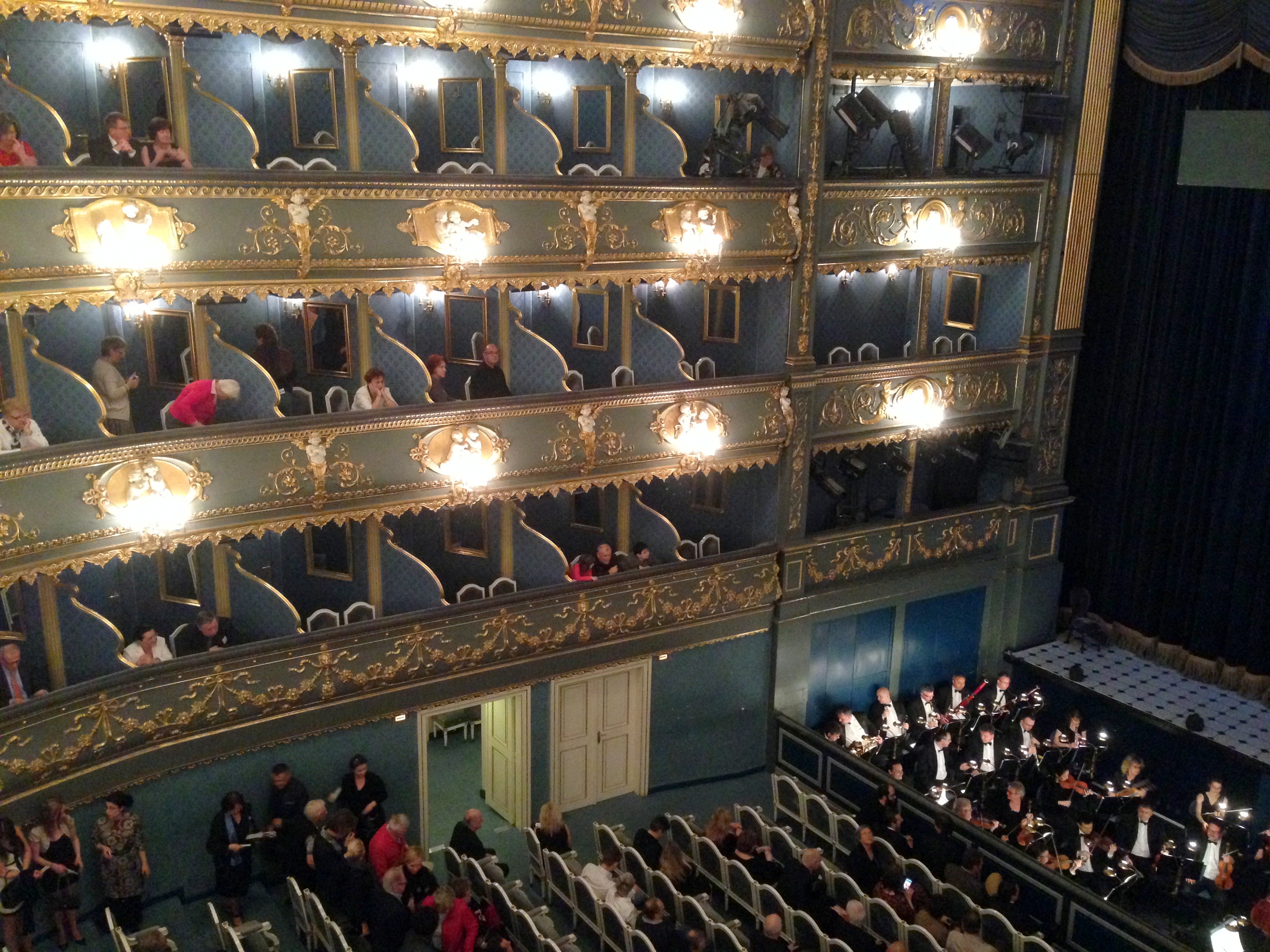
The Estates Theatre, where Amadeus was shot.

The Estates Theatre, where Amadeus was shot, where we saw a funky dunky Mozart singspeil called The Abduction from the Seraglio.

There are a bunch of funky jazz clubs, a few puppet theatres (could be creepy, but I’ll offer the benefit of the doubt) and something called “black light theatre”, which came out of the sixties, in which the use of black light allows performers to create what can best be described as live-action animation.

They have a really impressive art museum that seems to be all but unnoticed, which is a crying shame because it’s stuffed with all those famous names we’ve come to know and love – Picasso, Van Gogh, Monet, Seurat, Chagall, Klimpt – and a long list of Czech artists that you probably haven’t heard of but who were holding their own alongside many of these folks. It also has a wing of contemporary art that is great once you get tired of looking at all that fancy stuff.

And then there’s the food. Let’s face it, central European food will kill you if used as directed, but that’s usually what makes it so good. As in Hungary, the Czech diet is heavy in soups, stews, massive bread or potato dumplings, sour cream, and huge hunks of pig, usually washed down with copious amounts of beer. This is a terrible place to start a diet, but a great place to end one.

But where to begin? We had been here a day or two when I realized how much I envied Anthony Bourdain. After all, he gets paid to travel around the world and eat and drink stuff, but he also always has some local foodie by his side, holding his hand, and taking him to the best place for blowfish, or guinea pig, or whatever. I believed these folks are called “fixers” in the travel show business. Well, I want a fixer!

Why should we have to make all the arrangements? Why should we do all that web surfing and trial and erroring? Why can’t we have a fixer like Bourdain?

It turns out anyone can have a fixer. Fixers are everywhere. They’re called tour guides. But average workaday tour guides just give tours. Sometimes they’re even counterproductive. They take you to glorified souvenir stands where you’re expected to buy stuff, which is just awkward for everyone. We needed someone better than that. Someone who would take us places, feed us stuff, and who knows what’s really, really good. A person like this would talk to us, laugh at our lame jokes, and be our friend (for a small fee). I guess what we were really looking for was a culinary concubine.

Well, I’m sure you’re all screaming at your iThingys right now, because the solution was so obvious. Just go on an eating tour. Every city has one. An eating tour is even better than a hop on, hop off bus. Some nice person will take you around town, feed you all the best stuff, liquor you up, and unlock all the secrets of your new city. If you’re lucky, they’ll give you their business card and tell you to just send an email if you need any more recommendations during the rest of your stay, and they’ll mean it.

Like the man who discovers the joys of golf on his eightieth birthday, at the end of our long adventure I have finally figured out a dead easy way to get started in a new city. Take a food tour, dumb dumb.

I was doing a little web research on Prague and stumbled upon something called “The Food Lover’s Guide to Prague,” and holy sweet mother of pearl was that a good idea.

Our new best friend, a hip, friendly, voluble fellow named Jan, was just the ticket. He started our tour with a classic Czech dessert, called a hořice, a rolled wafer stuffed with whipped cream which comes with a warm chocolate sidecar for dipping. It was a bit unconventional to start our tour with dessert, but I was game.
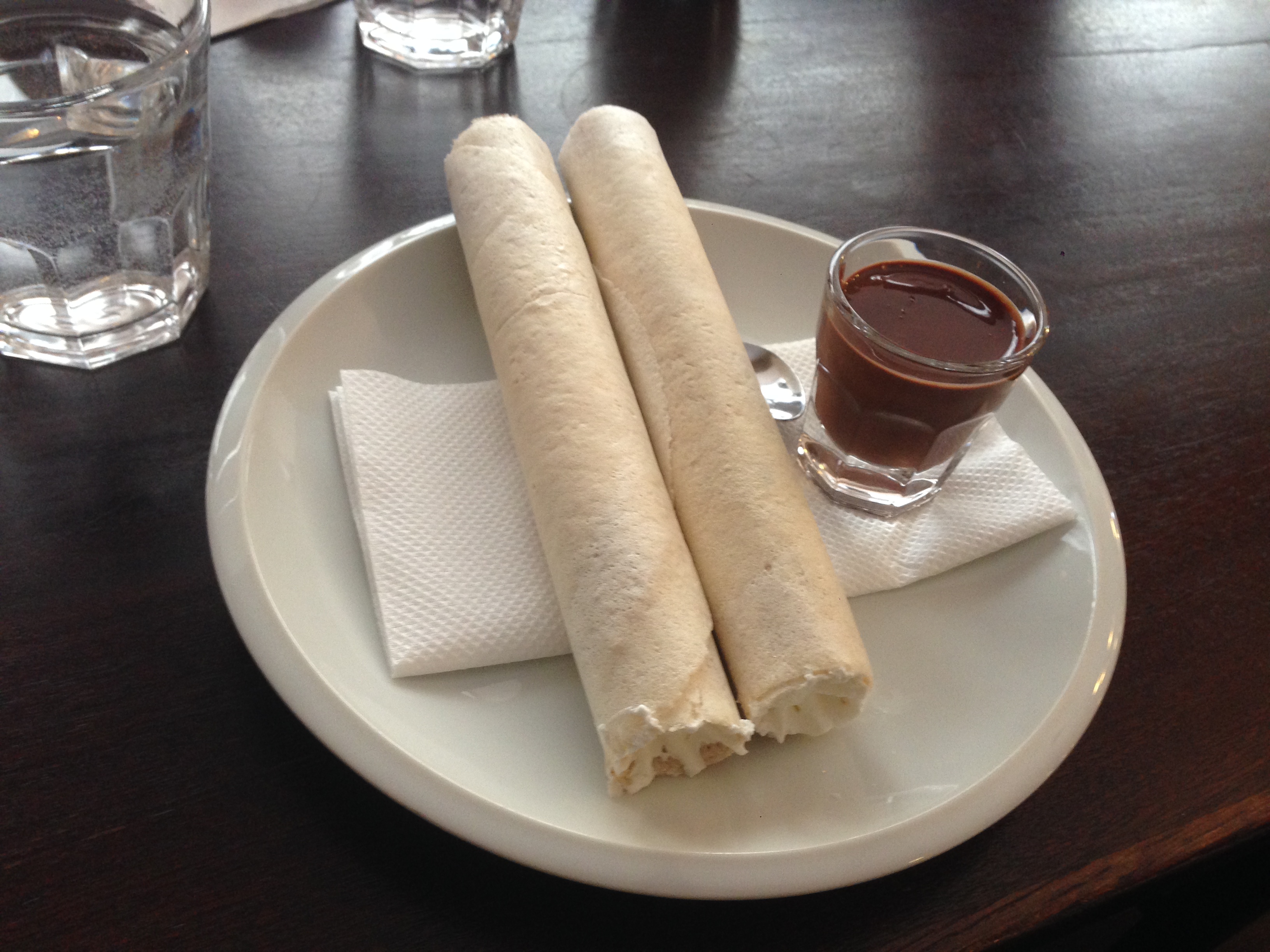
Priming the pump with horice, thin-rolled wafers stuffed with whipped cream.

Priming the pump with horice, thin-rolled wafers stuffed with whipped cream.

Next we strolled through the old part of town a bit and made our way to a place called Sisters, which serves something called chlebičky, which are fancy little open-faced sandwiches. Ours had the first good version of pickled herring I’ve ever had, as well as a very nice whipped beet spread with goat cheese, and a celery root slaw sandwich.
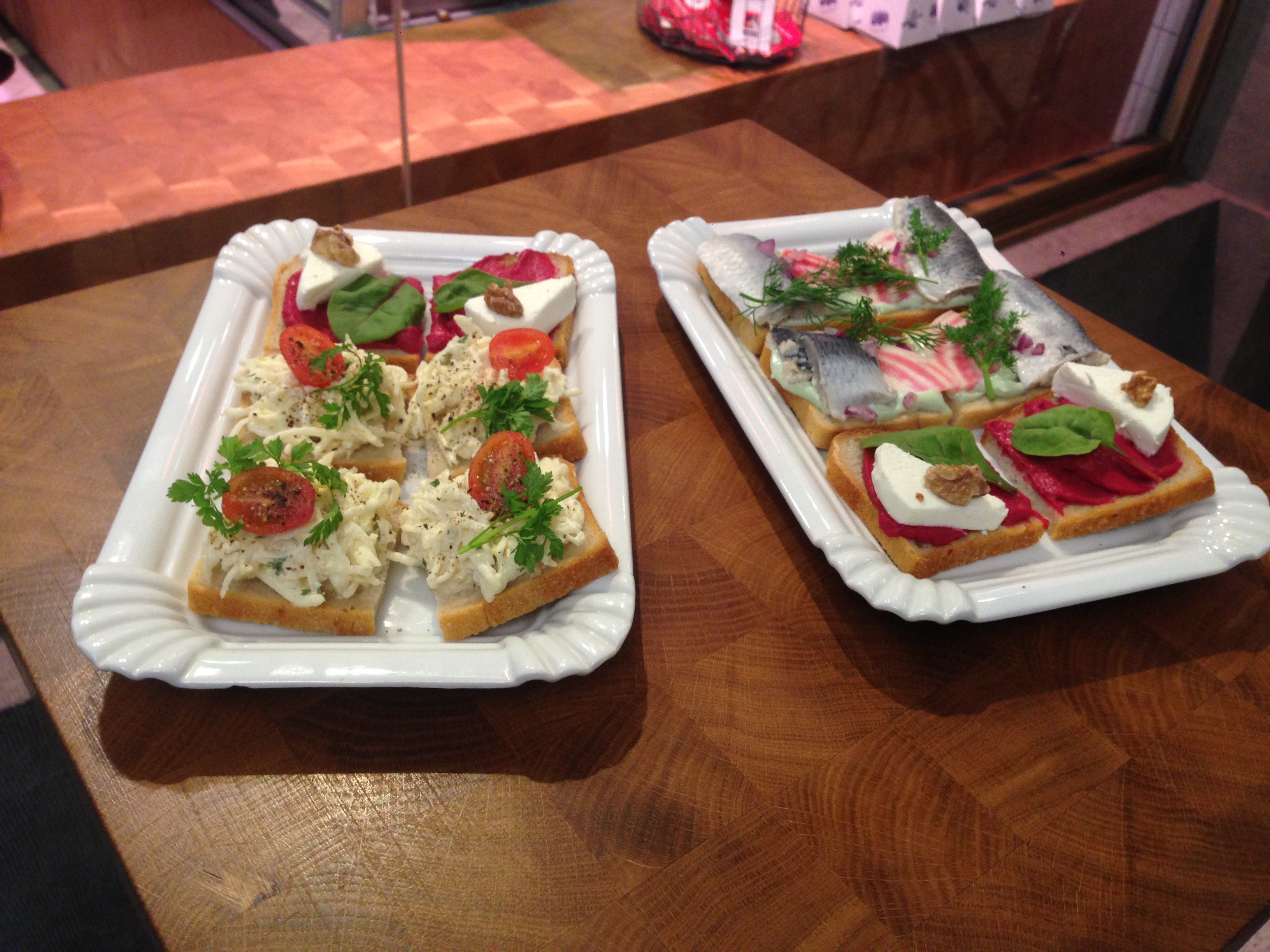
Open-faced sandwiches at Sisters.

Open-faced sandwiches at Sisters.

Next door was a butcher shop called Nase Maso, (which translates to “our meat.”) Well, Czechs like meat, but these guys really like meat. This is a post-modern butcher shop where the staff is young and attractive and the butchers visit the farms and go pet the pigs before they are invited to the great beyond (and then your plate). We had two kinds of ham, a spicy sausage, and a delicious thing that was somewhere between a terrine, a meatloaf, and a sausage. They were served with a crusty rye bread, a zingy mustard, and delicious little pickles – all made in house. Damn, make it stop!
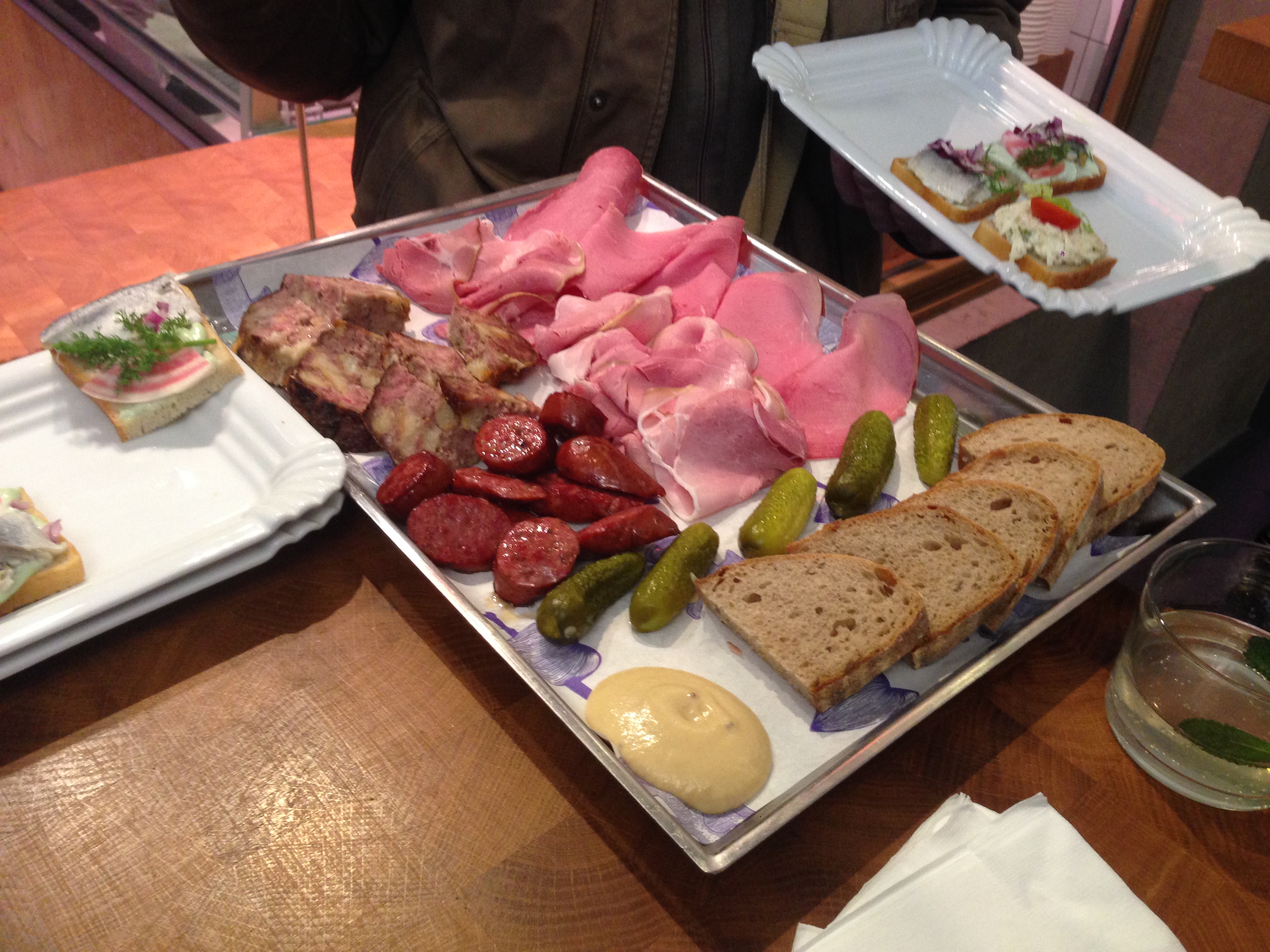
The butcher plate at "Our Meat." Have you noticed how I've restrained myself from making a joke about a place called "Our Meat"?

The butcher plate at “Our Meat.” Have you noticed how I’ve restrained myself from making a joke about a place called “Our Meat”?

Then we were off to a charming, quiet garden café that doubles as a furniture store just off chaotic Wenceslas Square where we had red current wine and pork terrine. The square was the site of a series of anti-Soviet demonstrations and later the Velvet Revolution that produced the Czech Republic’s modern democracy. After that it became infamous for its red light district and British hooligan tourists taking advantage of $20 airfares on Ryanair, but it now seems like just another busy shopping district in a big European city. After that, we headed to Restaurant Zvonice, which sits in the belfry of the Jindrisska Tower. The tower dates back to 1475, and at almost seventy meters it’s the highest stand-alone belfry in Prague. The visit would have been worth it for the view alone, but like geese being fattened for liver-ectomies, the food kept coming. This time it was a vinegary and really delicious sauerkraut soup, an old Bohemian favorite, and I can see why.

By this point we were feeling like that guy in Monty Python’s Meaning of Life, but we hadn’t even had our main course yet. For that, we were off to Café Louvre, another old Prague classic, which was a former haunt of Kafka and Einstein, among others. The main course was by far the most unusual of the day – Svíčková, a braised beef served on top of a root vegetable puree, with a cranberry compote, some fluffy Czech bread dumplings, and, strangely, a rosette of whipped cream. It was delicious but I’m still not sure about the whipped cream. After all that they had the nerve to place an aircraft carrier-sized piece of apple strudel with a small pitcher of custard crème on the side, which we ate, of course.

Braised beef with dumplings and...whipped cream!

Braised beef with dumplings and…whipped cream!

Even though they were serving us what they called tasting-sized portions, by the end of the tour we were all ready to be wheeled home on gurneys. It was some of the most over the top gluttony we’ve done so far, but we got the chance to taste Prague’s greatest hits, and they were pretty terrific. Our new friend laughed at our jokes, fed us the good stuff, and sent us home happy, although if we keep eating like this, we may need to be sent home in shipping container.
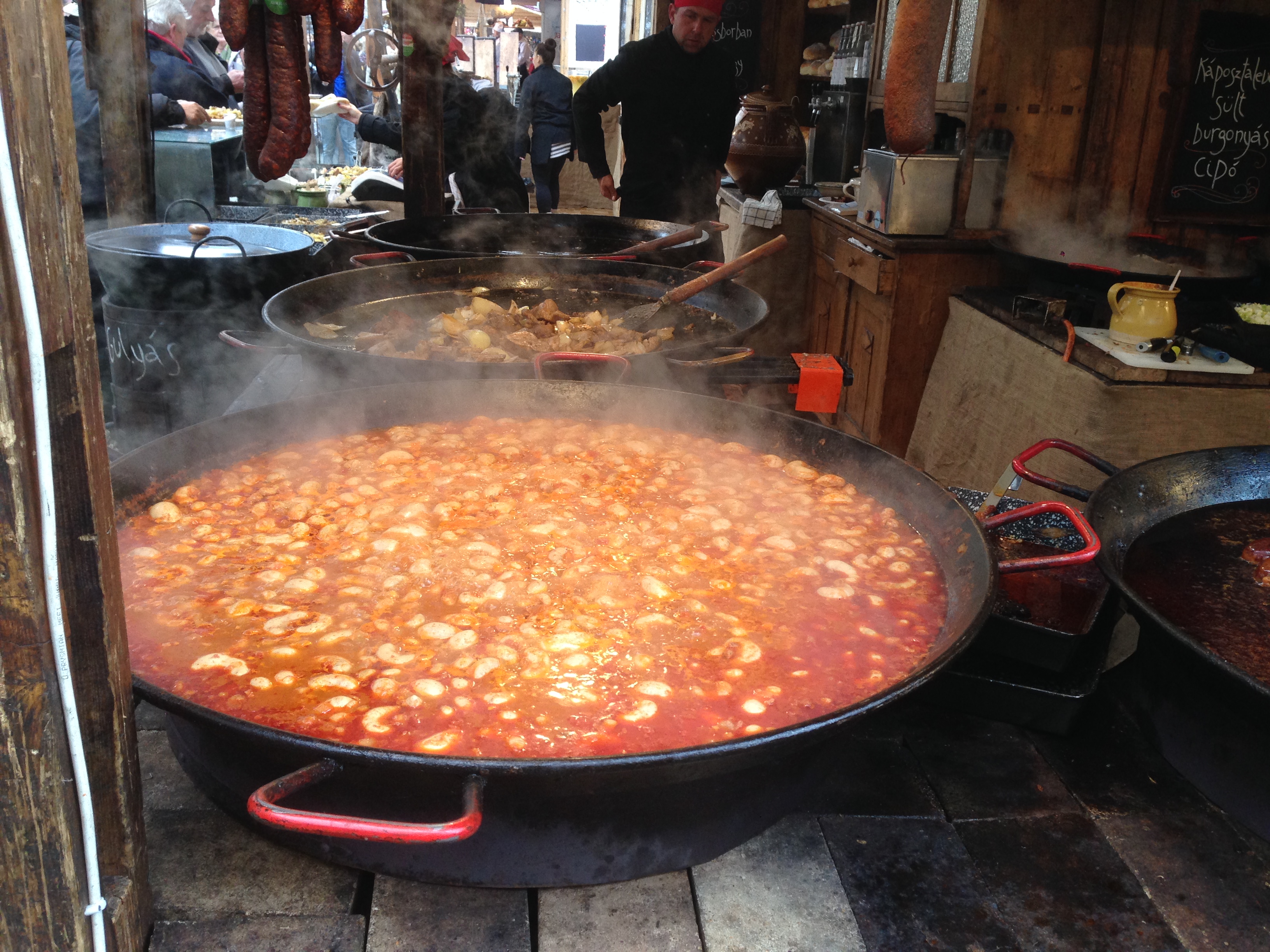
Rooster Testicles in Budapest. Oh, yes I did…

I had a ball in Budapest. Actually, I had a bunch of them. We were walking down the street here, minding our own business, when what should confront me but a simmering cauldron of rooster testicles.

We had stumbled upon an Easter market set up in the middle of a small square not far from our apartment. There were food stalls with all sorts of delicious looking things – spring lamb turning on a spit, potatoes sauteeing in onions and goose fat, pork knuckles in sauerkraut, and lots of other light and healthy snacks. And then there was a pot of rooster testicle stew. That other stuff looked great, but how could I pass up rooster testicles and look myself in the mirror?

A steaming cauldron of testicles.

A steaming cauldron of testicles.

What would you do? I know what you would do. You would do what normal people do. You would giggle, crack a little joke, and you go about your life. Right?

Well, not me. Rooster testicles aren’t just food, they’re a challenge. I pride myself on being the ever-so-slightly-more-hirsute Andrew Zimmern, the guy from the TV show Bizarre Foods. If there is some crazy weird morsel out there, chances are I’ll eat it. And there I was, staring at these tiny spherical gauntlets that had been spread at my feet (my apologies for combining a medieval warfare metaphor with a reference to male poultry reproductive organs). I could not back down. I would not back down.

Why on earth was I put in this position in the first place? Apparently Hungarians either 1) are very hungry (har); 2) have an excess of roosters this time of year; 3) don’t like to waste anything, even rooster testicles; or 4) have a terrific sense of humor.

They didn’t look that scary, and the pot of nuts even smelled kind of good, although Janine didn’t agree. I was standing downwind of the big vat of boiling orbs, but I suppose the cooking smells clung to my clothes a bit. Later, Janine would berate me for walking around Budapest smelling like a chicken’s jockstrap. I will admit that Marky Mark may not make Eau du Boule du Coq his next fragrance, but if you ask me she was overreacting. I think she was planning to burn my clothes while I slept, but I’m relieved to report that she restrained herself.

And so I walked up to the stall and proudly and unashamedly announced that I would like an order of rooster testicle stew. “Would you like a full order or a half order?” the nice lady replied. I went for the half order. I’m not crazy, you know. (It is here that I thank my lucky stars that the Hungarians speak English so well. If we had been in Japan I would have certainly inadvertently ordered a double helping.)

By now you’re all dying to know how they were. Well, they were good. They came in an onion-y tomato sauce, which might be the part that Janine most objected to (well, that and the testicle part). They were, well, creamy, a bit gamey, and they were indisputably offal. I guess you could call these testicles the ultimate organ meat.

Really, they were much better than you would think.

Really, they were much better than you would think.

Enough of this nuttiness. What are we doing in Budapest anyway? Weren’t we just in Burma? Well, yup. Apart from a brief side trip to Japan, we have managed to stay in the southern hemisphere for the winter, but we decided to take one more swing through Europe before heading home. This meant risking some cold weather, however.

Going from southeast Asia to eastern Europe is a massive shift. One day, we were melting in hundred degree heat in a shorts and flip flops (the common garb for men and women alike is a light cotton longhi – a simple sarong that provides some excellent ventilation).

Sweating profusely (but happily) in Myanmar.

Sweating profusely (but happily) in Myanmar.

Four plane flights and twenty five hours later we were standing in thirty five degrees of wind chill next to the Danube wearing all the clothes in our suitcase.

3 weather in budapest

Freezing our bippies off in Budapest.

Janine had always wanted to see Budapest and Prague, so here we are, freezing our asses off and eating testicles. We were hoping that by April things would warm up a bit, but we were wrong. No matter, Budapest is a lovely city with lots to offer.

In addition to its adventurous cuisine and astonishingly cheap beer and cocktails (at a nice bar, a gin and tonic will run you about $3.50), Budapest has elegant nineteenth century architecture, a very moving and informative Holocaust museum, an old and stately Parliament building, and one of the most beautiful opera houses I’ve ever seen.

Hungary's beautiful parliament building.

Hungary’s beautiful parliament building.

The Hungarian State Opera House is a lot nicer than its communist-era name would suggest. It’s another one of those wedding cake jewels that looks like something out of the movie Amadeus. It opened in 1884 and is said to have some of the best acoustics in the world. Janine and I have been on an opera house kick. After taking lots of opera house tours, we finally saw an actual opera in Sydney, but the Sydney Opera House is a decidedly new world creation and we hadn’t experienced old world opera the way we’re supposed to.

A gorgeous opera house with an impenetrable opera.

A gorgeous opera house with amazing acoustics.

We started going to the opera back in San Francisco and decided that we really like it. Operas are like broadway musicals with bigger sets, bigger casts, much bigger orchestras, less dancing, and a lot more singing. The good news was that there was an opera being performed while we were in town, there were tickets available, and they were cheap!

The bad news was that the opera was Parsifal by Richard Wagner.

Let’s set aside, if we can, the complications of seeing an opera by Wagner. Wagner is performed all over the place, so having outsourced my moral decision making to opera buffs who still attend Wagner in New York, San Francisco, and other places, we settled into our seats to see what the fuss was about.

The thing is, we’re opera novices. What we know about opera you can put on the head of a pin. Well, Wagner is complicated, and Parsifal damn near impenetrable. What’s it about? I’m still not entirely sure, and neither, it seems, is the Hungarian State Opera. In the program notes, even they admit that “it’s difficult to pin down what the story is about.” I’ll say. It has something to do with the holy grail and the spear used to wound Christ, and it’s often performed on Good Friday, but that’s about as far as I got. I will say that it was long and that it had more false endings than the Bush family.

Opera requires a lot of patience for the performers and the audience, but Parsifal really puts one to the test. Some guy would come on stage, sing a bunch of exposition for thirty or forty minutes, and then disappear for an hour or two. Where did he go? When’s he coming back? Some other guy would sing two or three lines and then be made to stand on the side of the stage watching everyone else do stuff for hours on end. Was he being punished? What about us? The first act, which clocked in at a hair over two hours, felt like a twenty two inning baseball game in which both pitchers walk the bases loaded in every inning but nobody ever scores.

On the positive side I thought the orchestra was wonderful and the acoustics were indeed splendid. And if I got bored I could look at the ornate room or compose this blog post in my head.

I confess that we didn’t stick it out for the whole five and a half hours, but I’m really glad we went. Like all stretching exercises, now that we’ve seen Wagner it will make all the other stuff a lot more easy.

And now, for your viewing pleasure, the video evidence of my culinary conquest:

A Burmese Bar Mitzvah in Bagan

Buddhist temples are to Bagan, Myanmar as Starbucks coffee shops are to New York – there’s one every few feet. Or so it would seem.

Bagan is a quiet little village in central Myanmar. If Yangon is the Manhattan of Myanmar, Bagan is the Poughkeepsie. At one time is was a major political center of the region that would become modern Burma. Around the 11th and 12th centuries, people starting building temples here to beat the band. They’re everywhere.

Temples as far as the eye can see. There are over two thousand in Bagan.

Temples as far as the eye can see. There are over two thousand in Bagan.

But my comparison with Starbucks and New York is off by a factor of about four hundred. There are said to be something like two hundred Starbucks in New York to caffeinate the city’s eight million inhabitants. Bagan has more than two thousand temples to provide solace to its two hundred thousand residents. In other words, this is the equivalent of having over EIGHTY THOUSAND Starbucks in New York. Now that’s a lot of Enya CDs and frappa macchiatochinos.

Coming to Bagan wasn’t exactly easy, but it was nevertheless necessary. We asked our friend Robert, who lives in Yangon, what one thing we shouldn’t miss when visiting Burma, and he strongly suggested that we include Bagan in our plans. The problem is that we have grown lazy, or maybe just tired. There are two ways to visit a place you’ve never heard of and have no idea what to do in. One is inexpensive and a royal pain in the patootey and one is more expensive, but pretty easy. I’ll give you no guesses about which option we went for. For one thing, it’s damn near impossible to book online air travel to Bagan. While there are no less than four little putt putt airlines that fly here from Yangon, none of them seem to have functional websites, and Orbitz or Vamaya will send people to your house to laugh at you if you try to book a flight there. Thus, if you want to buy a ticket to Bagan, you need to pick up a telephone and start calling the various airlines to compare prices and flight times, and hope that you make some headway. Hotels are a little more straightforward, but then you have to figure out what you’re going to do when you get there. Or you can just get yourself a travel agent and let them do all the dirty work. They picked us a nice hotel and arranged air travel on that famous airline, Mann Yadanarpon Airlines, for the trip to Bagan.

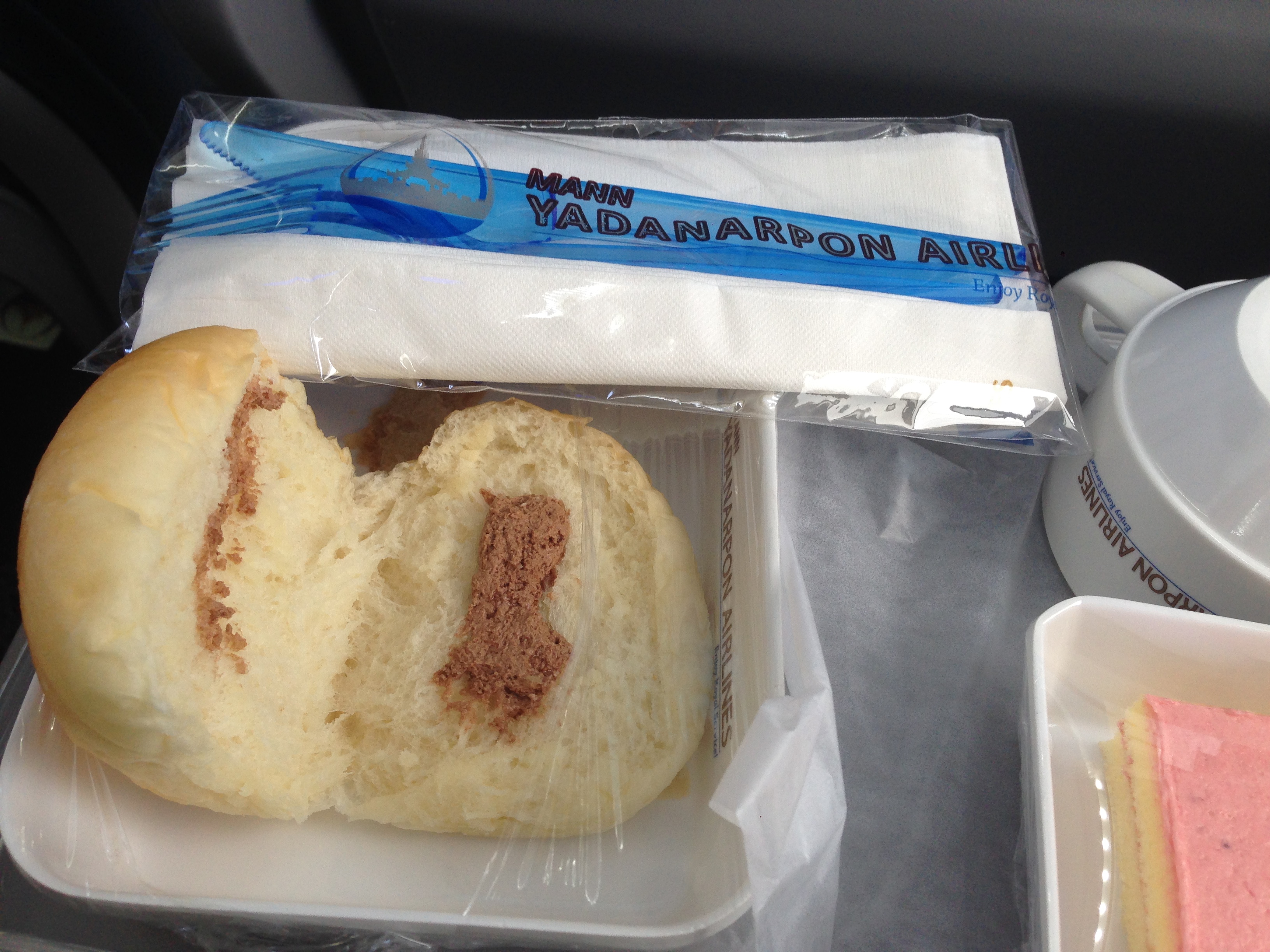
I have certainly flown on worse airlines, but I have to say that I have never been served a meal as off-putting as the one they served on Mann Yadanarpon.

I'm an adventurous eater, but I draw the line at poop on a bun.

I’m an adventurous eater, but I draw the line at poop on a bun.

I was heartened to learn, however, that the airline just bought a second plane.

Yay! Another plane!

Yay! Another plane!

For the flight back to Yangon, we were booked on Golden Myanmar Airlines, which is Burma’s first budget airlines. Can you imagine flying on Myanmar’s version of Easyjet?

We flew up to Bagan and were met by a very nice fellow named Min Min who was to be our guide for the day. We checked into a perfectly nice hotel, which we liked despite the fact that pigeons seemed to be roosting everywhere. It gave Janine, who really doesn’t much like birds, the heebie jeebies, but we were there to see temples, and temples we saw.

We saw big temples and little temples. There were golden buddhas and marble buddhas. We scaled several steep pagodas and admired the view from on high. Min Min would walk us through the temple and give us a little background on each place and leave us to scamper around in our bare feet and take pictures.

IMG_2739

Two of the many beautiful Buddhas in Bagan.

Some people don’t like having guides show them around, but I don’t mind. We’ve been making so many decisions these days that it’s kind of nice to just put things in the hands of a local. It’s also nice to get local intelligence.

Dhammayan Gyi Temple, built in 1170.

Dhammayan Gyi Temple, built in 1170.

Min Min mentioned that the following day, in which we’d be left entirely to our own devices, there would be a monk initiation ceremony parade nearby. A few boys would be initiated into a nearby monastery, where they would have their heads shaved, put on robes, and learn about Buddhism for a week or so before resuming life at home. Min Min said that it was like monk summer camp. We might think of it as a Buddhist Bar Mitzvah. And so the next day, off we went. We rented electric assist bicycles and made the 10 km trip to what is known as “New Bagan” (people used to live above an archeological treasure trove in “Old Bagan” but in 1990 the government forced residents to move to the new village a few kilometers away). It was quite a thing. The boys were conveyed through town atop a pair of elephants (Min Min said that they cost $1500 a day each to rent), and there were musicians, lots of kids and adults in their best dress, and a real sense of excitement and spectacle. You don’t see something like this every day.

A little boy and an elephant. They cost $1500 a day to rent. The elephants, not the little boys.

A little boy and an elephant. They cost $1500 a day to rent. The elephants, not the little boys.

Getting to Bagan was a royal pain in the ass, but it’s a still-unspoiled part of a still-unspoiled country. It’s clean, quiet, and there was almost no traffic. It was hotter than blue Hades, as my mother likes to say, but it was a stunning change of pace from the chaos and grunge of the city. All it takes is a couple of plane rides from just about anywhere in the world to stand among a few thousand Buddhist temples and imagine what life was like a thousand years ago. The world is indeed flat.