Malls, Steaks, and Nice People – A Hodgepodge of Buenos Aires Stuff

We put Maggie on a plane the other day and after three really terrific weeks with my mother and/or our daughter, we have now returned to normal programming, if you can call traipsing around the world normal.

Back in Buenos Aires after a week in Uruguay, our first order of business was to go…to the mall. It seems that Knucklehead Jones left a small pile of clothes in a dresser drawer at our last stop, and I was down a number of vital pieces of clothing. One of them was my new favorite shirt, made by the same nice people who make my special undies – Ex Officio. Another, alas, was a pair of those undies. I’m down to four.

The big tragedy was losing that shirt. It dries fast, doesn’t (er, didn’t) wrinkle, and it just looked snazzy. And there it sits, lonely, scared, and abandoned, in a dresser drawer in Uruguay. (The owner of the apartment, bless him, said he’d send the stuff home to the States, but a fat lot of good that does me here.)
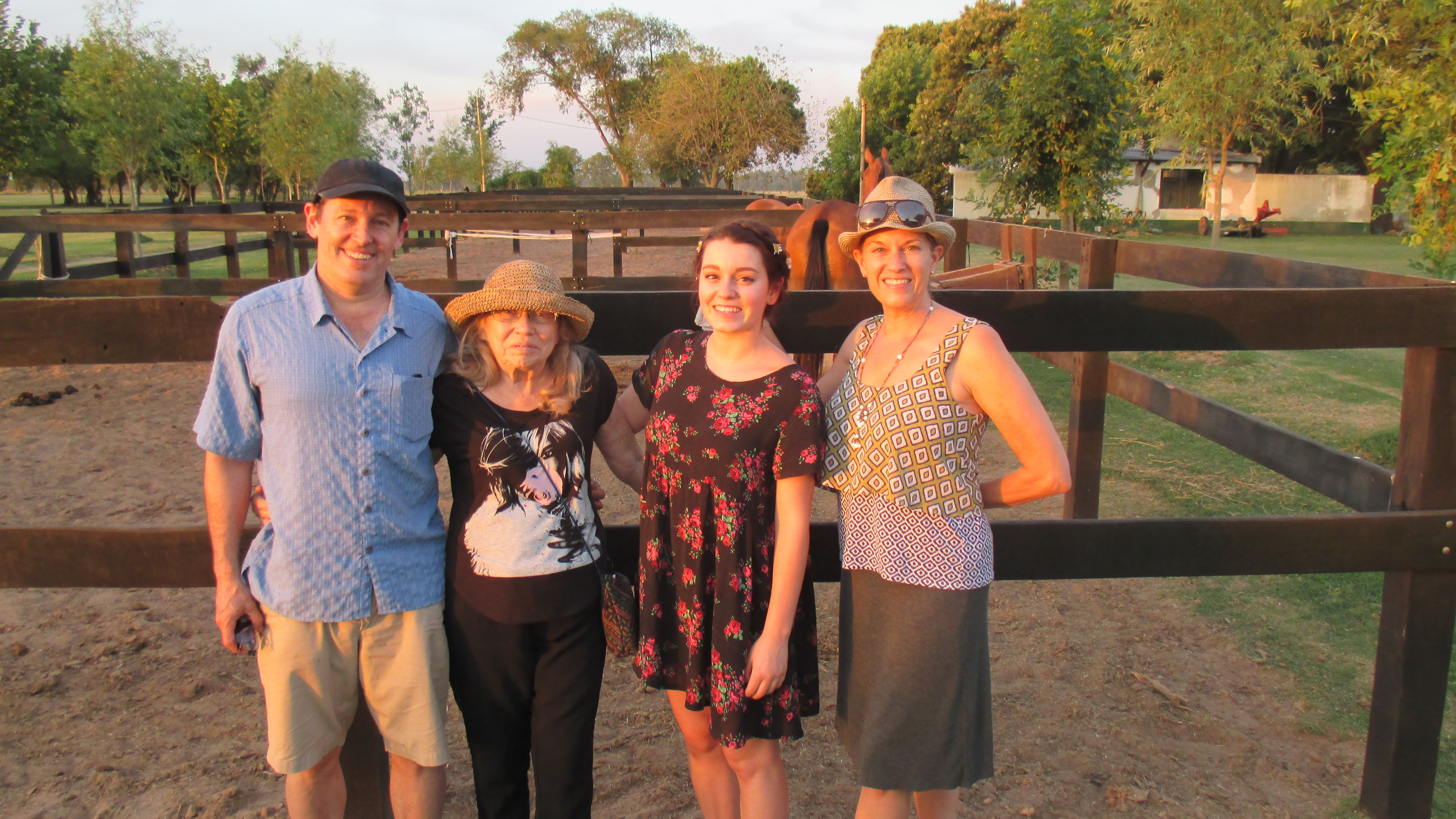
With my favorite people (and my favorite shirt)

With my favorite people (and my favorite shirt)

I hate losing stuff (especially snazzy wrinkle-free shirts), I hate shopping, I really hate buying clothes, and I hate malls. I was full of hateful hate. After several hours of scouring the mall for overpriced pale imitations of my beloved shirt, among other lamented items, I was able to procure some replacement duds, but the experience was like a bladder exam, only not as fun.

The mall of hateful hate notwithstanding, I liked Buenos Aires a lot. It’s a cosmopolitan, peppy, fun, tango-y place. People eat, they drink, and they dance. I cannot think of a single person we encountered who wasn’t cheerful and friendly. Can you imagine that? Cabdrivers were honest and efficient (although once, when I was going out to the airport to meet my mother, one cabbie asked if we could stop at McDonald’s for coffee – I explained that her flight had already landed, which he took in stride). Shopkeepers were gracious, even on the rare occasions when we didn’t buy anything. Waiters seemed genuinely glad to see us. People were amazingly patient with our infantile Spanish. This is easy travel, and it’s a jumping off point to places like Patagonia and Iquazu Falls that we’ll return to someday, I hope.

If you like steak, it’s a particularly good town. After a few culinary misses, we decided to play to the place’s strength – meat. We wandered into a relatively pedestrian-looking steakhouse and did what you’re supposed to do – we ordered some salad, a steak, some fries, and some Malbec – and life was mighty fine. Today, we hit the jackpot at an absolutely charming place called Gran Parrilla del Plata with almost the same format. We had a simply perfect meal of skirt steak, a salad of lettuce, tomato, carrots, and beets, a plate of fries, a morcilla sausage (made from blood – Janine was not nearly as happy about it as I was), and a 500 cl bottle of simply smashing Malbec. When the waiter couldn’t interest us in dessert or coffee, he brought us a round of sparkling wine on the house anyway. The bill came to thirty bucks. It was all waaaayyy too much fun for a Tuesday afternoon, and I almost felt guilty, but not quite.
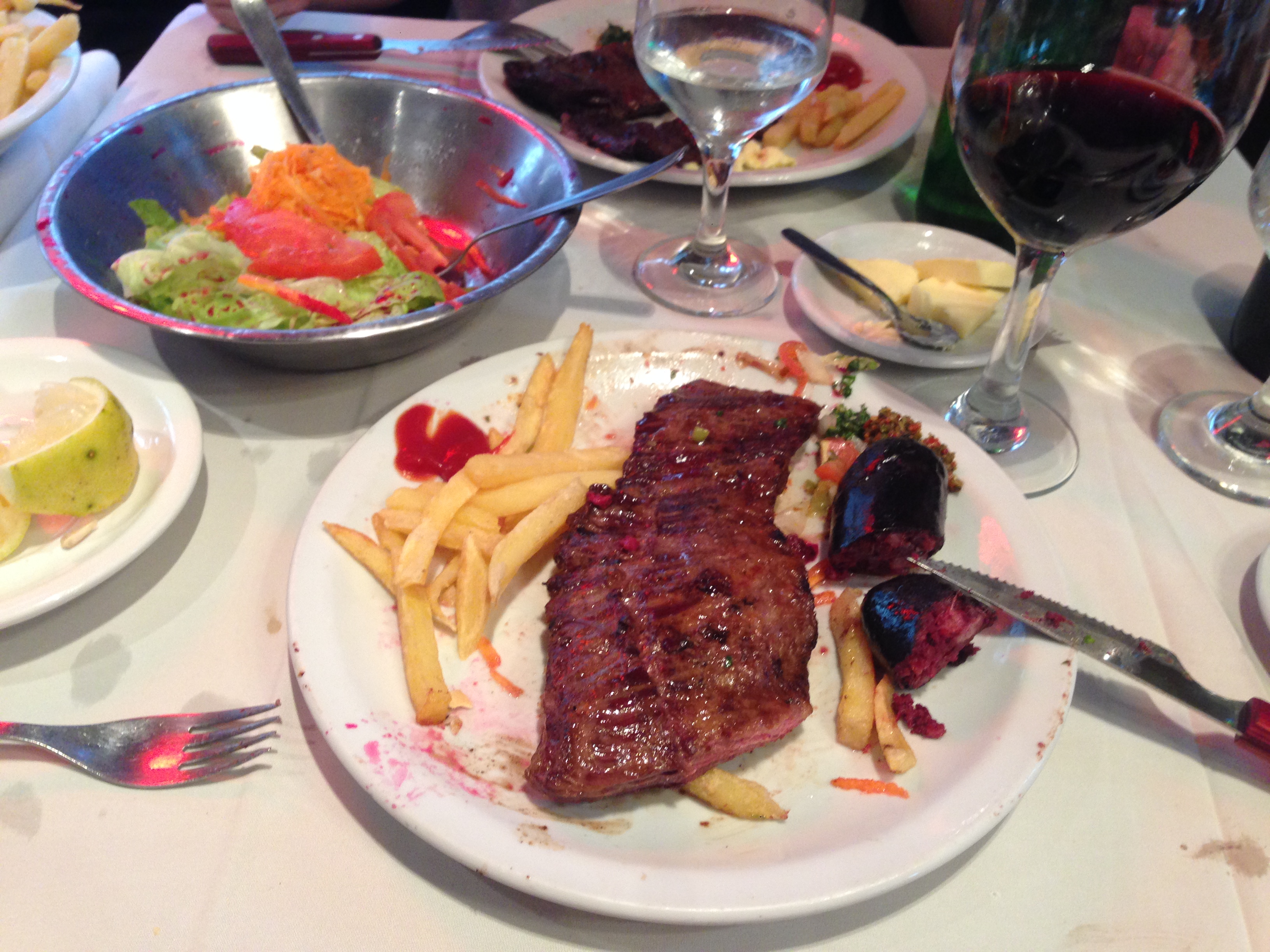
Does this meal rival the chivito?

Does this meal rival the chivito?

On our return from Uruguay we repositioned ourselves closer to downtown in the neighborhood called San Telmo. Our new apartment was just a short walk to a great weekend flea market, but more than that, I think it’s good to have a chance just to try different parts of town on for size. These extended visits give us that luxury. We arrive in town, suss the place out a bit, wander out of town for a spell, then resume the visit in a different neighborhood.

Janine does love a flea market.

Janine does love a flea market.

If Palermo Viejo was Soho (New York’s Soho), with cafes and boutiques, San Telmo was the West Village (um, with cafes and boutiques). Today, we also wandered through Recoleto, which could easily stand in for the Upper East Side, complete with dainty dowagers and older gentlemen in summer suits and ties. The Upper East Side does not have the gravesite of Eva Peron, however. Wander the streets of Buenos Aires and you could be in New York, Madrid, Paris, Barcelona, or even Rome, but remarkably free of the attitude.

We also took in an actual tango show. Mind you, we didn’t dig deep for the fancy pants tango bar extravaganzas, which will run you at least a couple hundred bucks before the night is out. No, cheapskate Eric lobbied for the intravaganza presented by the non-profit Borges Cultural Center, which, if you ask me, put on a perfectly fine tango show for twenty bucks. There were men and woman, they wore fedoras, they danced, they twirled their legs in that Argentinean way, and it looked like tango to us. There was also this earnest young fellow who repeatedly crooned at us (while the tangoers changed costumes) and who made up for in passion what he lacked in subtlety. Next time, though, we’ll go to a milonga, which is basically a neighborhood dance hall that starts at midnight and goes until dawn. They usually start with a tango lesson and then let people loose on the dance floor. To do this, though, you need to take a disco nap at around eight, and then drink a pot of coffee chased by a couple of Red Bulls. If you do all this you might be able to pull it off, but then again, maybe not.

Finally, we made yet another visit to a famous theatre without actually seeing a performance in it. The Teatro Colon is said to be one of the finest acoustic opera houses in the world. It’s certainly one of the most beautiful theatres I’ve seen. I would spend a month shopping for socks in malls to see an opera here.

Just another beautiful theatre without a performance. (Photo courtesy of Janine, who graciously agreed to let me use it.)

Just another beautiful theatre without a performance. (Photo courtesy of Janine, who graciously agreed to let me use it.)

On the other hand, while the acoustics may be nearly perfect, whoever designed the men’s room needs to find another line of work.

I swear I took this photo in the Teatro Colon and didn't crib it from somebody's PowerPoint presentation on failure.

I swear I took this photo in the Teatro Colon and didn’t crib it from somebody’s PowerPoint presentation on failure.

We are now off to South Africa and Kruger National Park. We may or may not have internet access, so if I go quiet for a while, please don’t be alarmed. After that, we’re off to New Zealand and Australia, about which we have done ZERO research. Any recommendations about where to go or what to do will be most welcome. See you in the funny papers.
All hail the chivito – the national sandwich of Uruguay!

This post comes with a parental warning. It contains food writing at its most obscene. Please put the children to bed lest they
look over your shoulder at the dirty pictures. With any luck they are too young to read.

Now sit back, pour yourself a cocktail (unless you’re at your desk, in which case you may just prefer to take a nip at your flask) and let me tell you about the mighty chivito – the national sandwich of Uruguay. (By the way, a shout out to loyal reader Phillip Shaw, whose timing was impeccable – he sent me a note about the chivito as I was in line to buy one.)

Uruguay, you say? What happened to Buenos Aires? We wanted a little time at the beach and this was the closest, cheapest way to do that. The sleepy town of Colonia, Uruguay sits across the mouth of the Rio Plato from the Argentine capitol, an hour away by ferry.

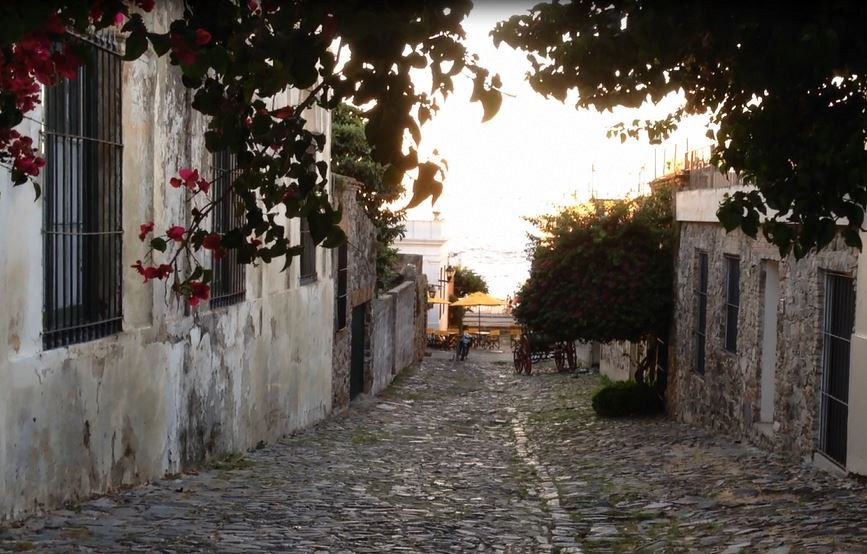
Cobbly, quaint Colonia, sleeping peacefully.

Cobbly, quaint Colonia, sleeping peacefully.

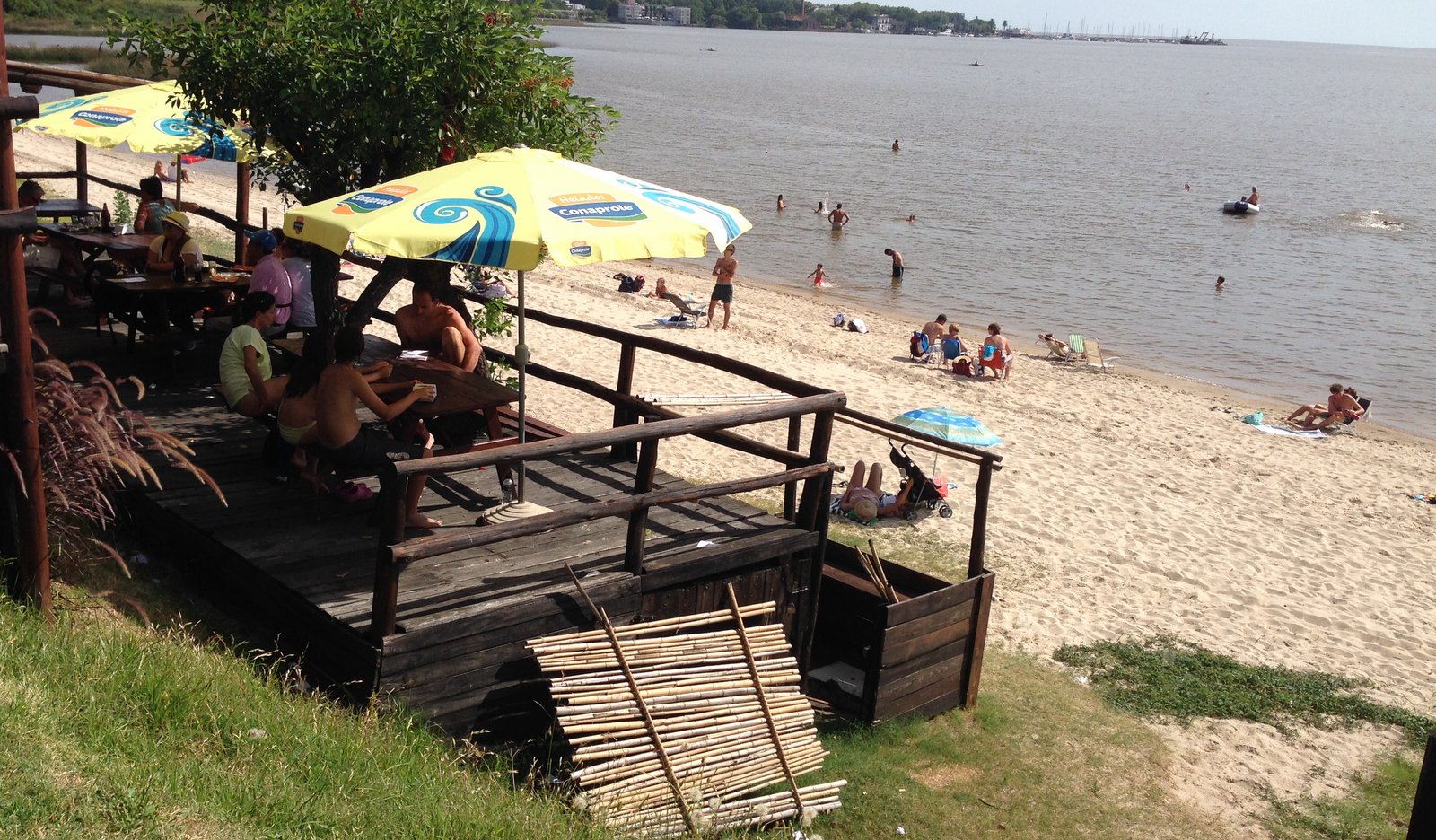
The river then empties into the South Atlantic. It’s the strangest body of water I’ve ever encountered. It’s a thirty mile wide fresh water, well, thing, that’s about ten feet deep. You could almost walk across it to Buenos Aires, which we can see way off in the distance from our twelfth floor apartment. The water is muddy brown, which might put you off, but it’s entirely pleasant to wade in from one of its quiet sandy beaches. So it’s not really the beach, but it will do in a pinch.

A perfectly nice beach!

A perfectly nice beach!

Colonia was so close yet so far. We got to the dock early, which was lucky, because our 1:15 ferry was cancelled and we were able to get on the 12:15, although we were then informed that it would be delayed until 1. There was a line to get onto the boat, but the poor saps who obeyed the rules were outnumbered badly by the throng that just rushed the door when the departure was announced. It was mayhem. I blame this on poor governance.

The boat made a nifty one hour trip across the water. Upon landing, we just sat there. There was much confusion about whether, when, or how we might get off the boat. About half an hour after landing, somebody made an announcement, which was met with sarcastic applause and then…nothing happened. After more waiting, people were allowed to make a mad dash for the exits. With sincerely jangled nerves, we finally made it ashore.

The town itself could be quieter but I’m not sure how. For four bucks (although thanks to the vagaries of demand pricing the ferry can cost as much as fifty, if you can believe it) you can travel from crazy BA to the town that time forgot. Colonia has many charms. You can get U.S. dollars from the ATM, and there’s one exchange rate – no blue rate to make you crazy. It’s full of history. In fact, we wandered by this store and saw a family that looked amazingly like us. Apparently we have Uruguayan relatives deep in our past.

Janine, Maggie and I were astonished at the amazing resemblance we bore to this distinguished Uruguayan family.

Janine, Maggie and I were astonished at the amazing resemblance we bore to this distinguished Uruguayan family.

You can sit on a flat sandy beach, you can wander little cobblestone streets, you can have a cocktail at a cute little restaurant that has great appetizers and mystifyingly bad entrees as you watch the world’s most beautiful sunset, and you can watch people wander the streets lugging their thermoses and sipping maté through a metal straw.

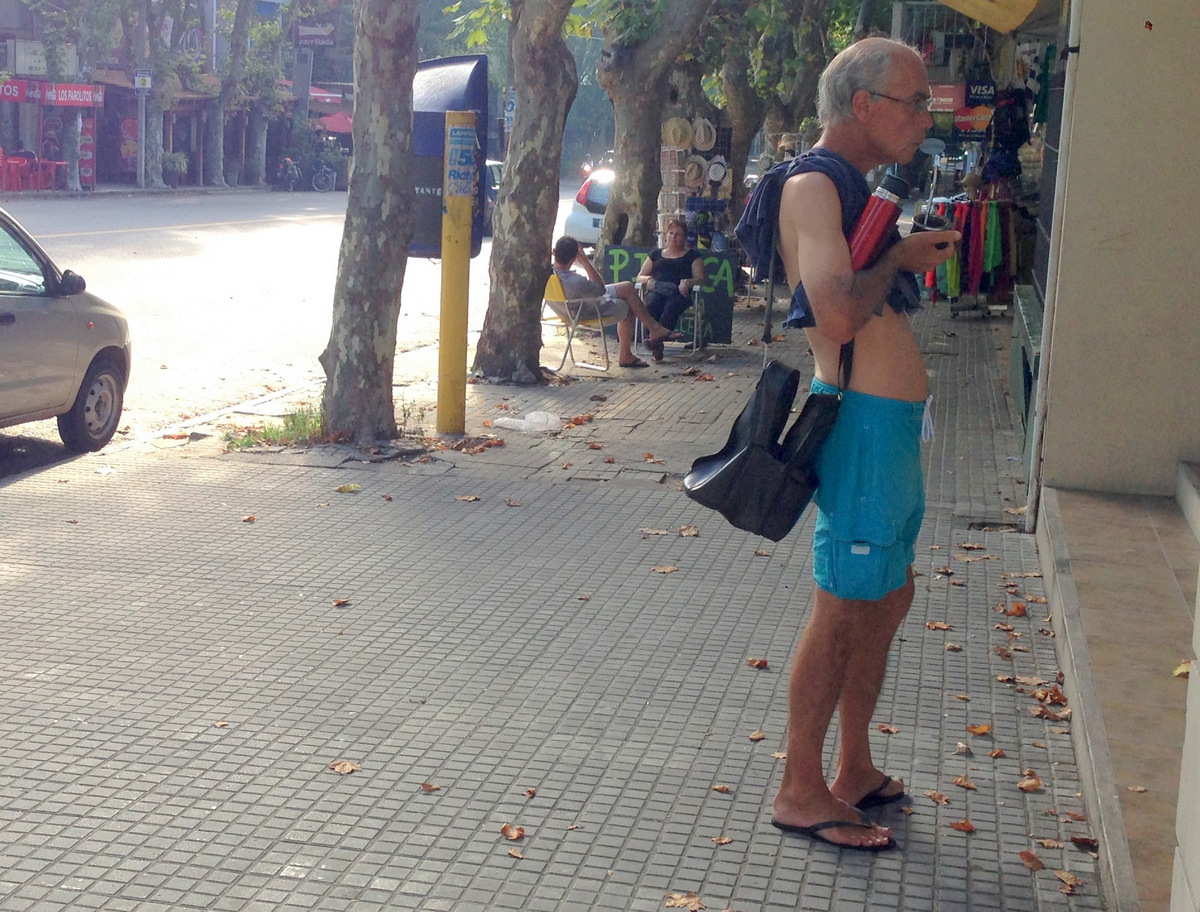
This man is carrying his thermos of water, which he uses to refill his mate cup. Apparently, this drink also keeps you thin.

This man, like so many other people in this town, is carrying his thermos of water, which he uses to refill his maté cup, which he sips at through a metal straw while walking down the street. Apparently, this drink also keeps you thin.

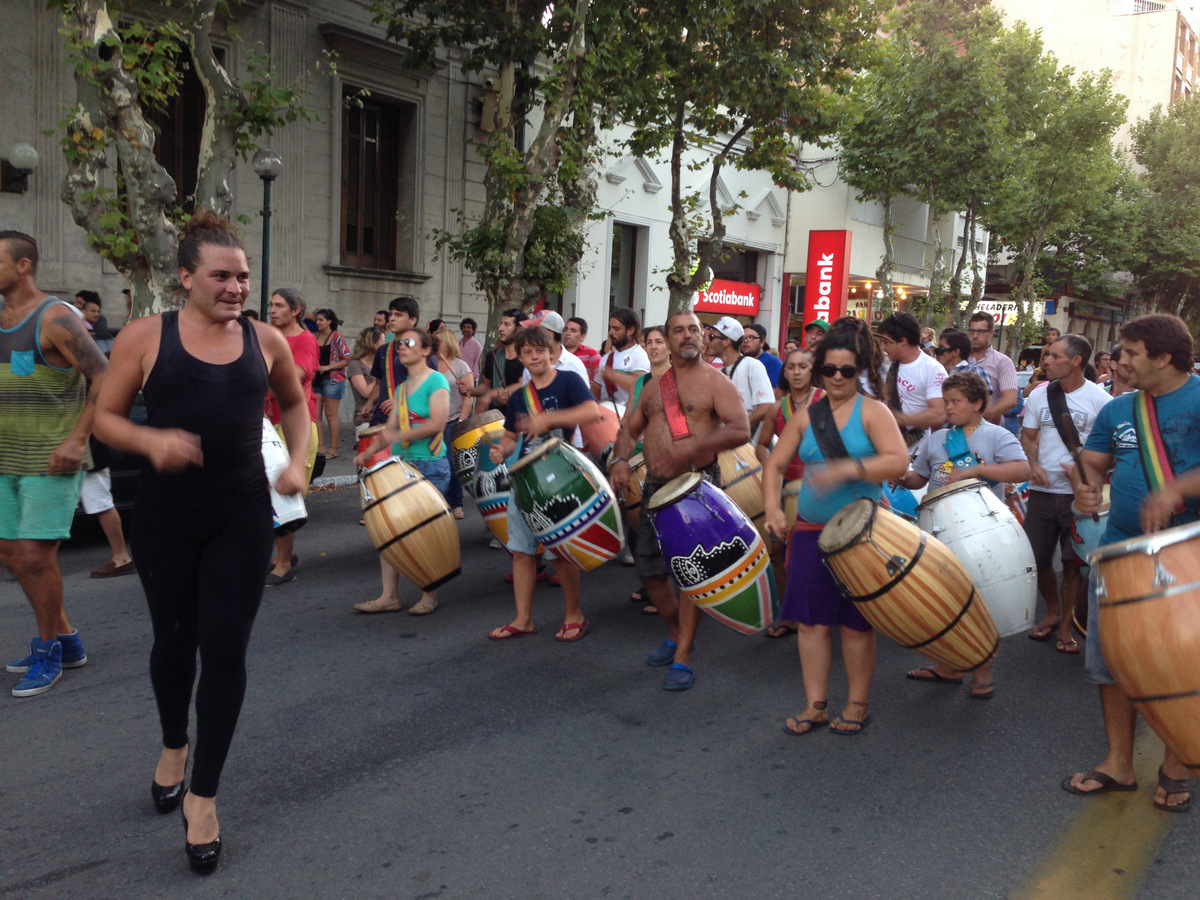
We even stumbled across a parade led by a man in very high heels.

Just another day in Colonia. In addition to an excellent national sandwich, Uruguay has progressive laws on abortion and same sex marriage to boot.

Just another day in Colonia. In addition to the world’s finest national sandwich, Uruguay has progressive laws on abortion and same sex marriage to boot.

You can walk the length of Colonia in about fifteen minutes. There’s a charming little marina and the people are amazingly polite. Oh, and you can eat a chivito.

Yes, it’s the moment you’ve all been waiting for, the chivito.

This sandwich is like nothing I’ve ever seen, or eaten. Chivito means little goat, but there’s no actual goat in it. Why little goat? Who cares? The sandwich has been hardening arteries in Uruguay for seventy years or so, and you can get one on every single street in this town. What is it? What isn’t it? It’s a layer of thin sliced filet mignon with ham, melted cheese, a fried egg, lettuce, tomato, mayo, and about a dozen condiments including pickled vegetables, marinated peppers, olives, peas, carrots, and a bunch of other stuff I couldn’t identify. The whole shebang is served on a massive bun, which, if it does its job right (and it seldom does) stays together for at least two or three minutes before yielding to the pressure of its outsized contents and disintegrating into a pile of stuff in front of you.

There is another sandwich that takes the chivito to another, even more sinister, level – the Milanesa. In the Milanesa, instead of a thin slice of filet, they insert a hubcap-sized portion of breaded, fried chicken or steak that hangs over the rest of the sandwich like a diving board.

That’s right, they take all that stuff and add a piece of deep fried meat to it. Mike Bloomberg, bless him, will never set foot in Uruguay for this reason alone.

As this barely-safe-for-work photo will prove, the result is absolutely obscene.

Here it is, in all its glory, the chivito! (Actually this is a Milanesa with chivito fillings, but whatever.)

Here it is, in all its glory, the chivito! (Actually this is a Milanesa with chivito fillings, but whatever.)

The equally obscene cutaway shot.

The equally obscene cutaway shot, taken from our balcony.

I had three of these in three days this week. If I stay in this town for much longer, I will have to be loaded by crane onto a barge and evacuated for my own protection. I secretly suspect my wife is contacting the producers of some intervention reality show as I type.

Steak, Tango, and Polo – the Argentine trinity. And speakeasies!

Let’s play word association. What three things do you think of when you think of Argentina? (Let’s leave out Eva Peron and economic woes.) For me, it’s steak, tango, and polo.

We begin our journey with not just a steak, but a steak in a speakeasy.

What is it about me and speakeasies? I guess I like being in on a secret. At a speakeasy, everybody’s cool, even me. You may recall my speakeasy fetish in New York. Well, in Buenos Aires, they have these things called puertos cerrados, or “closed door” restaurants. The concept isn’t particularly new – people open up their home to guests, who are thrown together in a dinner party-like atmosphere. It’s a little different in Buenos Aires. These puertos cerrados act more like restaurants but they occur in the home. Like the blue market for currency, there seems to be a blue market for dinner.

We’ve been to two so far, and the first, Paladar, was a big winner. The restaurant is in an apartment building in the residential part of the Villa Crespo neighborhood. We arrived at the address, rang the bell, and were led up the stairs to an apartment that is converted on Thursdays, Fridays, and Saturdays into a lovely mid-century modern dining spot. (I wonder what the neighbors think about all this. Would you want the people downstairs to host a dinner party three days a week? Me neither.)

The meal was five really good courses, each paired with a cocktail or a dandy Argentinean wine. A husband and wife team run the show – he’s the chef and she’s the sommelier. We had a lovely corn croquette amuse paired with a welcome cocktail. There was a nice appetizer of baked ham, mozzarella balls, and cherry preserves served with a great Malbec rose. The main was one of the famous cuts of beef in Argentina, the bife de chorizo, (we call it the New York strip), dry rubbed with the North African spice mixed called ras al hanout. Be careful how your order your steaks in Argentina. They grade on the curve here. Rare means medium, medium means well done, and well done means you want them to turn your steak into flooring, which they will. As far as I can tell, you cannot get a steak that is actually rare unless you cook it yourself. We ordered rare and got medium rare, which we considered a victory. This was served with a really terrific cabernet from Mendoza that tasted like black cherries and velour, if such a thing is possible. One of the joys of this particular place is what appears to be the bottomless glass of wine – our hostess Ivana roamed the dining room seeking out empty glasses to refill. This is the kind of dinner party you want to go to, unless uncle Hershel can’t hold his hootch. The whole shebang came to 400 pesos per person, which is thirty one bucks if you’ve gotten a good rate on the blue market. It may be the dining deal of the century, if you don’t count koshery.

Our other closed door effort was somewhat less successful. It was called Almacen Secreto, or Secret Warehouse, although it was simply an apartment that had been converted into a restaurant (unlike Paladar, which actually seems like it could be somebody’s home). We went to Almacen for New Year’s Eve. The food was fair at best, but the fun happened at midnight when they passed out party favors and turned the backyard into an impromptu disco.

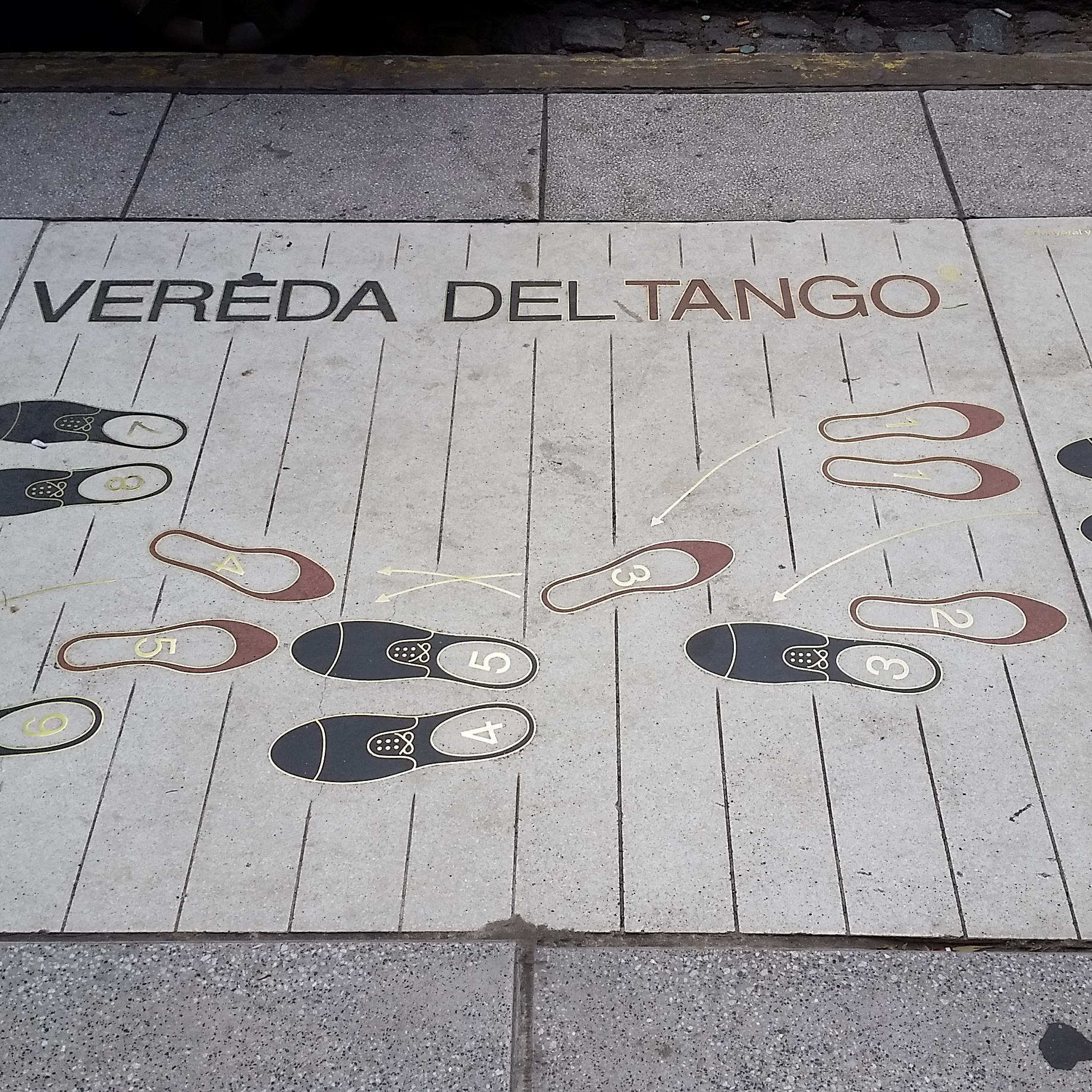
Sometimes clichés are clichés for a reason. You can’t think of Argentina without thinking of tango. Tango seems to be everywhere here. There was a free tango show at the flea market, all over town you will find tango lessons followed by an evening of dancing at events called Milongas, and you can even give it a try yourself walking down the street.

See, it's easy! (Photo credit to my lovely wife)

See, it’s easy! (Photo credit to my lovely wife)

We even went for an evening of tango-y jazz without the dancing. At Café Vinilo in Palermo, we caught Noelia Moncada and the Orquesta Victoria. The band was like nothing I’ve ever seen or heard before. There was a piano, a bass clarinet, two concertinas, four violins, one viola, one double bass, one cello, and a sultry, deeply wrought singer who sang a lot about the heart. Either that or she sang many a lot of songs about cardiology, because I heard the word “corazon” a lot. The music was earthy, sexy, soulful, and playful at the same time. And it was a ridiculous bargain. Tickets were eight bucks and drinks were cheap. How do they do it? Anyway, Noelia and her pals made you want to undulate across the dance floor, although if you didn’t know the steps, you could seriously hurt your partner or yourself, or both.

Here’s a clip:

Finally, my missive about cliché Argentina tourism would not be complete without a trip to the polo field. For some reason, Argentinians are the world’s best polo players, so how do you pass up the chance to watch a polo match? My mother still owns and rides horses, so this sounded like a particularly fun outing for her.

Believe it or not, this is my mother, who was a trick rider in her youth.

Believe it or not, this is my mother, who was a trick rider in her youth.

Somehow Janine managed to find what appeared to be a freelance polo player who would pick us up in town, serve us lunch, and take us out to the polo fields to watch a match. He signed his emails “Vito, Professional Polo Player.” This was going to either be really fun or we were in for trouble.

The economics of polo are scary. To play a single match you need at least four really well-trained horses, all of which need to be fed, boarded, groomed, saddled, and ready for action. If you are rich enough to do this, why do you need to drive tourists around? Vito, Professional Polo Player’s fee would scarcely pay for a single polo mallet. Something wasn’t quite right here.

Well, Vito, Professional Polo Player arrived and the guy was right out of Argentine Central Casting. He’s young, handsome, and fit. His English is excellent, and of course there’s that charming South American accent. My daughter, my wife, and my mother all seemed to be enjoying themselves immensely and we hadn’t left the apartment yet.

Vito, Professional Polo Player

Vito, Professional Polo Player

VPPP drove us out to the polo fields, set up a table in a meadow next to the field, and served us finger sandwiches.

Just another day on the polo fields.

Just another day on the polo fields.

He was particularly gentlemanly with my mother – jumping up to get her chair and otherwise turning on the Latin charm to which she seemed particularly susceptible – and we watched him and seven other guys with thirty some-odd horses scrimmage on a private polo field for about an hour and a half. Polo is gorgeous to watch. The horses are extraordinary athletes, as are their riders. The game itself is uncomplicated and fun – hit the ball with a mallet through the uprights while riding full tilt on a thousand pound animal. What’s not to like?

VPPP at work.

VPPP (L), at work.

During our couple of hours in the car, we chatted with our new friend about the life of a professional polo player (although he is also an architect – some guys…), life in Argentina in general, and our day of polo turned out to also be a game of a hundred and twenty questions with a local. We ended the day with Vito dropping us off one of his favorite Argentine steak houses, which lived up to its billing. As it turns out, our day was a big winner, and it may be a while before my mother wipes the grin off her face.