Tombs, Alleyways, and a Big Pile ‘o Carbs – My Happy Cairo Recap

This is not Club Med, that’s for sure. But Egypt is obviously full of wonders – it’s got the stuff I’ve dreamed of seeing for as long as I can remember. You want mummies? They got ‘em. Tombs? Scads. Oh, and the best, cheapest meal I’ve ever eaten.

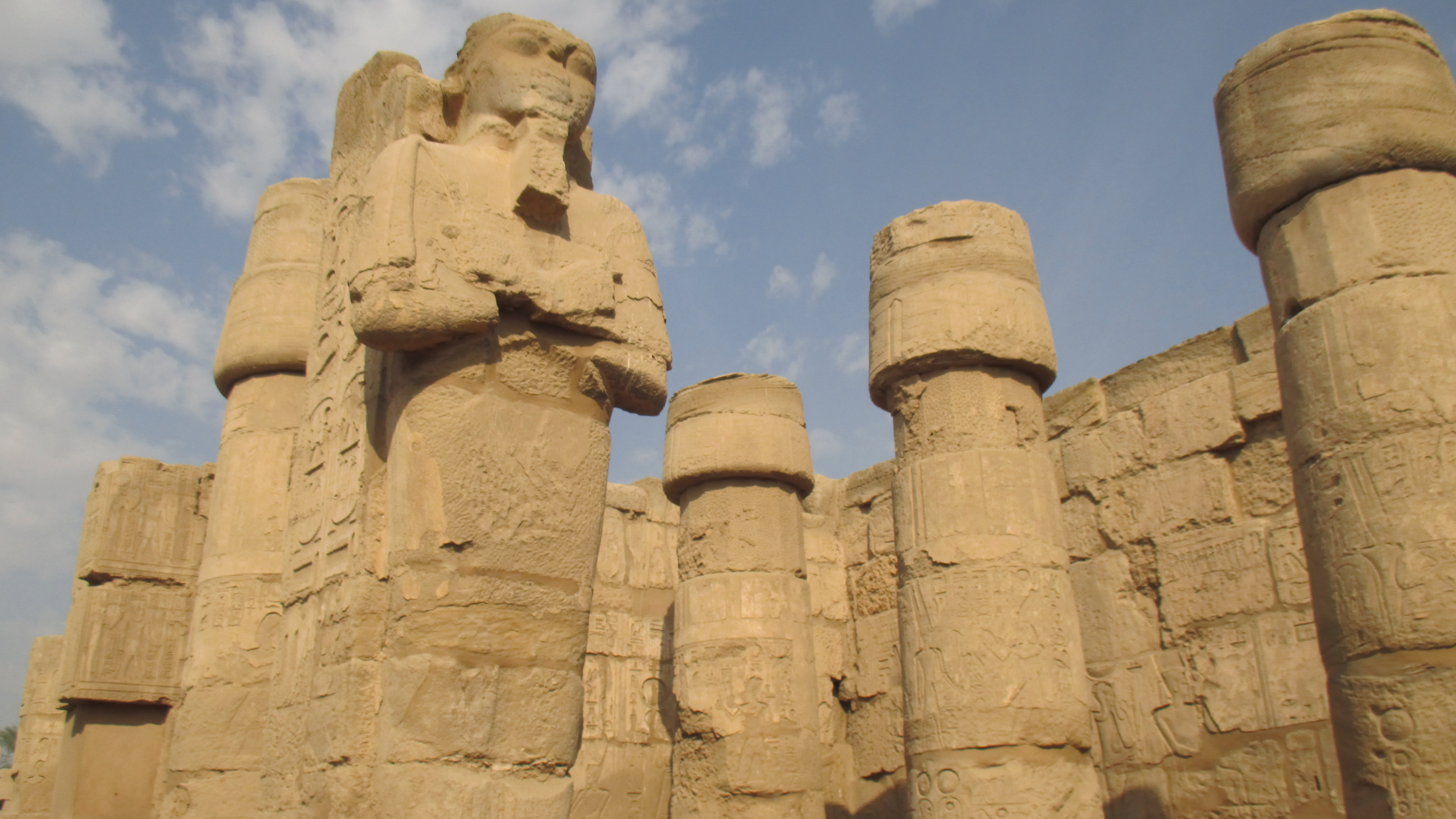
We visited temples and tombs. We saw Hatshepsut’s mountainside funeral temple, with most of the references to the woman king scratched out by her cranky stepson. We floated on the Nile in a felucca, the Egyptian sailboat. We went back to the temples at Karnak during the morning and got a chance to see its massive columns in full sun. We hunkered down and descended the hundred meter tunnel to the tomb inside the red pyramid at Dahshur (just next to the bent one). This journey requires pretty good quads and a willingness to shuffle and squat deep into a very narrow cave. The place also reeks of ammonia. Our guide Mina said that this was the byproduct of the embalming fluids from the mummies. It’s possible that it’s also just pee. If you have any problems with claustrophobia, don’t do this. If you have trouble bending, don’t do this. If you don’t like the smell of several thousand year old embalming fluid (or pee) don’t do this. Of course the tomb was raided thousands of years ago. At some point, the pharaohs realized that the pyramids they were building were gigantic billboards that read, “steal my stuff here.”

With our guide Mina at the Sphinx.

With our guide Mina at the Sphinx.

They finally got the memo at Luxor, where they hid their booty deep underground in the Valley of the Kings on the west bank of the Nile. Of course, with the exception of Tut, almost everything from these tombs was looted and is gone forever. Our buddy Bob tells us that there are around twenty tombs that are unaccounted for just in Valley of the Kings. For all we know, they’re right there near the other sixty some-odd tombs. In fact, Howard Carter’s team discovered King Tut’s tomb entirely by accident. I’m told that one tomb was discovered by an Egyptian donkey, which stepped into a hole to its knee, revealing an ancient wonder. Someday, someone will make a discovery that will put the Tut stuff to shame. Won’t that be exciting?

We wandered around the Egyptian Museum of Antiquities, which may be the world’s worst museum with the world’s best collection. It’s a jumble of stuff with not much rhyme or reason, but what stuff there is! Here’s a hallway full of painted burial caskets. There’s a gallery full of Tut’s jewels. What is half this stuff? Who knows? Sometimes you’re lucky and there’s a yellowed piece of paper with a brief description that was typed on an actual typewriter decades ago. Turn a corner and there it is – the King Tut exhibit. You may have paid twenty five bucks to see a small portion of it on one of its world tours. Well, here’s all of it – the famous golden head and everything – almost hiding in the back of the museum. It’s kind of like Egypt itself – chaotic and disorganized, but dazzling if you give it a chance.

A fabulous display at the Egyptian Museum

A fabulous display at the Egyptian Museum

You never know what you’re about to discover. We were led by a clever tout through Islamic Cairo – a warren of alleyways where all manner of commerce is conducted. He took us into the back room of a printing shop that was churning out Korans, we visited a guy making lamps with a rusty old acetylene torch (surprise, surprise, they were for sale!), and we ended up in the spice market. This stuff may be fascinating to tourists, but the alleys were packed with locals, most of whom (but not all) greeted us with a smile or a wave. This was not Disneyland Cairo, that’s for sure.

Koran factory in Islamic Cairo

Koran factory in Islamic Cairo

The three main pyramids at Giza are all that, but you have to work at it a bit. They used to be out of town, in the desert, a few miles from the city’s border, but the city has been built out to meet the pyramids. It’s a little weird. You approach these epic structures from a crowded parking lot that now sits on the edge of town. But wander to the far side of the pyramids, the part that still touches the desert, and you can look at these amazing monoliths as people have for thousands and thousands of years. Just a few million stones stacked on top of each other and a world of sand. Every few minutes a camel walks by. I could have just sat there all day and just looked at it.

IMG_1009

We packed in a ton of stuff in Egypt. Here’s a rundown of the sites:

Luxor

  • The sound and light show at Karnak
  • Luxor Museum
  • Habu Temple (Funeral temple of Ramses III)
  • Deir al-Madina (temple built for themselves by the workers who constructed the tombs of the Valley of the Kings)
  • Karnak Temple
  • Luxor Temple
  • Valley of the Kings
  • Al-Deir Al_Bahari Temple (King Hatshepsut’s funeral temple)

Edfu

  • Edfu Temple
  • Kom Ombu Temple (Temple built to appease the Nile crocodiles. I have a feeling it didn’t work.)

Aswan

  • Aswan High Dam
  • Unfinished Obelisk (they spent six months carving out a gargantuan piece of pink granite, but it cracked, so they left it there)
  • Philae Temple

Cairo

  • Egyptian Museum of Antiquities
  • Pyramids of Imhotep and Saqqara
  • Red and Bent Pyramids at Dahshur
  • Giza Pyramids
  • Ibn Tulun Mosque
  • Saint Virgin Mary’s Coptic Orthodox Church (where Jesus, Mary, and Joseph were said to have lived after they fled Bethlehem)
  • Ben Ezra Synagogue (Oldest synagogue in Cairo. Not sure if they can get a minyan.)
  • El-Tanoura Sufi Troupe (Otherwise known as Dervishes – one dude spun for over half an hour without tossing his cookies. Better than the Istanbul Dervishes by a lot.)

You may have noticed that I have not said anything about the food. In general, the cuisine borrows heavily from the countries along the Mediterranean. There’s baba ganoush, tabouli, hummus, some very good falafel and the like. I love that stuff, but you can get it anywhere. I did eat a stuffed pigeon, which tasted a bit like duck.

Taste like a winged rat!

I dare you not to think about Washington Square Park or Piazza San Marco.

What I’d never seen before is this wonder of wonders called koshery. Our houseboat landlord Dan turned us on to this, and my life may never be the same. Koshery is street food, served at stalls and in very humble restaurants all over Cairo. It’s a bowl of assorted grains – a mixture of rice, lentils, tiny macaroni tubes, hunks of broken spaghetti, and bits of toasted spaghetti that resemble Spanish fideos. Dr. Atkins is surely spinning in his grave. It’s topped with this out of this world tangy vinegary tomato sauce, crispy fried onions, a bit of garlicky oil, and a fiery hot chili paste that will sear your soul if properly applied. On our first night back from Luxor I navigated myself across our busy street, found the koshery place, managed to communicate my order to the fellow at the register, and figured out how to retrieve my order from the guy at the counter. That stuff is stressful, but oh was it worth it. The total bill for two orders? Twelve Egyptian Pounds, or $1.68. A dollar sixty frigging eight. For you humanities types, that’s eighty four cents per order. We had so much left over that we ate it the next morning for breakfast with a poached egg on top, and I can’t remember ever being so happy. I can’t wait to get back to the states and start making koshery. In fact, I dug up a recipe online, and here you go. Someone out there make this and tell me how it was.

It may look like a dog's dinner, but oh my good heavens is this good!

It may look like a dog’s dinner, but oh my good heavens is this good!

Egypt was a marvel. It was exhausting, frustrating, wondrous, and very, very illuminating. We are glad to leave – there’s only so much of this you can take at one time – but I will never forget the people we’ve met and the places we’ve seen. I’ll be back, inshallah.
The Music of the Streets and other Cairo Phenomena

Raise your hand if you live in the United States and think you have bad traffic. Now put your hands down. Compared to Cairo, you have very good traffic. It may take you a long time to get to work, but in your world there are traffic lights, crosswalks, and some semblance of order. The only order you experience in Cairo are the laws of the vehicular jungle.

I seem to remember some pretty bad traffic in certain cities around the world, but Cairo stands out for its sheer anarchy. Cairene conveyances are not unlike those in other developing countries. There are taxis and private minibuses that stuff themselves so full that people hang outside the open door like tourists on San Francisco cable cars. There are also donkey carts, big, bad tour buses, bicycles, mopeds, LOTS of pedestrians, private cars, and there are now tuk-tuks, an import from India. These moped/rickshaws are entirely unlicensed – if one of them hits you, good luck trying to get satisfaction. There is no auto insurance to speak of, and people are left to work it out if they have an accident. It’s utter chaos. You could go all day and not find a car without a dent.

There are some really good things about getting about in Cairo. Taxis are dirt cheap. The flag drop is three Egyptian Pounds, or forty two American cents. A trip from downtown to our apartment takes anywhere from ten to forty minutes, depending on traffic, and costs about two dollars with tip (I always give the cab drivers a tip and they seem genuinely grateful). Getting the cab to take you there is another story. We were advised to make sure that the cab driver always turns on the meter. Most will, but some will tell you it’s broken, or come up with some kind of story about why the meter is a bad idea. Apparently, this is a chapter in the International Cab Driver’s Union Handbook. When that happens, you’re supposed to make the driver stop the car and just get out of the cab. One day last week it took us three tries to find a cab driver who would turn on his meter. Then there’s the matter of the destination. Fortunately, our apartment is near a spot known to all cabbies – Kit Kat Square (yes, that’s what it’s called). The amusing part is that there are no hotels near us and cab drivers are highly entertained that we want to go there. One actually laughed at me. My guess it’s as if a tourist hopped into a cab and told the guy to take him to Riker’s Island, or Cleveland.

If the lines in the street are the equivalent of a coloring book, drivers in Cairo are Jackson Pollock. The flow of traffic is an organism unto itself. Drivers weave in and out, sliding from lane to lane, poking through the briefest of openings while they have the chance. The Cairene driver is not just a painter, but a musician. The horn is his instrument (and I mostly mean his – most of the drivers I saw were men). Cairo drivers toot their horn to let you know they’re coming, they beep it to remind you to stay out of the way, they honk it to signal discontent, and they will also tap out a tune from time to time, seemingly out of boredom or maybe just sheer creativity. One day we were heading back to the apartment after a day downtown. There was a brief, rare, blissful moment in which our taxi was all alone for at least a hundred meters. There we were, with the road to ourselves. What did our cab driver do? He honked his horn. Maybe it was a reflexive act. Maybe he was just making sure it worked for the moment, in anticipation of ten or twenty seconds hence, when he knew he’d need it. No matter. It was an auditory transportation non sequiter. The music of the streets, which we can hear quite clearly from our houseboat on the Nile, and which seems to amplify the sounds of the traffic as it bounces off the face of the water, is like an Ornette Coleman composition. At first it sounds simply like noise, but if you listen carefully, you will find that it most definitely develops a rhythm. It somehow makes sense. There are no two ways about it, this is music. Sometimes, the tune is catchy. One driver will tap out a rhythm on his horn (boopedy boop boop, boopedy boop boop) and another will join in, and another, until you have an impromptu automotive symphony.

In any event, just wandering down the street to the market on any given day is an exercise is sensory overload. If you need to cross the street, it also becomes a test of survival. We had one episode in which we had to make it across six lanes of two way traffic. Janine was a bit tentative, and I was too bold – never a very good combination. I confidently stepped off the curb and was halfway into the street when a motorcycle came out of nowhere and nearly ran us down. We retreated back to the curb in flinching self-defense. Janine was more than traumatized. It reminded me of the time when we gave in to our daughter Maggie’s desperate desire to have her ears pierced when she was about five. The problem was that the ear piercing shop only had one person on duty, so they had to shoot the earring stud gun into her earlobes one at a time. Well, these stud guns make a lot of noise, and the first one sent her into a frenzy of tears and recrimination. It took at least a half hour of cajoling to get Maggie to agree to endure the horrifying process of driving a second hole into her other earlobe. That was how Janine felt when she saw her life flash in front of her eyes in Cairo traffic. After a fair amount of suffering, she finally braved the traffic and made it across, but I suspect she’ll carry the moment with her for years to come.

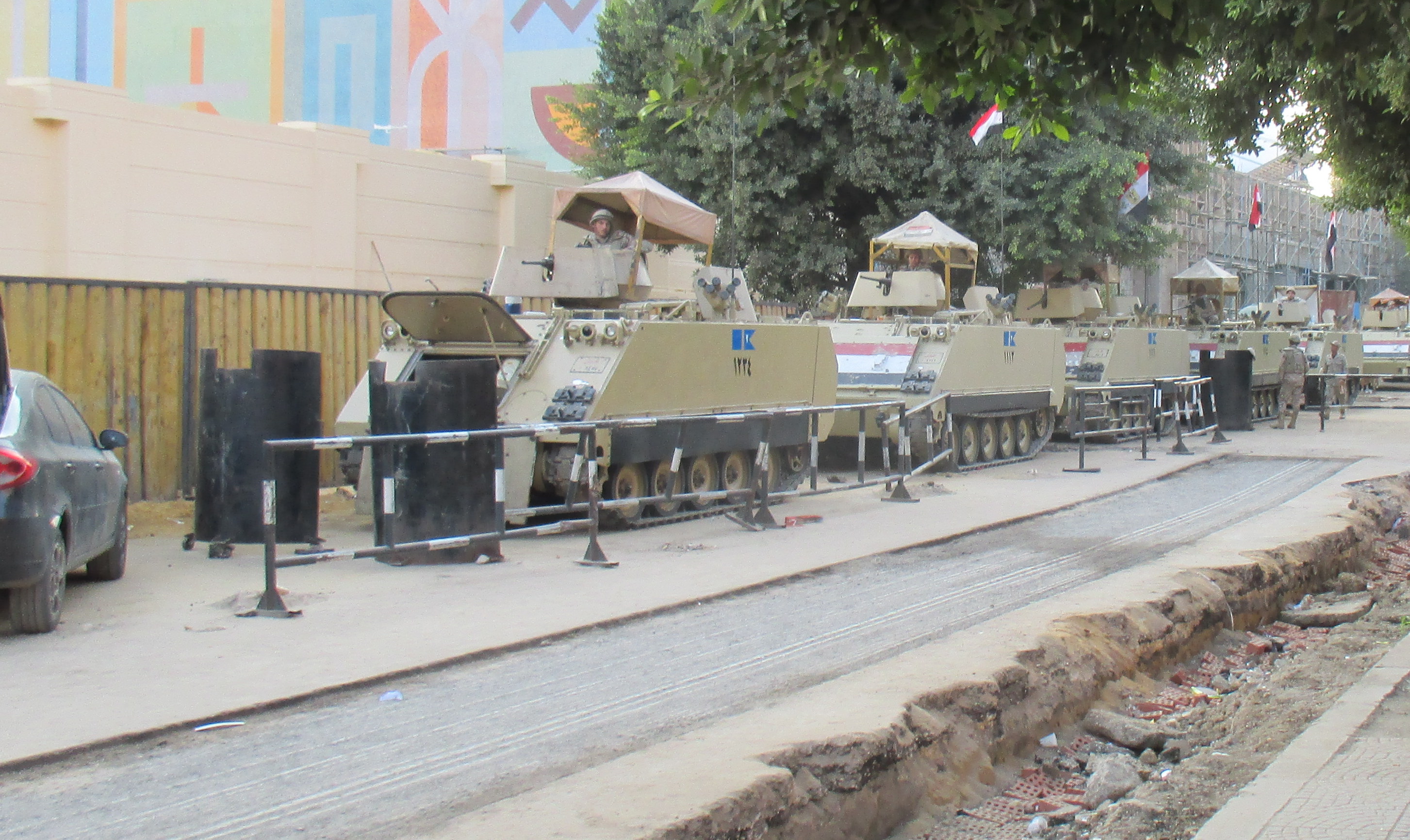
Cairo is not for everyone. In fact, it might not be for most people. For one thing, it’s a developing world country with all that goes with it. Garbage is everywhere. Sidewalks, not so much. The country is also on edge, with well-armed police and army everywhere. Outside the Egyptian Museum, which sits at the edge of Tahrir Square, the epicenter of the recent revolutions (the one to depose Mubarak, and the other to depose Morsi), there is a line of tanks, with soldiers on high alert. Long strands of barbed wire blockades are staged at the sides of the roads, ready to be rolled into place at a moment’s notice.

Line of tanks outside the  Cairo Museum

Line of tanks outside the Cairo Museum

In a poor country, public services are catch as catch can on their best day. One person I spoke with talked of the lack of public space in this city. For example, there are few public playgrounds. The wealthy can buy access to private ones, but poor kids play in the street. Public parks are rare. It’s no wonder that much of the place appears to be treated as a no man’s land where people toss garbage, relieve themselves, or otherwise discount the value of having a clean, well-organized common resource. It was always nice to get home. To get to our houseboat, we pass through a simple unlocked wrought iron gate. Inside our gate, the space was ours, and the chaos of the city was reduced to a thrumming pulse that was over there, while we were over here, down by the river, separated from the madness.

Cairo is not the easiest place in the world to be a tourist. Unlike in many world capitals, westerners in Cairo are a great big curiosity. With my mishmash of European genes, locals have asked me for directions in Rome, Athens, and even Istanbul. Not so in Cairo, where we really, really stand out. Perhaps it’s because there are so few of us after the revolution. Perhaps it has always been the case. But to walk down any street in town is an exercise is being a very big goldfish in a teeny, tiny bowl. I wasn’t terribly bothered by it, but Janine was regularly made quite uncomfortable by the attention she attracted, especially from men. Janine said that she understands why a woman would want to cover herself completely in a culture that seems so polarized by gender.

Then there are the touts. If you look like a foreigner, you won’t get far before someone starts talking to you (at best), or aggressively attempting to sell you something (at worst). Or, like the squeegee guys around the Holland Tunnel, someone will begin to provide a service (like pointing out that the pyramid is a pyramid) that you neither asked for nor need. At the so-called “bent” pyramid in Dahshur, just outside of Cairo, Janine and I had the entire place to ourselves. At one point, one of the two fellows guarding the site (who was packing a very intimidating looking automatic weapon) began following me around the area.

My guide at the bent pyramid at Dahshur.

My guide at the bent pyramid at Dahshur.

Your humble correspondent at the Bent Pyramid

Your humble correspondent at the Bent Pyramid in a photo taken by my pistol packing pal.

Unnerved, Janine retreated to our guide’s car. Silly me, I wanted a better angle to take a photo, and found myself being tracked by my new friend. He may have been toting some serious firepower, but I could also see his socks through his cheap cracked cardboard shoes. He began pointing out some very simple elements of the pyramid, and I could see where this was going. Whether I liked it or not, I would be tipping my well-armed but underpaid new friend. You basically have two choices for how to respond – you can get frustrated or even angry, or you can go with it. I must confess that sometimes I feel charitable, but sometimes I feel manipulated. It’s not like wandering the streets of Rome or Paris, in which you will be left to your own devices no matter what. In Egypt, you are what’s for dinner. Anyway, I suspect that the pyramid touts are members of the Associated Squeegee Guild, or some such august institution.

People will approach you on the street and claim to be just trying out their English, and before you know it, you’re being led to some souvenir stand. It’s unnerving. On the other hand, after the revolution the tourist trade has cratered, and people are attempting to get by on a lot fewer scraps. For the rare tourist, that means a lot more attention. I find it hard to blame people for trying to make a living. We had a fabulous guide in Cairo, a young man in his thirties named Mina, who was introduced to us by houseboat Dan. We spent a few days touring the city with him and he patiently explained who we should tip and how much. The fellow who opened the minaret for us at the Ibn Tulun Mosque gets ten pounds (a little more than a dollar). The guy who led us around the really terrific Gayer-Anderson Museum for half an hour gets twenty. That’s the rate, that’s how it works, and boy does it take the edge off. (By the way, I can’t wait to read the book The Irish Pasha, which explores the fascinating double life of the Egyptologist Robert Gayer-Anderson. It’s being crowd funded at Unbound. If everyone buys a copy maybe we’ll actually get to read it.)

The view from the top of the minaret at the Ibn Tulun Mosque in Cairo. The view was well worth the small tip I gave the fellow who unlocked the door to the minaret.

The view from the top of the minaret at the Ibn Tulun Mosque in Cairo. The view was well worth the small tip I gave the fellow who unlocked the door to the minaret.

By this time you may be asking why anyone would come to Cairo. What with the traffic, the garbage, the unwanted attention, the smog (the air is really bad), and the poverty, why subject yourself to such challenges when you could sit in French cafes or on a Caribbean beach?

My answer, believe it or not, is that it’s actually all quite wonderful. The call to prayer is a perfect example. Each morning at 5:15, it wakes you with a start, even with the best earplugs. But it’s charming, atmospheric, and deeply meaningful to the faithful, who worship in a way that most Americans don’t understand. It reminds you that you are far from your comfortable life and that you are a visitor in a strange land. And it’s really quite beautiful, even if you’re trying to sleep. I really like that.

Next time – thanks for all the atmospherics, Eric, but will you ever tell us what you saw and what you ate?

I got a guy in Luxor…

Something came over us a few months ago, and we decided to go to Egypt. Needless to say, Egypt hasn’t exactly been a top destination for western tourists for a while. But things seem pretty good right now, and we decided to give it a whirl. Janine has been talking about wanting to see the pyramids for years and we were in the neighborhood, so we decided to stop by for a visit.

Once we decided to come to Egypt it became clear that we had to take a Nile cruise. I mean how do you go to Egypt and not go on a Nile cruise? The trip began with two nights at a hotel in the town of Luxor, after which we were to embark on our river boat. The travel agency described the place as a four and half star hotel, but it turned out to be closer to a three and five eighths star hotel. It was fine, but it had the slightly gamy air of a Graham Greene novel. They keep the lights in the lobby off during the day (to save electricity?), the wifi only works in the lobby, and there was a general sense of semi-dubiousness about the place. No matter, we were staying in a hotel in Luxor, on the mighty Nile! And it had a very nice view of the river. So there’s that.

Three and five eighths stars, but a nice view.

Three and five eighths stars, but a nice view.

We were met at the airport by an interesting fellow who called himself Bob. Bob? Really? Yes, he insisted, even his wife calls him Bob. He says that people started calling him Bob when he was a teenager because of his love for Bob Marley. He wears a polo shirt with the name Bob embroidered in hieroglyphics. He’s about my age, he’s about the same height as Janine and he has a slight build, a close cropped beard, and stylish glasses.

As in Turkey and so many other relatively poor countries, you can sometimes be skeptical about people’s motives. Someone offers to help you and then asks for a tip. I really can’t blame people for trying to make a living, but it can be hard to get around without being hawked at. Sometimes the hawking is quite respectful, but other times it’s less so. In the car on the way from the airport, Bob wanted to know if we were interested in an extra tour on our free day. Why, we wondered, did they put a free day on a tour when they know very well that the guide will suggest more? My guess is that it’s because that’s just how it’s done. Bob had a bunch of suggestions, none of them cheap. But we had come all this way and figured we should try to see as much as possible. Could we just add it to our tour cost? Nope, he wasn’t able to take credit cards. I was starting to wonder how this was going to go.

We arranged for an event that night and then a full day’s excursion the following day across the river on the west bank of the Nile. Bob told us that he going to be our guide for the duration of the tour. He’d accompany us on board the boat, sail upriver with us, (We’re traveling upriver, which is south, which is confusing because the Nile flows north and most rivers flow south. Did you get all that?) and guide us around the sites along the way. Bob says that this is how it’s done here. Each group, no matter how large or small, gets its own tour guide.

I should point out that we have done zero homework about the places on our itinerary. I mean zero. Janine knows a bit about Egypt, but as far as I know, the Temple of Karnak is where Johnny Carson kept his turban. Smart people bone up on the places they’re about to visit, but we just haven’t made the time to get even the most rudimentary information about our Nile trip. This puts us at something of a disadvantage. Do we want to go to the Sound and Light show on the first night? Houseboat Dan mentioned something about it, so we figured we’d give it a try.

That night, Bob collected us at the hotel and we drove a few minutes to a cruddy parking lot ringed with souvenir stands. This was not looking so good. We waited by what appeared to be the entrance – two concrete pillars strung with a skinny chain. Finally, someone unhooked the chain, and we were led in the near-darkness down a wide walkway where we could barely make out a colonnade of what looked like some sort of sphinx-y things.

The entrance to the Karnak complex.

The entrance to the Karnak complex.

Just then, music blared from hidden speakers, the sphinx-y things were bathed in light, and the temples emerged under huge floodlights. I nearly wet myself. It turns out that we were at the temple complex at Karnak. Imagine thinking that you’re at a dopey light show when you’re actually at one of the greatest archeological sites on the planet.

The show was an audio dramatization of the story of the temple complex (it’s a complex because the pharaohs kept adding to it over time), complete with very old timey British narrators who sounded like actors in one of those goofy mummy movies of the thirties (with a soundtrack to match).

No matter. We were led from one part of the temple to the next and as we advanced they’d light up this part of Karnak and that, the crazy music would swell, some Edward Everett Horton-sounding dude would talk about Amenhotep or Tutankhamun, and you’d get glimpses in the dark of this extraordinary series of temples with one hundred thirty four columns, the largest of which are more than sixty feet high, which are over thirty five hundred years old. Since we were there in the dark, and they would only light small bits at a time you were left to wonder what the entire place looked like. It was an archeological peep show. Things were looking up.

I thought we were going to a dorky sound and light show. Turns out we were going here.

I thought we were going to a dorky sound and light show. Turns out we were going here.

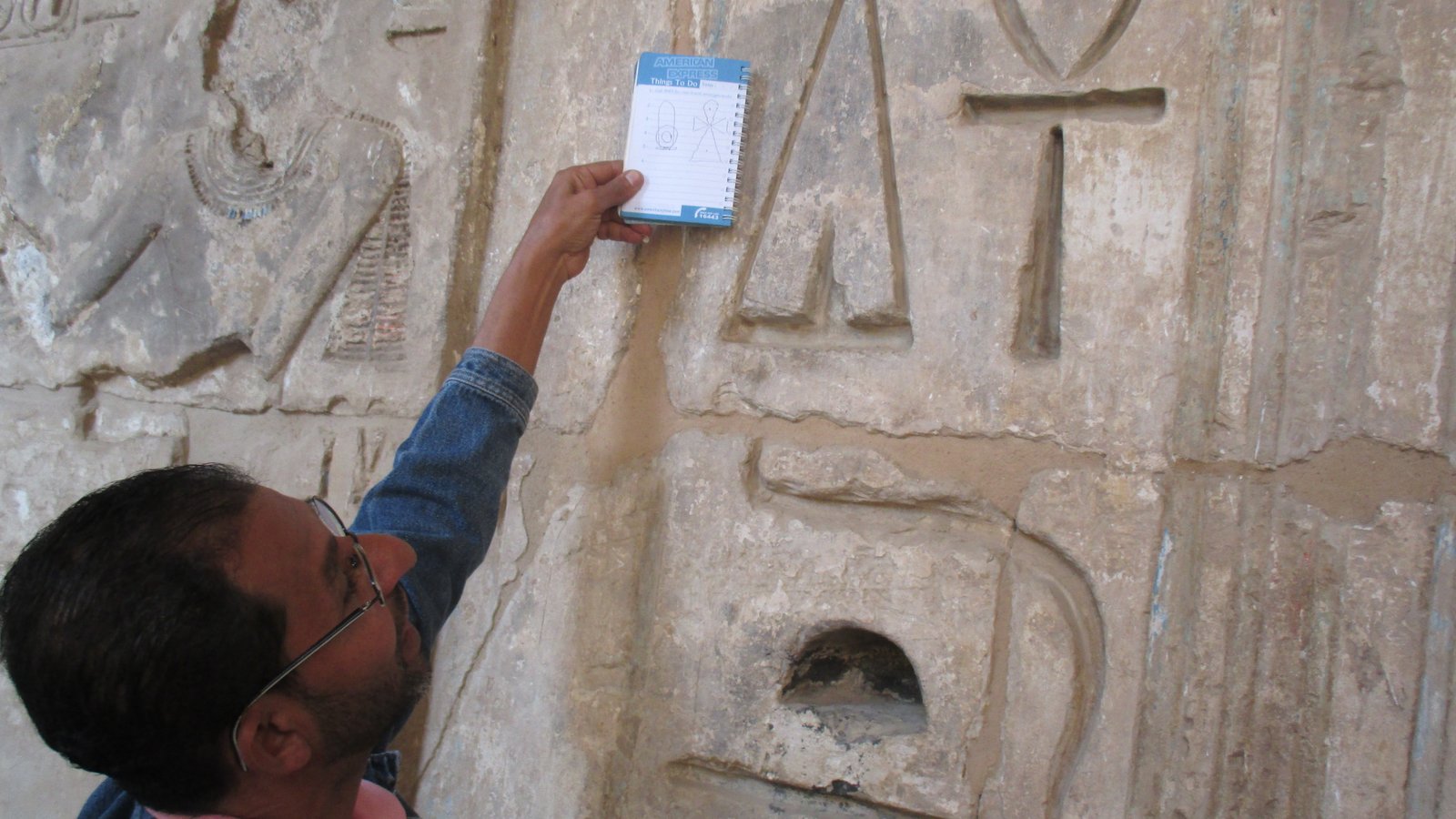
I started taking a liking to Bob as well. He is full of opinions about almost everything – the travel industry, his fellow guides, politics, sociology, religion – you name it. Ask Bob a question and he’ll answer it with candor and commitment. He can read hieroglyphs like I can read a boxscore. His English is excellent, although he speaks it with what sounds like a German/Egyptian accent, and his interpretation of English grammar can have exciting results. He is unfailingly polite, especially when making anatomical observations about Egyptian art. “Look this god, he got, excuse me, two willies.” “The queen here she got skinny waist and, I’m sorry, little poops” (he meant boobs). He gargles his r’s deep in the back of his throat – “Look at this picture of grrrrrrrrrrapes and ficks” (grapes and figs). If I close my eyes, he sometimes sounds like the Yiddish rabbi played by Gene Wilder in Frisco Kid.

Bob

Bob, reading to us in hieroglyph

He’s perpetually cheerful and energetic and he seems to know everybody. When Janine observed this, he replied, “I know! If I’m running for mayor I’m winning.” Bob hates to wait and he makes sure somehow that we are in the front of the line, first on the trolley, first in the building, whatever. When we arrive at any visitor center, the room with the National Geographic overview narrated by Omar Sharif (I’m not kidding, almost every significant site we’ve visited has a National Geographic video narrated by Omar Sharif) magically opens and is switched on. I have watched him grease a half dozen palms.

He has also procured for us, at various times, wine, water, tonic water, and a pile of limes. At the end of each day, he appears with whatever items we expressed interest in during the day. We will get the bill, and I’m sure won’t be cheap (nothing seems to be), but it will be reasonable.

In short, Bob is the fixer’s fixer. He’s the Pope of Greenwich Village, Egyptian style.