Welcome to Shakedown Street

Where was I?

Oh yeah. We had the bright idea to rent a car in Johannesburg and drive to Kruger National Park. It didn’t go according to plan. And now for the thrilling conclusion!

On the morning in question, we took an Uber (three cheers for Uber, which we have used in Rome, Istanbul, Abu Dhabi, and now Johannesburg) to the nearby train station for a fifteen minute ride to the airport, where we picked up our Toyota Corolla for the 5 ½ hour drive to Kruger National Park and environs. We decided on a real splurge – a luxury safari camp in a private reserve open to the park on the shore of the Olifants River. From there we would move a short ways upriver to a much cheaper camp hidden deep in another private reserve. From there we planned to head to a camp in Kruger Park itself, where we would go for a three day wilderness hike. So we needed our own car to do all this, right? Sure.

We had directions from the lodge, but they were a bit cryptic, so it made sense to reconcile them with Google maps, which worked fine on my iphone. (Although for some strange reason, using GPS turns my phone into a handwarmer. This can’t be good. I half expected it to burst into flames on the seat beside me.)

I drove and Janine served as navigator. She doesn’t like navigating. This would become an issue.

I should mention that when we booked into the second lodge on our trip, I received an attachment from the place warning us not to pay bribes to the police. Huh? The fellow told me that there are cops in the area who would like to make a quick buck, which I assume is where nice tourists like us come in. I put the minor warning out of my mind, but reminded myself to be very careful about obeying the traffic laws.

After a few wrong turns out of the airport, we finally put ourselves in the proper direction, and things seemed well in hand. I made sure to always travel under the speed limit, and I was feeling pretty good. And hey, driving on the left side of the road is fun!

Google Maps had us arriving at our lodge at about 3, which was perfect. Lunch was at 2:30, after which we’d have our first safari into the bush at 4:30. Africa! Bush drives! Things were looking good.

I was enjoying the moment, doing about 100 km/hour on an easy stretch of road when I looked up and saw a man in an orange vest waving his arms IN THE MIDDLE OF THE HIGHWAY. I was being pulled over by a cop on foot standing in the highway. My first impulse, strange as it may seem, was to ignore him, but some combination of fear, sanity, and curiosity got the better of me and I eased the car to the side of the road. Then the depressing reality sunk in that I was about to take a ride down shakedown street.

The fellow in the vest approached the car and informed me that I was going 96 in an 80 zone. It seems that the speed limit goes from 120 to 80 very quickly (this is an international practice, apparently). If there was a sign, I never saw it. The gentleman handed me a piece of paper that described the fines for speeding. (Was he an actual cop? He didn’t wear a badge or a nametag. Should I press him on this point? Perhaps not.) I felt like I was being handed a menu for bribery and corruption. “Sir, can I interest you in a nice 750 Rand bribe for doing 96 in an 80 zone that comes on you so fast that you couldn’t slow down if you wanted to? Or perhaps our top of the line bribe strikes your fancy – 1500 Rand for doing 120. That’s a nice one.”

The warning about not paying bribes was ringing in my ears.

I did a variation on what I do naturally – I played dumb. This worked extremely well on our way out of the Cairo airport. After screening our bags, the customs agent asked me if I had any money. I told him that I didn’t understand the question, partly to buy time, and partly because I didn’t understand the question. It seems that the stack of brochures we’d been collecting resembled stacks of currency on the x-ray.

In any event, the more the traffic cop spoke, the more confusingly I responded until the guy gave up and called over his supervisor. The supervisor said that we’d have to pay a speeding fine and I recommended that he give me my ticket and that I’d pay the fine on my way back through town, which was certainly not a part of his plan. This went on for some time until the supervisor seemed to tire of the whole enterprise. He finally said that we could go together to the police station where I could pay my fine, but that they only had one police car that they couldn’t spare, so I was free to go. He also mentioned something about not wanting visitors to think ill of the police. Oh heavens no! Why would I think ill of these upstanding keepers of the peace? The supervisor urged me to go slow because, as it put it, “speed kills.” Indeed. I would later find out that tourists have a tendency to get pulled over and end up having to pay off the cops to be let go. Next time I’m taking the bus.

Having dodged a bullet, and more than a little jangled from the experience, we pressed on for our lodge. We were still several hours away, and, while we were making progress, the directions to the lodge showed a lot of turns ahead.

Somewhere along the line, we missed a turn. The problem is that rather than being a strong guiding force, Google Maps is at best more like a weak-willed enabler and at worst a passive aggressive son of a bitch. If you miss a turn, it does not call out, “Hey schmuck, you missed the turn! Go back and do it the right way!” No, Mr. Google takes it all in stride. If you miss a turn, Google either finds you the next best way to get there (which, as it turns out, could be a VERY BAD IDEA) or it takes umbrage at your rejection of its previous excellent suggestion and says, with Midwestern passive aggression, “Fine, if you don’t like my directions, let’s see what you think of this dirt road, bub.”

Which is exactly what it did. When we missed the turn that would take us where we needed to go, Google spat in the proverbial soup and directed us to a 12 km long dirt road. This didn’t seem right. I thought that maybe the road would be paved just ahead, or that we’d soon be on the right road, but no, this was a long dirt road. At this point both parties in the car were expressing a combination of worry that we’d miss lunch and frustration that the journey was not going according to plan. After a very cordial conversation, it was agreed that I would now be the navigator, and Janine would pilot the craft.

I recommended a backtrack – Google said that maybe we’d be interested in this other nice road a few miles back, so we decided to give it a shot. Sadly, this road was worse than the one we just quit, but for reasons that remain mysterious to me still, we advanced, hoping again that what we were seeing was not actually what we were seeing. And what we were seeing was baaad. This road was just hideous. Janine plowed through a deep rut that was filled with water. After cresting a short ridge, she gamely pushed her way through a deeper, muddier rut, nearly bogging the car down in a trough of water and mud. The mud went spitting in every direction as she span the wheels at full throttle. There was no way in hell we were getting through. I had visions of being stuck in a mud rut miles from civilization, and hours from our destination. I’m all for adventure, but I have my limits.

I suggested an about face and Janine managed to re-ford the two mud ruts and we were back on the main road, but with no good idea about where we’d gone wrong or how we’d make it right.

It is at moments like these that a couple decides whether it would like to remain married.

We gathered our wits and decided to press on. I returned to the somewhat cryptic directions to the lodge and attempted to reconcile them with the options that the Google now presented and made a series of executive decisions. If I was right, we’d make it to the lodge just in time for our game drive. If I was wrong, we’d drive straight to Joburg Airport and fly home and straight to the office of the nearest divorce lawyer.

The fates were with us. We were finally able to find the road we missed and pushed on to the lodge, avoiding any more interactions with the local constabulary. As we pulled into the lodge just in time for the evening game drive, the world’s kindest woman was standing there with welcome cocktails. I wanted to live again.

From Cairo to Buenos Aires – super duper uber reverse culture shock.

It’s hard to explain just how shocking culture shock can be, but Buenos Aires is the un-Cairo. Argentina is full of booze, pork, visible skin, and the people dance in the street until very, very early in the morning. Cairo has tea, koshery, long robes, and they get up at 5:15 am to pray. Perhaps we should have traveled to a cultural halfway house to decompress first.

Don’t get me wrong, I am thrilled that I had the chance to experience Egyptian (and Muslim) culture. It is another world, and I have a much fuller understanding of how a great many people live their lives. On the other hand, booze, pork, skin, and dancing (all in moderation of course) have their charms as well.

But first, I would like to tell you about the massive Turkish Airways business lounge in Istanbul. Here’s the hideous itinerary we endured to get from Cairo to Buenos Aires – Cairo, Istanbul, Sao Paulo, Buenos Aires – all in one go. Oh, and our flight to Istanbul left Cairo at 3:55 am and arrived here at 11 pm the following day. Human beings shouldn’t do this, but it was all made better by the 30,000 square foot Disneyland business lounge in Istanbul. In addition to all the good stuff like showers and an open bar that you find in most international lounges (but almost never in the US), this place has a pool table and a golf simulator. There are private relaxation rooms with beds in them. You can get a panini grilled to order. There’s a barista and an omelet station. There’s foosball. There’s a movie theater! It’s like a cruise ship at the airport. I recommend flying through Istanbul on a Star Alliance flight just to stop over in this crazy wonderful place.

Yes, the airport lounge in Istanbul has a pool table.

Yes, the airport lounge in Istanbul has a pool table.

Why on earth are we in Argentina? Thanks for asking. We’re here because it seemed like a good enough warm weather convergence point to meet up with our daughter and my mother. As you may recall, we kissed our daughter Maggie on the head and sent her off to college this fall and we couldn’t wait to see her again. And my mother is game for just about anything. And thus I am joined by three generations of the women in my life. Hijinks shall ensue.

A photographic chain letter. That's Maggie and my Mom on our rooftop terrace in Buenos Aires.

A photographic chain letter. That’s Maggie and my mom on our rooftop terrace in Buenos Aires.

Buenos Aires was also high on Janine’s list, so Buenos Aires it is. Besides, what’s a world tour without a little South American flair? After five weeks in Turkey, the United Arab Emirates, and Egypt, we were ready for a decent steak and some good red wine. Does that make us bad people?

When we eventually arrived the culture shock slapped us in the face and kept hitting. In the cab on the way from the airport, I noticed a woman walking alone, at midnight, with bare shoulders, and I flinched. In our hip little neighborhood of Palermo Viejo, there are bars every few feet, and they’re open until the wee hours of the morning. People wear as little as they can get away with, which is saying a lot (or a little). Taxis are everywhere, they’re cheap, and you don’t have to bullyrag the cabdriver into using the meter. Nobody stares at you. Toto, we’re not in Cairo anymore.

Ah, Argentina!

They don’t have these in Cairo.

One thing that wasn’t obvious when we arrived is that there are two conversion rates for foreign currency – the official rate and the unofficial, so-called “blue market” rate. If you get Argentine pesos from an ATM or use your credit card, you’ll be charged the official rate of about 8.5 pesos to the dollar. If you have US greenbacks, you can get anywhere from 11 to 13 pesos to the dollar. Why is this? Apparently, Argentinians are not allowed to buy dollars. Since the government regularly devalues its currency and inflation runs at about 25% a year, people buy dollars as a hedge anyway. Thus, a foreigner carrying US dollars is quite popular. At one restaurant, even our waiter asked us if we had any dollars to sell, but we had already sold them to the woman who manages our apartment. It doesn’t sound like the greatest way to run a railroad, if you ask me. If you run out of greenbacks, there is a service called Xoom that will allow you to send a money order at blue market rates to Argentina. How on earth is this? Beats the heck outta me.

Next time – “closed door” restaurants, our day with a professional polo player, and an evening of Latin jazz.

The Music of the Streets and other Cairo Phenomena

Raise your hand if you live in the United States and think you have bad traffic. Now put your hands down. Compared to Cairo, you have very good traffic. It may take you a long time to get to work, but in your world there are traffic lights, crosswalks, and some semblance of order. The only order you experience in Cairo are the laws of the vehicular jungle.

I seem to remember some pretty bad traffic in certain cities around the world, but Cairo stands out for its sheer anarchy. Cairene conveyances are not unlike those in other developing countries. There are taxis and private minibuses that stuff themselves so full that people hang outside the open door like tourists on San Francisco cable cars. There are also donkey carts, big, bad tour buses, bicycles, mopeds, LOTS of pedestrians, private cars, and there are now tuk-tuks, an import from India. These moped/rickshaws are entirely unlicensed – if one of them hits you, good luck trying to get satisfaction. There is no auto insurance to speak of, and people are left to work it out if they have an accident. It’s utter chaos. You could go all day and not find a car without a dent.

There are some really good things about getting about in Cairo. Taxis are dirt cheap. The flag drop is three Egyptian Pounds, or forty two American cents. A trip from downtown to our apartment takes anywhere from ten to forty minutes, depending on traffic, and costs about two dollars with tip (I always give the cab drivers a tip and they seem genuinely grateful). Getting the cab to take you there is another story. We were advised to make sure that the cab driver always turns on the meter. Most will, but some will tell you it’s broken, or come up with some kind of story about why the meter is a bad idea. Apparently, this is a chapter in the International Cab Driver’s Union Handbook. When that happens, you’re supposed to make the driver stop the car and just get out of the cab. One day last week it took us three tries to find a cab driver who would turn on his meter. Then there’s the matter of the destination. Fortunately, our apartment is near a spot known to all cabbies – Kit Kat Square (yes, that’s what it’s called). The amusing part is that there are no hotels near us and cab drivers are highly entertained that we want to go there. One actually laughed at me. My guess it’s as if a tourist hopped into a cab and told the guy to take him to Riker’s Island, or Cleveland.

If the lines in the street are the equivalent of a coloring book, drivers in Cairo are Jackson Pollock. The flow of traffic is an organism unto itself. Drivers weave in and out, sliding from lane to lane, poking through the briefest of openings while they have the chance. The Cairene driver is not just a painter, but a musician. The horn is his instrument (and I mostly mean his – most of the drivers I saw were men). Cairo drivers toot their horn to let you know they’re coming, they beep it to remind you to stay out of the way, they honk it to signal discontent, and they will also tap out a tune from time to time, seemingly out of boredom or maybe just sheer creativity. One day we were heading back to the apartment after a day downtown. There was a brief, rare, blissful moment in which our taxi was all alone for at least a hundred meters. There we were, with the road to ourselves. What did our cab driver do? He honked his horn. Maybe it was a reflexive act. Maybe he was just making sure it worked for the moment, in anticipation of ten or twenty seconds hence, when he knew he’d need it. No matter. It was an auditory transportation non sequiter. The music of the streets, which we can hear quite clearly from our houseboat on the Nile, and which seems to amplify the sounds of the traffic as it bounces off the face of the water, is like an Ornette Coleman composition. At first it sounds simply like noise, but if you listen carefully, you will find that it most definitely develops a rhythm. It somehow makes sense. There are no two ways about it, this is music. Sometimes, the tune is catchy. One driver will tap out a rhythm on his horn (boopedy boop boop, boopedy boop boop) and another will join in, and another, until you have an impromptu automotive symphony.

In any event, just wandering down the street to the market on any given day is an exercise is sensory overload. If you need to cross the street, it also becomes a test of survival. We had one episode in which we had to make it across six lanes of two way traffic. Janine was a bit tentative, and I was too bold – never a very good combination. I confidently stepped off the curb and was halfway into the street when a motorcycle came out of nowhere and nearly ran us down. We retreated back to the curb in flinching self-defense. Janine was more than traumatized. It reminded me of the time when we gave in to our daughter Maggie’s desperate desire to have her ears pierced when she was about five. The problem was that the ear piercing shop only had one person on duty, so they had to shoot the earring stud gun into her earlobes one at a time. Well, these stud guns make a lot of noise, and the first one sent her into a frenzy of tears and recrimination. It took at least a half hour of cajoling to get Maggie to agree to endure the horrifying process of driving a second hole into her other earlobe. That was how Janine felt when she saw her life flash in front of her eyes in Cairo traffic. After a fair amount of suffering, she finally braved the traffic and made it across, but I suspect she’ll carry the moment with her for years to come.

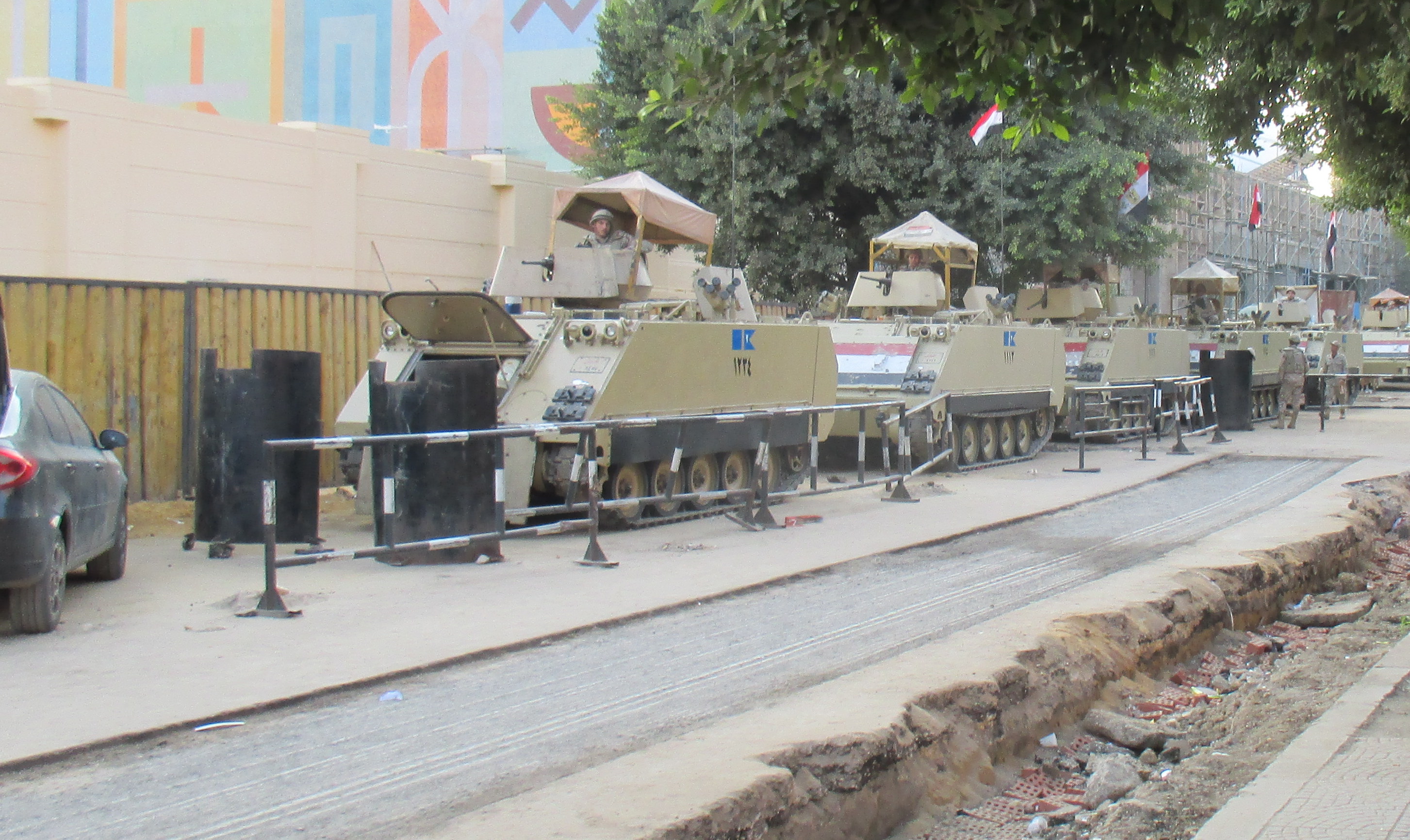
Cairo is not for everyone. In fact, it might not be for most people. For one thing, it’s a developing world country with all that goes with it. Garbage is everywhere. Sidewalks, not so much. The country is also on edge, with well-armed police and army everywhere. Outside the Egyptian Museum, which sits at the edge of Tahrir Square, the epicenter of the recent revolutions (the one to depose Mubarak, and the other to depose Morsi), there is a line of tanks, with soldiers on high alert. Long strands of barbed wire blockades are staged at the sides of the roads, ready to be rolled into place at a moment’s notice.

Line of tanks outside the  Cairo Museum

Line of tanks outside the Cairo Museum

In a poor country, public services are catch as catch can on their best day. One person I spoke with talked of the lack of public space in this city. For example, there are few public playgrounds. The wealthy can buy access to private ones, but poor kids play in the street. Public parks are rare. It’s no wonder that much of the place appears to be treated as a no man’s land where people toss garbage, relieve themselves, or otherwise discount the value of having a clean, well-organized common resource. It was always nice to get home. To get to our houseboat, we pass through a simple unlocked wrought iron gate. Inside our gate, the space was ours, and the chaos of the city was reduced to a thrumming pulse that was over there, while we were over here, down by the river, separated from the madness.

Cairo is not the easiest place in the world to be a tourist. Unlike in many world capitals, westerners in Cairo are a great big curiosity. With my mishmash of European genes, locals have asked me for directions in Rome, Athens, and even Istanbul. Not so in Cairo, where we really, really stand out. Perhaps it’s because there are so few of us after the revolution. Perhaps it has always been the case. But to walk down any street in town is an exercise is being a very big goldfish in a teeny, tiny bowl. I wasn’t terribly bothered by it, but Janine was regularly made quite uncomfortable by the attention she attracted, especially from men. Janine said that she understands why a woman would want to cover herself completely in a culture that seems so polarized by gender.

Then there are the touts. If you look like a foreigner, you won’t get far before someone starts talking to you (at best), or aggressively attempting to sell you something (at worst). Or, like the squeegee guys around the Holland Tunnel, someone will begin to provide a service (like pointing out that the pyramid is a pyramid) that you neither asked for nor need. At the so-called “bent” pyramid in Dahshur, just outside of Cairo, Janine and I had the entire place to ourselves. At one point, one of the two fellows guarding the site (who was packing a very intimidating looking automatic weapon) began following me around the area.

My guide at the bent pyramid at Dahshur.

My guide at the bent pyramid at Dahshur.

Your humble correspondent at the Bent Pyramid

Your humble correspondent at the Bent Pyramid in a photo taken by my pistol packing pal.

Unnerved, Janine retreated to our guide’s car. Silly me, I wanted a better angle to take a photo, and found myself being tracked by my new friend. He may have been toting some serious firepower, but I could also see his socks through his cheap cracked cardboard shoes. He began pointing out some very simple elements of the pyramid, and I could see where this was going. Whether I liked it or not, I would be tipping my well-armed but underpaid new friend. You basically have two choices for how to respond – you can get frustrated or even angry, or you can go with it. I must confess that sometimes I feel charitable, but sometimes I feel manipulated. It’s not like wandering the streets of Rome or Paris, in which you will be left to your own devices no matter what. In Egypt, you are what’s for dinner. Anyway, I suspect that the pyramid touts are members of the Associated Squeegee Guild, or some such august institution.

People will approach you on the street and claim to be just trying out their English, and before you know it, you’re being led to some souvenir stand. It’s unnerving. On the other hand, after the revolution the tourist trade has cratered, and people are attempting to get by on a lot fewer scraps. For the rare tourist, that means a lot more attention. I find it hard to blame people for trying to make a living. We had a fabulous guide in Cairo, a young man in his thirties named Mina, who was introduced to us by houseboat Dan. We spent a few days touring the city with him and he patiently explained who we should tip and how much. The fellow who opened the minaret for us at the Ibn Tulun Mosque gets ten pounds (a little more than a dollar). The guy who led us around the really terrific Gayer-Anderson Museum for half an hour gets twenty. That’s the rate, that’s how it works, and boy does it take the edge off. (By the way, I can’t wait to read the book The Irish Pasha, which explores the fascinating double life of the Egyptologist Robert Gayer-Anderson. It’s being crowd funded at Unbound. If everyone buys a copy maybe we’ll actually get to read it.)

The view from the top of the minaret at the Ibn Tulun Mosque in Cairo. The view was well worth the small tip I gave the fellow who unlocked the door to the minaret.

The view from the top of the minaret at the Ibn Tulun Mosque in Cairo. The view was well worth the small tip I gave the fellow who unlocked the door to the minaret.

By this time you may be asking why anyone would come to Cairo. What with the traffic, the garbage, the unwanted attention, the smog (the air is really bad), and the poverty, why subject yourself to such challenges when you could sit in French cafes or on a Caribbean beach?

My answer, believe it or not, is that it’s actually all quite wonderful. The call to prayer is a perfect example. Each morning at 5:15, it wakes you with a start, even with the best earplugs. But it’s charming, atmospheric, and deeply meaningful to the faithful, who worship in a way that most Americans don’t understand. It reminds you that you are far from your comfortable life and that you are a visitor in a strange land. And it’s really quite beautiful, even if you’re trying to sleep. I really like that.

Next time – thanks for all the atmospherics, Eric, but will you ever tell us what you saw and what you ate?