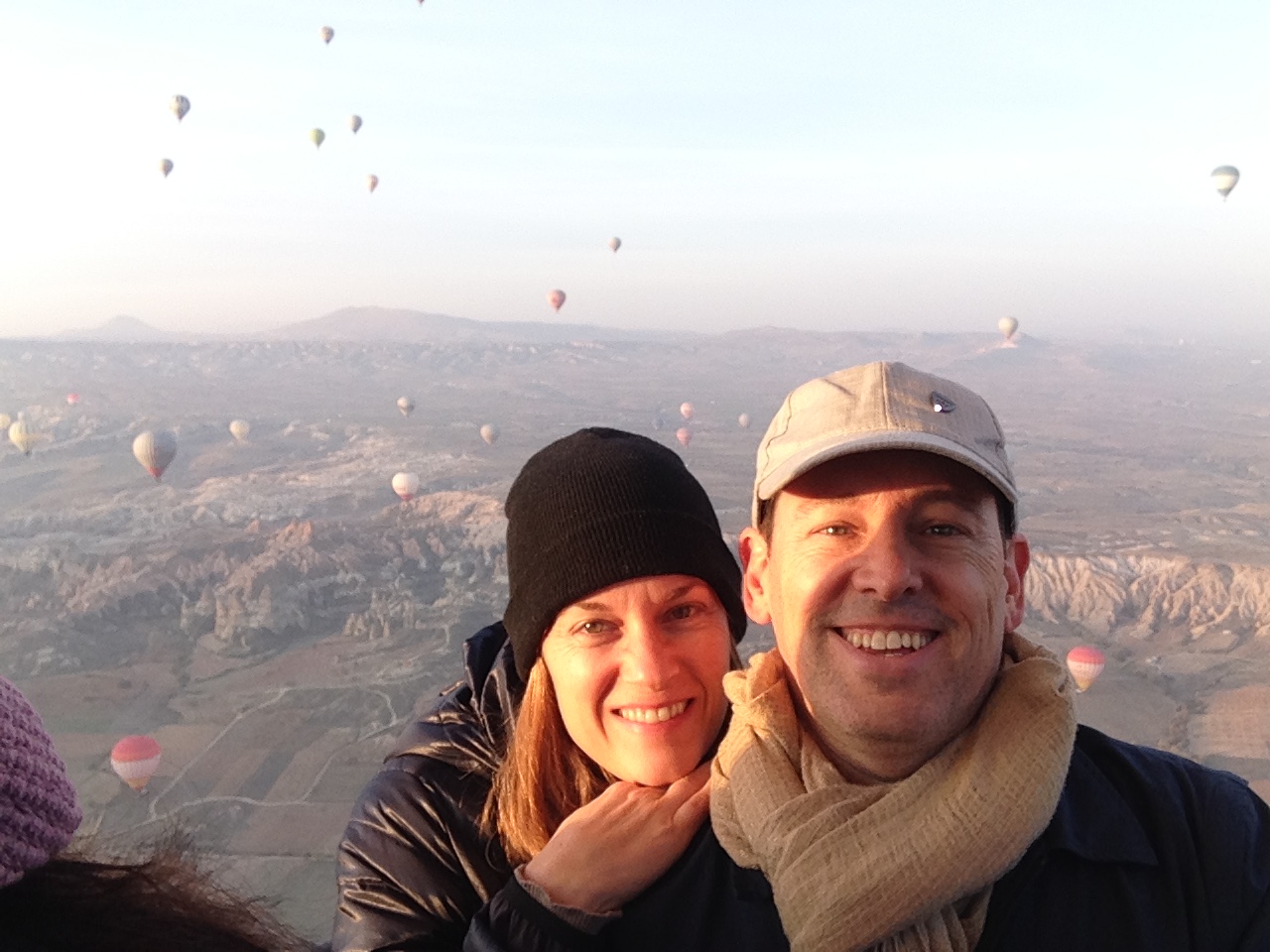
The ultimate Thanksgiving destination – Abu Dhabi!

Let’s just say you have a week to kill and you decide to fly to Abu Dhabi to spend it with people you barely know. It’s your wife’s friend and her husband. You’ve had dinner all together exactly once. What could possibly go wrong?

It is impossible to plan a nine month journey with too much precision. Things happen. Plans change. When we drew up our around the world wish list, Abu Dhabi was probably not in the top fifty, and yet, here I sit, poolside, in Abu Dhabi. In the words of David Byrne, “How did I get here?”

Allow me to explain.

Through nobody’s fault at all, we had a hole in our schedule.

Somewhere along the line, Janine’s friend Kathy invited us to visit her, her husband Brian, and their dog Rupert in Abu Dhabi. I think she said something like, “You should come visit us in Abu Dhabi sometime,” which Janine interpreted to mean, “Please invite yourselves to Abu Dhabi for a week when you have a hole in your schedule.”

It’s a relatively short flight from Istanbul and we were hoping they’d say yes.

Kathy graciously accepted Janine’s proposal, but let us know that she and Brian would be leaving mid-week for a vacation to Sri Lanka. Even so, they encouraged us to stay at the apartment after they left, which worked out well for us and allowed us the opportunity to take care of Rupert P. Kleiver, their loveable, five year old Black Mouth Cur.

Think about it. Janine and Kathy met at a conference and stayed in touch, but that was about it. They have really only seen each other a couple of times. We all had dinner together in New York once, but I doubt Brian or I could have picked each other out in a lineup of one guy. And now we were signed up for a week of close contact and we were also on the hook to make sure that their beloved dog didn’t run away or wreck the place or bite some kid.

As I look back, if you will pardon my French, this had the makings of a real shitshow.

And let this be a lesson to you people.

Every so often a truly bad idea has a happy ending.

This could have been the week from hell, but as it turned out we had a terrific time. There were many boy-boy/girl-girl Men are like Mars, Women are Like Venus moments. While the four of us are all fabulously modern with regard to gender roles and such, it is also true that the boys played golf and the girls had their toes done.

Thanksgiving was brilliant. Kathy made a stunning sweet potato and apple soup, and Brian made a turkey roulade, mashed potatoes, roasted Brussels sprouts with pancetta, stuffing (on top of which he roasted a turkey leg and thigh – I must try that someday), a pecan pie, and a pumpkin pie. I made an apple pie (although Brian had already made the crust, which was excellent).

When I woke up on New Year’s Day 2014, I would scarcely have imagined that I’d be having Thanksgiving dinner in the United Arab Emirates with people I barely know, but that’s life for you, isn’t it?

(By the way, if you’re interested in reading more cultural fish out of water in Abu Dhabi-type stuff, check out Kathy’s terrific blog, Blonde in ‘bu Dhabi)

Thanksgiving, Abu Dhabi style

Thanksgiving, Abu Dhabi style

I didn’t have much of a mental picture of Abu Dhabi. I know that its next door neighbor Dubai is famous for its tall buildings and Vegas-y vibe, with a Middle East twist, but I had no sense of what Abu Dhabi would be like. Abu Dhabi is much different. It has tall buildings and a Miami vibe with a Middle East twist.
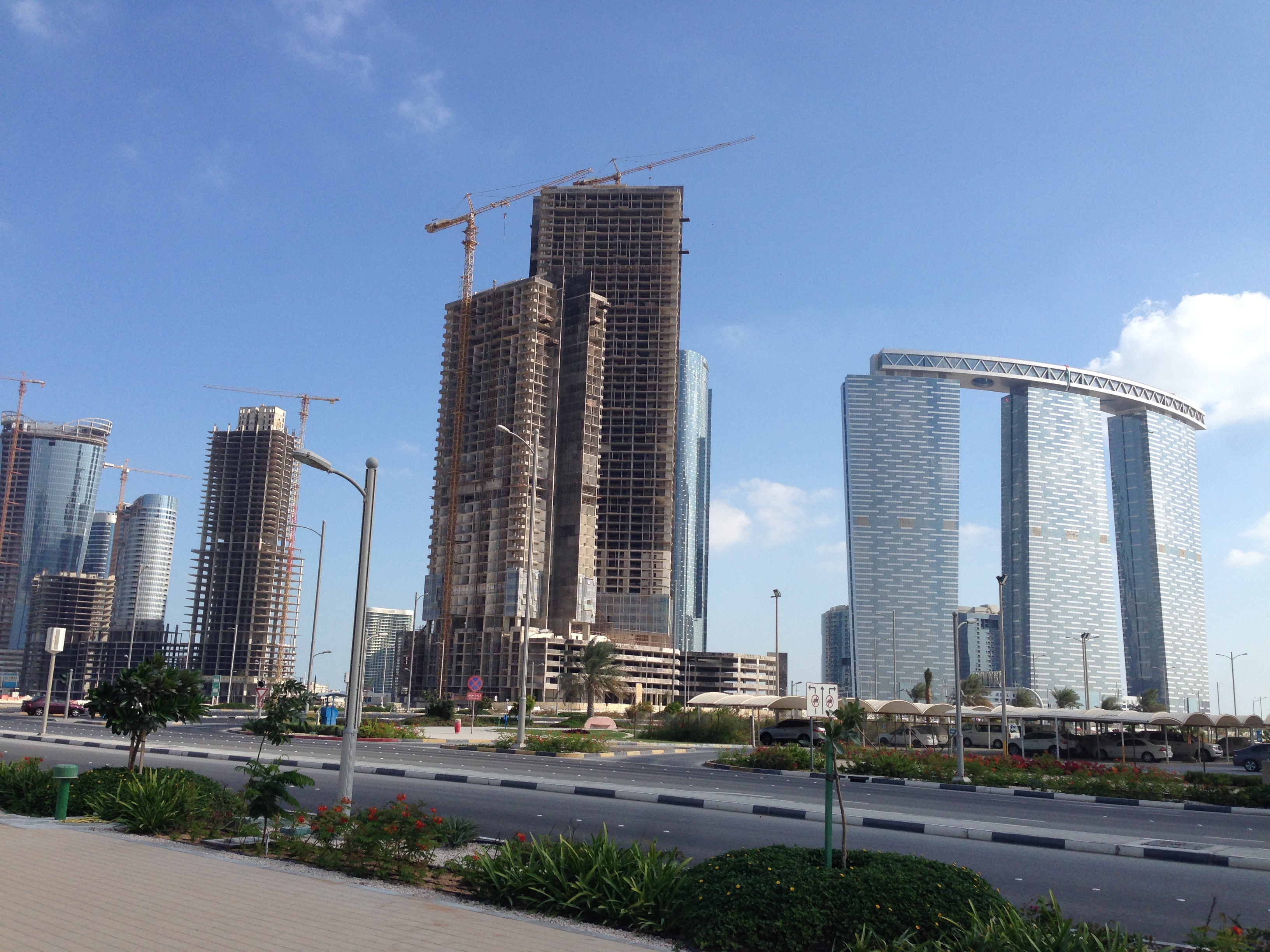
Abu Dhabi under construction

Sometimes it seems that there are more cranes than people.

The weather is lovely this time of year, topping out in the low 80s. (Don’t come in summer, when it gets up to 130. No, that’s not a typo). After flatlining during the downturn, there are once again cranes everywhere. It’s a city of outsiders – only about a third of the population are from the Arabian peninsula.

But it is nevertheless a very Arabian Muslim city. Many women are fully covered and wherever you look you see men in the familiar white robe called a thawb.

The call to prayer emits from speakers around the city five times a day. The workweek is Sunday through Thursday.

In the UAE you have to go to a separate store to buy alcohol (Wait! That’s also true in New York and Maryland.) and it’s only served in hotels. Certain supermarkets sell pork, but to get to the pork products, you have to enter the “pork room,” which brings to mind the curtained-off section of the video store (remember them?) that had the dirty movies.
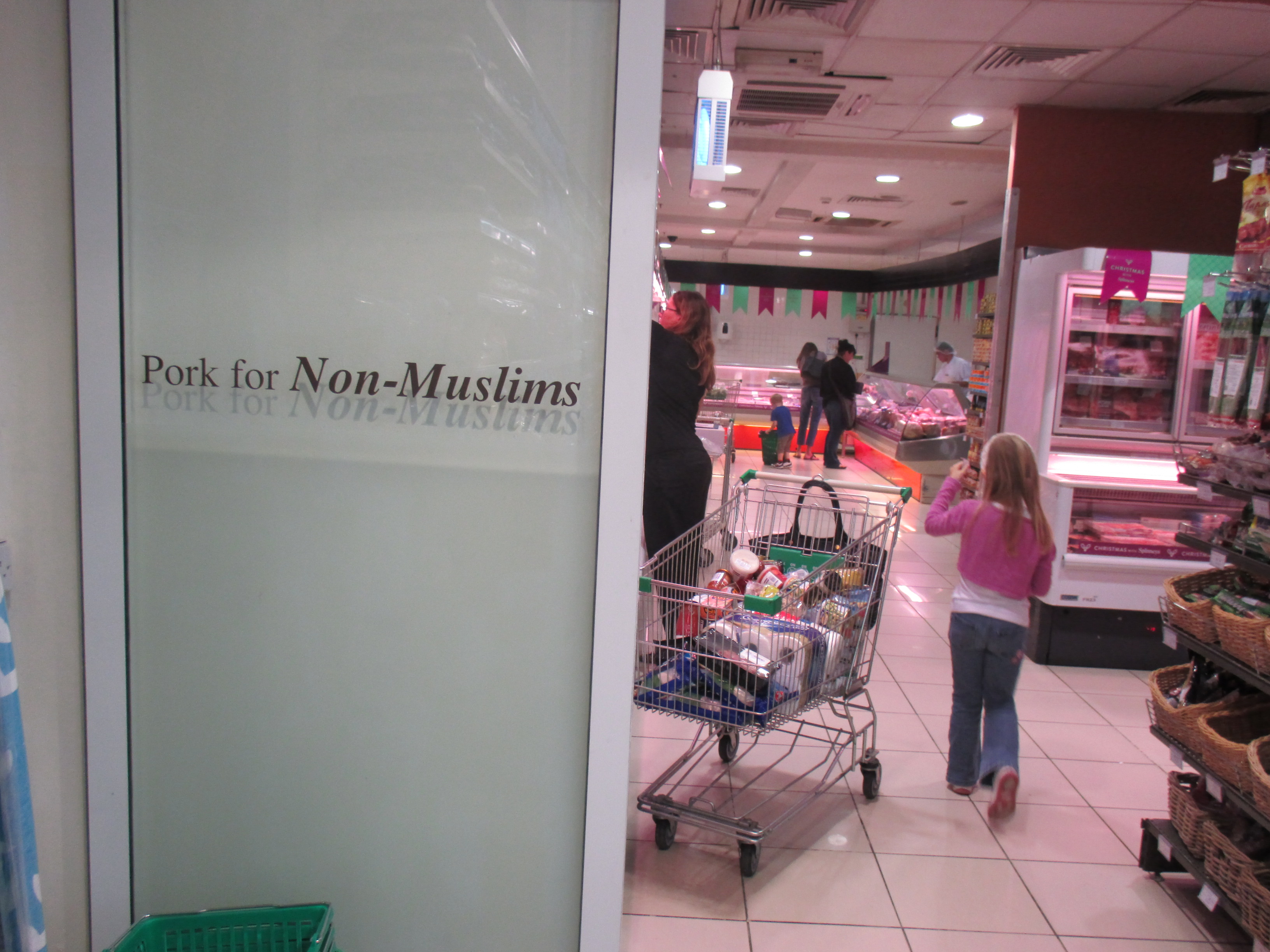
The Pork Room

Behind this door is a world of pork.

At the same time, the supermarkets are chockablock with familiar foods, from taco shells to Hellman’s mayonnaise. The malls (and there are tons of them) have just about every western product you can think of, including a Shake Shack (or, if you will, Sheik Shack, har har). You can live here indefinitely without having to learn a word of Arabic.

The Sheik Shack

Sheik Shack

There is no shortage of national pride here. Our visit coincided with National Day, which celebrates the unification of seven emirates (including Dubai, Abu Dhabi, and five others that I hadn’t heard of) into one administrative body independent of the British, who ran the place until 1971.

The UAE flag was everywhere, and people have taken to draping their cars with those vinyl wrappers that you normally see on buses and trains. Most incorporate the suave if slightly grumpy visage of the UAE’s George Washington, Sheikh Zayed bin Sultan Al Nahyan, who was the federation’s first president.

National pride, UAE style.

National pride, UAE style.

The UAE’s version of the Blue Angels flew overhead, streaming the national colors in their contrails. We watched a fireworks display that would have impressed the Grucci brothers. It was Thanksgiving and Fourth of July rolled into one.

We did not do a ton of sightseeing, but what we saw was impressive.

The Grand Mosque, which was completed in 2007, is the eighth largest mosque in the world. It took eleven years to complete, and it’s full of notable features. The Persian carpet is more than 1.3 acres and has more than 2 billion knots. Its largest chandelier (there are seven) is the third largest in the world. The list goes on. In short, this is a big, brash mosque.

Inside the Grand Mosque, Abu Dhabi

Inside the Grand Mosque, Abu Dhabi

We also toured the Grand Mosque’s secular counterpart – the Emirates Palace Hotel. This is the building that oil built, like much the rest of the great structures of Dubai and Abu Dhabi. Where the region once produced fish and pearls (and sand), by an accident of prehistoric happenstance, this place is now fabulously wealthy. The decision to make the UAE a tourist and shopping destination represents a realization that the wells will someday run dry. For the world’s rich and famous, the Emirates Palace is as good a place as any to efficiently relieve yourself of excess capital. The three room sultan’s suites (there are a bunch of them) are more than seven thousand square feet, they rent for about $16,000 a night, and they are regularly occupied. In the lobby, you can have a cappuccino topped with gold leaf (I opted for the humble camel’s milk version) and there is a vending machine that dispenses gold necklaces.

Yep, a gold vending machine.

Yep, a gold vending machine.

Abu Dhabi and Dubai may seem gaudy and excessive, but who are we Americans to judge? After all, Business Week says that Americans spend over forty billion dollars a year on weight loss products. I won’t be making a habit of gold leaf cappuccinos, but this place is similar enough to our own part of the world to be familiar but different enough to set your cultural gyroscope spinning just out of control enough to make you pretty dizzy.

I like places that do that.

Speaking of spinning cultural gyroscopes, our next stop is Cairo.

Let’s meet some Turks

I have heard endless stories about Turkish hospitality, and I can’t say if these are Turkish traits or not, but in a very short time we have met people who feel like they represent an archetype – the Turquetype, if you will – albeit in vastly different ways.

Let’s meet a few.

Friends as family

When we lived in DC, we became friends with Janine’s co-worker Judy and Judy’s husband Haluk, who was born and raised in the old neighborhood in Istanbul called Sultanahmet. When Haluk found out we were coming to Istanbul, he insisted on picking us up at the airport. He commutes between DC and Istanbul, and he was planning to leave the day after we arrived so he put us in the care of his childhood friend Oktay and Oktay’s brother Adam. They own a restaurant and a handful of other businesses, and they check in on us daily and make sure that we’re well taken care of. When we are in the neighborhood, we make sure to stop by one of the shops, where we hang out and visit. Sometimes Oktay and I head down to the teahouse in the evening and play backgammon. Oktay says that since we’re Haluk’s friends and Haluk is like family, then we are by extension family, and he seems quite sincere about it. It’s like a Turkish syllogism.

Oktay beating me at backgammon

Oktay beating me at backgammon

We were at the restaurant the other night and Adam reported that the guy who plays the reed flute for the whirling Dervishes at the restaurant brought a pile of fish he caught off the banks of the Bosphorous into the restaurant. Would we like some? (A brief aside about the whirling Dervishes. I had grown up thinking that a whirling Dervish was a person with uncontrollable restless energy. Far from it. The Dervishes are practicing a form of Sufi religion in which they arrive at a meditative state that allows them to close their eyes and turn around hundreds and hundreds of times without tossing their lunch all over the front row. If it’s a party trick, it’s a great one. I confess I now have an obsession with these guys.)

Seriously, do NOT try this at home

Seriously, do NOT try this at home

Of course we want Dervish flautist fish. You don’t get that every day. It’s nice to be family.

Other Turquetypes

The crossroads guy during challenging times

Turkey is the bridge between Europe and Asia. In fact, you can cross a bridge in Istanbul and go from Europe to Asia. The other part of this position as crossroads of the world is that Turkey is in the middle of a mess of problems. The country shares long, tense borders with Syria, Iraq, and Iran. Since the Syrian civil war got going, more than 1.5 million Syrian refugees have poured into the country. We met one the other night at dinner. Over the course of our dinner, Muhammad told us that he fled Syria for Kurdish Iraq two years ago, and slipped across the border into Turkey earlier this year. His family left Aleppo, and he can’t imagine the day when he’ll be able to return, or if he does, what will be left. Muhammad was gracious, kind, and he was obviously very sad. I wish him well, but worry for him and his family. Turkey may find itself hosting Muhammed and his countrymen and women for many many years to come. They can’t go home, so they’ll have to stay.

The tout

If you walk ten feet in Istanbul, some guy will try to get you to come into his restaurant, his carpet store, his souvenir stand, or for all I know, his proctology clinic. At Muhammed’s restaurant, where you can get a very nice grilled fish, a friendly, short, stocky fellow in a leather jacket spends his evenings trying to reel in customers. Turns out fishing is in his blood. “In the morning, I fish for fish,” he told me. “In the night, I fish for people!” and pantomimed tossing out his rod and reeling in a couple that was making its way up the hill. He’s not bad at, either. He caught us, after all, and the fish was excellent.

Another fisher of people tried to strike up a conversation, which is simply a pretense to reel you into his business. A young kid named Mehmet wasn’t nearly as skilled as our fisherman friend, but he did his best, even though he didn’t quite have the vocabulary for an extensive conversation. He asked me where I was from, I asked him where he was from, he asked if I wanted to have dinner, I told him I had already eaten. Then I asked his name and he said “Mehmet” and took my hand, shook it, and air kissed me in the direction of both cheeks like he was in the Hamptons, or, it turns out, Istanbul.

The trailblazer

Fatima runs our favorite restaurant in Turkey so far, called Shirahne Cave Restaurant, in Goreme, which is in the central Turkey region called Capadoccia. Goreme is one of those cave towns in Capadoccia in which people have hollowed out the volcanic cliffs and outcroppings and turned them into dwellings. In the past several decades, locals have converted their homes into hotels and restaurants. On this night we ate in a cave and we slept in a cave.

IMG_1098

Be it ever so cave-like, there’s no place like home.

The town is almost comically charming. We wandered up one hill and perched ourselves in a bar overlooking the floodlit town, which brings to mind something out of an animated Disney film.

Goreme at night

Goreme at night

Goreme is a jumping off point for hot air balloon rides and tours of the cave churches and underground cities that dot the region and they’ve done a good job of making the place quite hospitable.

From 1,500 feet up

From 1,500 feet up

After our sundowner, we were getting peckish and we glanced at the menu in front of Shirahne and were thrilled to finally find a place that didn’t have kebabs, hamburgers, or pizza on the menu.

The first night (we went back again the next evening) we had chicken with chickpeas and a handmade pasta that was a lot like spaetzle all served together in a tomato broth. It was the Turkish red pozole, and just as homey and loving. We also had eggplant stuffed with spiced ground beef and a dandy Capadoccian white wine.

The next night we had tiny handmade pasta squares (which reminded me of the Goodman’s squares that my grandmother used to put in her chicken soup) tossed in homemade yogurt and topped with a tangy tomato sauce. It’s as simple as it sounds, but I can’t wait to make it when we get back home. I’d add a bit of dill and serve it as a side dish to a lamb tagine. sounds good, huh? We also had a local black zucchini (Fatima said that were the last of the season) served in clay pot with tomatoes, beef, onions, and peppers. It was a deep, soulful relief to eat real Turkish food after a week of very simple fare. (Although the simple stuff isn’t all bad – one popular street food is a crazy stuffed baked potato called a kumpir that has everything except camel sashimi in it. Janine tucked into one like she’d never eaten before.)

Don't try this at home either

Don’t try this at home either

The real highlight, though, was chatting with Fatima. She feels the pressure of attempting to do real food in a tourist town. Likewise, she is a very modern woman in a place that, by her reckoning, is ambivalent about the role of women these days. She wears jeans and doesn’t cover her head, which in central Turkey has different implications than it may have in Istanbul or on the more European west coast. She told us that she agreed to marry her husband on the condition that he didn’t smoke or drink. The World Health Organization says that 41 percent of Turkish males smoke, but given the astonishing amount of smoking we’ve seen, I find that figure hard to believe. In any case, it’s an audacious requirement here, but Fatima issued it nevertheless. She mostly employs women in the restaurant because they are more reliable and she wants to give them an opportunity to develop marketable skills. She is raising her daughters to be independent, and she has encouraged her first child to delay getting married until she has finished college.

Can you really claim to know something about a person after a brief encounter in a restaurant, or even a week sitting in their shop drinking their tea? Probably not. I’m no more an expert on Turkish people than I am on Turkish taffy. But it’s valuable to try to look just a little bit deeper. The open top bus is fun, but you also have to get off an walk around every once in a while.

Well, so how’s Istanbul? Our intrepid traveler has some thoughts.

Istanbul has long been at the top of my list of places I’ve wanted to see. The Bosphorus Strait, which bisects the city, also serves as the dividing line between Europe and Asia.

bosphoros

Ships ply the Bosphorous. Across the strait is Asia.

That seems interesting. The city has been the capital of both the Roman and Ottoman empires. Must be important. These days, it is overwhelmingly Muslim, and you can count on the call to prayer at 5:00 am or so to wake you up unless you’re a very heavy sleeper or you’ve remembered to put in your earplugs. At the same time, you can easily get a drink. It seems that you see just as many women in jeans as headscarves. What’s going on here? I’ve always wanted to know. For my entire adulthood, I have wanted to experience this amazing stewpot of history and culture.

There are three buildings that everyone associates with Istanbul, and for good reason.

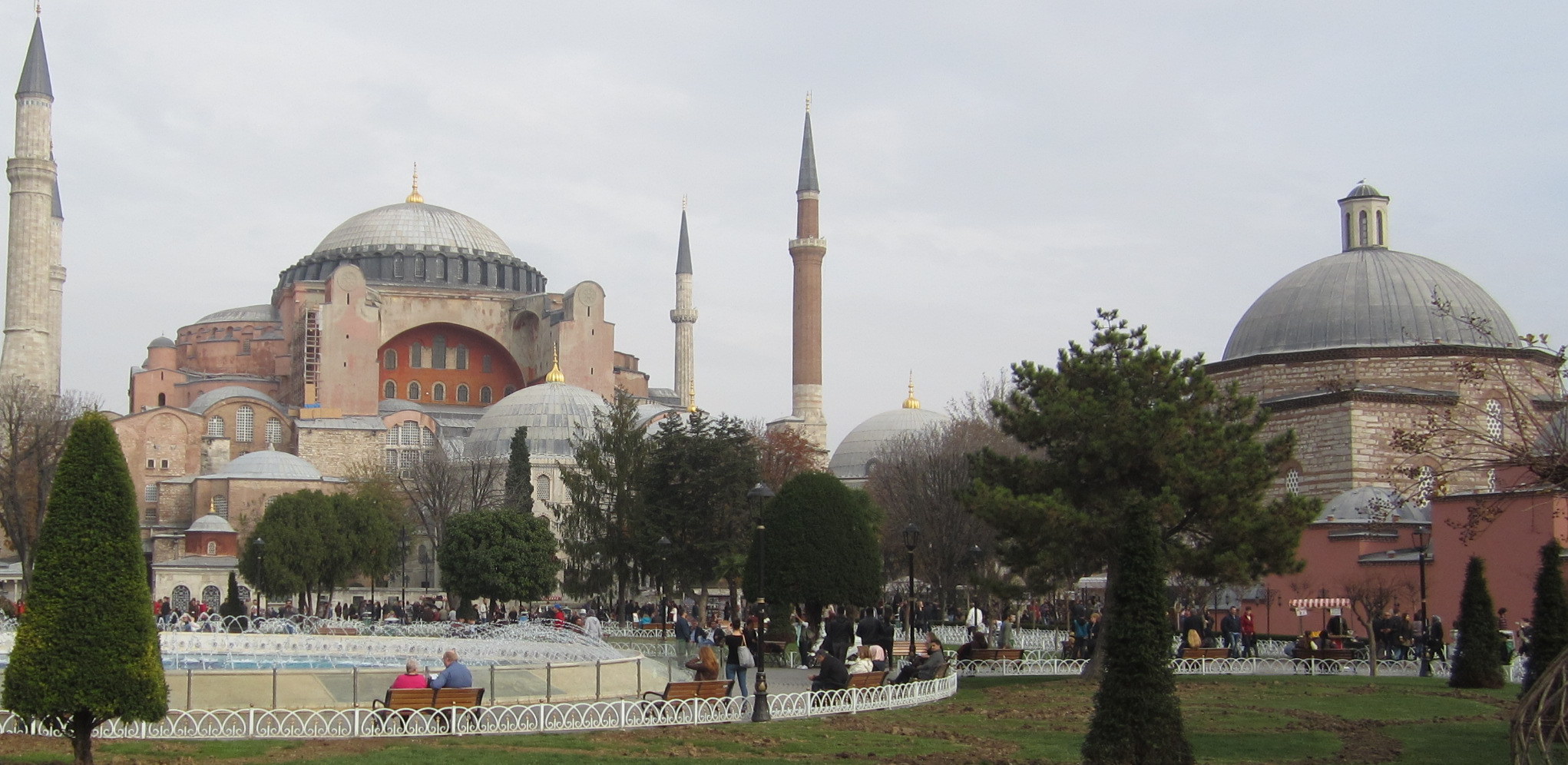
The Hagia Sophia is maybe the most famous of the three.

Inside the Hagia Sophia.

Inside the Hagia Sophia.

It began its life as a church, was converted into a mosque, and is now a museum. It was built in less than six years by 10,000 men, many of whom, I suspect, would have preferred to do something else.

The Blue Mosque is an extraordinary artistic and architectural achievement, and welcomes millions of visitors of all faiths every year while clearing the place out several times a day so the observant can pray.

Blue Mosque

The Blue Mosque

The Topkapi Palace reminds you that until the early twentieth century, a sultan ran an empire right here, complete with a harem full of eunuchs and concubines, among other anachronisms.

These three important structures are within five hundred meters of each other.

How can you not be fascinated by a culture such as this? On the other hand, is it possible to meet such outsized expectations?

Well, probably not.

In between all the history and all the east-meets-westyness, Istanbul is an onslaught of sales without marketing.

Walking down the Grand Bazaar helps me understand what a cocktail waitress at the Tailhook Convention must have felt like.Or maybe a nice Midwestern kid off straight off the bus at the Port Authority. Janine and I have a running joke about the shopkeepers who venture out into the street inviting you back to their shop, just to look. “C’mon, honey, let’s go back to my place. We’re just gonna talk.”

I have written in the past about the sheer terror that a tourist feels when trying to buy something in Morocco. Well, if Turkey’s not any worse in this regard, it’s certainly not any better.

There are thousands of carpet shops in Istanbul, and I would be willing to wager that if you ask about the price of ANY carpet in ANY one of these shops, you will be quoted a price that is outlandish and obscene. This is exhausting. If you ask me, if Istanbul wants to become a truly great city, it has to cut this out. It has to treat its visitors like guests, not marks.

On the other hand, if you are lucky and intrepid (and my dear wife is both) you can find stuff that is unusual and maybe even unique, and you won’t have to sell a kidney to pay for it. For example, Janine, who has made pilgrimages to flea markets in Rome, Athens, and now Istanbul, found a seven story market called the Horhor antique flea market in which we succeeded where many others fail. Mind you, we had to take a tram out of the city center and then stumble our way through a nondescript semi-residential neighborhood in the rain to find the place. Once we arrived, we discovered that we were the only customers in the place. In Istanbul! On the fifth floor, amid a graveyard of lamp parts and other detritus, we settled on an old Turkish lamp that will assume a prominent place in our apartment, if we can figure out a way to get it home.

IMG_2363

Our Horhor lamp. (The blue one)

We didn’t buy a lamp, we bought a chapter out of Homer and a story for the poor sap who looks up at the lamp back home and says, “That’s nice. Where did you get it?

Next time: We meet some of the archetypes of Turkey – let’s call them the Turquetypes.