When we decided to go on this trip, I put Myanmar, which used to be called Burma, up at the top of the list. I had a feeling that it would be the Cuba of Southeast Asia, for good or ill, unsullied by outside forces. And for good or ill, it is.
We were joined at the Bangkok airport by our dear friends Chris and Marianne for the trip to Yangon (which used to be called Rangoon). We stayed at a guest house called Bamboo Place Yangon, which is run by a woman named Nwezin, who may be the face of the Burmese revival. She was extremely hard-working, infinitely friendly, and she’s making a go of her new venture. It can’t be easy. For one thing, her family lives on the premises, which is a lovely colonial-era building, but it appears that most of the rooms are set aside for the guests. One evening I wandered through the front room (where the guests hang out during the day) and found her young daughters spread out on the floor under a mosquito net, hunkered down for the night. Other relatives appeared to be bivoaking in the hallway. Can you imagine waiting for a bunch of foreigners to get out of your sleeping area before being able to go to sleep? Me neither.
In the face of these challenges, the service was gracious and amazingly accommodating. One night we didn’t feel like going out, so Nwezin prepared a traditional Burmese dinner for us, which included a deeply satisfying chicken curry, some fried noodles, watercress salad, sautéed green beans, and a lovely clear soup of some kind. The meal came to ten dollars for the four of us. For breakfast, which was included, you could have eggs and toast or a traditional breakfast of spicy noodles from the Shan region. In my twilight years, when what’s left of my mind turns to paste, I will still remember these noodles. I attempted to extract the recipe from our hostess, but the best she could offer was that I should fry some chicken in onion, and add spices, noodles, and soy sauce. Oh, well. This is what the internet is for.
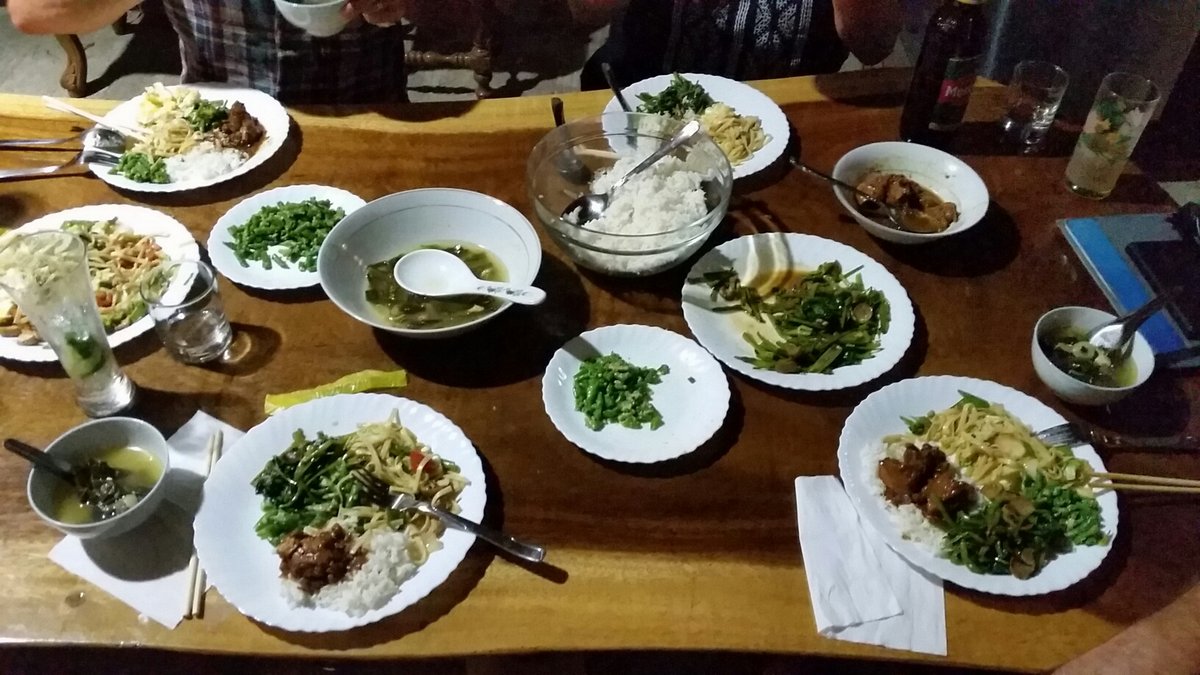
An absolutely delicious home-cooked Burmese dinner.
Yangon is a fascinating place. Myanmar was a longtime British colony, with Yangon as one of its major cities. As often happens, the colonizers built buildings that reminded them of home, whether or not those they’re particularly suited to the climate. Many of these buildings are still standing, if only barely. Some look like they’re being held together by mold and mildew. Others are starting to be rehabilitated and are being turned into, among other things, art galleries and hipster bars. One night, Chris, Marianne, Janine and I did a four-part Yangon happy hour pub crawl, where the evening’s bar tab for four people might have topped out at about sixty bucks. Take THAT, Brooklyn.
I love tourist attractions for the catastrophically lazy traveler. This is why I love the hop on hop off buses that wend their way through most major cities. For twenty bucks or so, you get on some relatively nice open top double decker bus and you drive past most of the sights worth seeing. It’s not cheap, but it’s remarkably efficient. You get a lay of the land and you can pretend that you saw a city. Oh, and you don’t have to move a muscle. It’s like the choo choo train that circles Disneyland. It’s fun and it’s efficient and I refuse to apologize for my sloth.
The hop on, hop off bus has not made it to Yangon yet, thank goodness. (Neither, for that matter, has McDonald’s or Starbuck’s, but that won’t hold.) For one thing, it would never get anywhere. In the three or so years since Burma opened up to the west, one of the major changes has been the influx of cheap used cars from Japan. This has made driving in Yangon a challenge for three important reasons – 1) the city roads were not constructed with a lot of traffic in mind; 2) there are still very few traffic lights and other means to control how traffic moves; and 3) since very few people owned cars until now, nobody really knows how to drive. Can you imagine setting many thousands of student drivers out on the roads with no traffic lights? That’s what it’s like to drive in Yangon. We regularly came to an impasse at an unregulated intersection in which the cabdriver and some other driver would struggle to determine how to proceed. It was entertaining, if a little unnerving.
Thus, one of the great ways to take in the city is the Yangon Circular Railway.
(A brief digression. The train was recommended to us by our friends Robert and Ana, who have lived abroad for many years, and in Yangon for the past year. Our kids were friends in pre-school in DC, and we haven’t seen them since they left the States in 2003. On our first night in town, they invited us over for dinner, and it was just fabulous to see them again. It reminded me that travel can be a great way to meet new people but that it’s also a great way to re-connect with people who no longer live nearby. While I’m at it, we hadn’t seen Chris and Marianne for five years because they’ve been living, of all places, in Yemen, the Republic of Georgia, Thailand, and now Pakistan. Thankfully, they were available to join us in Yangon, which has been such fun. Reconnecting with them has been a real highlight of our journey.)
Anyway, back to the railway. By contrast to the hop on, hop off bus, the circular railway has real passengers who are living their lives like normal people. (Tourists, on the other hand, live their lives like abnormal people. They walk around in circles, get in people’s way, and they dress funny.) The railway was built by the British more than a half a century ago, and it’s the lifeline for the city’s regular folk. I have a sneaking suspicion that with the exception of advertisements for cell phones and the like on the walls of the trains, a time traveler would not notice much difference over the years. The train putts along at about thirty miles per hour and circumnavigates the city in three hours or so. It passes though the center of town and then works its way out to the northern suburbs, although you won’t spot any soccer moms or minivans out there.
I was eager to give it a go. We found the funky old station, bought our tickets, and climbed aboard for our journey on a rolling metal time machine. We chugged through the city, which is gritty, dirty, and desperately lacking in modern infrastructure. After about a half hour, the train became a cargo vessel and filled with goods from the market, headed, one would assume, for the city. Soon after we were in the countryside, where farmers hip deep in flooded fields harvested watercress, which is a staple in the Burmese diet. There were rice fields, tea fields, and thatched roof shacks.
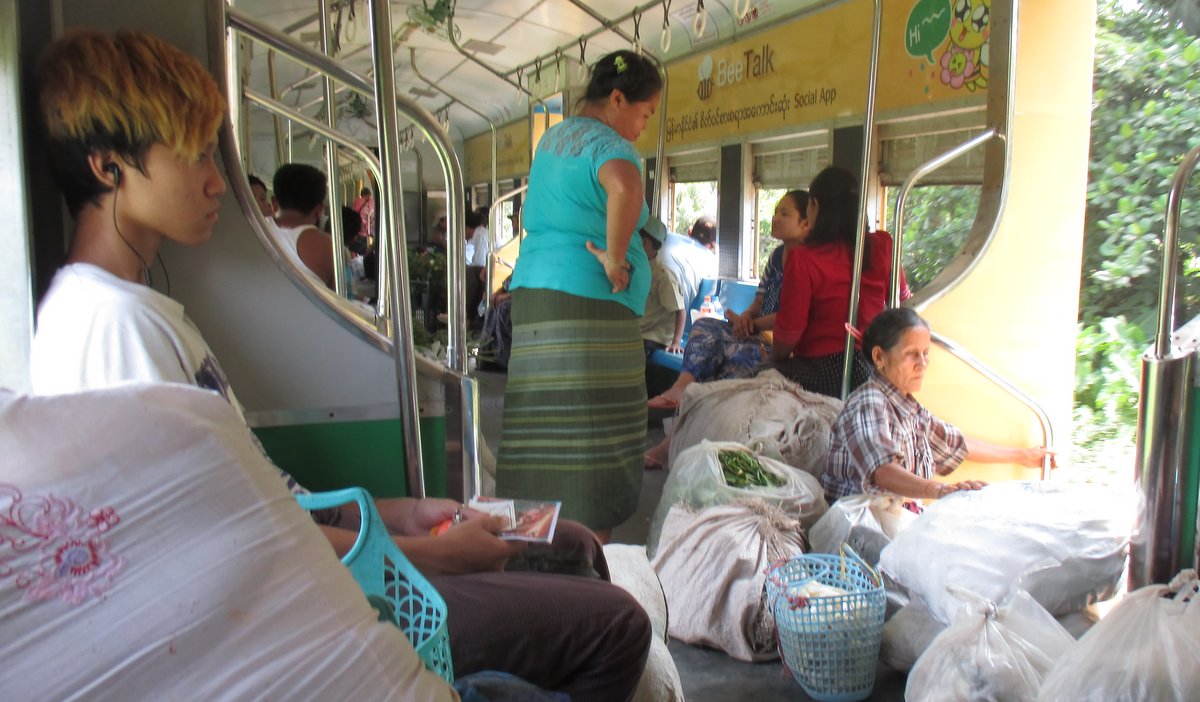
Passengers on the Yangon Circular Railway loaded down with goods from the vegetable market.
It was a hot, sweaty, stinky ride, but endlessly fascinating, and you couldn’t beat the price – a ticket on the circular railway will run you a grand total of two hundred Burmese kyat, or nineteen American cents, or 6.33 cents per hour. I read that there are plans afoot to modernize the railway, which I’m sure will make it more efficient but a lot less charming. I hope they find a way to keep it affordable for the people who rely on it to move their goods from place to place. Without this creaky, pokey, rolling wheelbarrow, life for lot of people would be even harder than it is.
One thing that is decidedly not poor is the Shwedagon Pagoda. This temple, which dates back in one form or another to about 600 BCE, is said to hold relics of the four Buddhas that attained enlightenment, and is an important Buddhist pilgrimage site. It is also just a bewildering collection of priceless religious art and architecture. The pagoda is covered in gold – not just gold leaf, but actual plates of gold. The top of the pagoda, known as the umbrella, consists of half a ton of gold alone. I was just as interested in the pilgrims themselves. There are monks of all ages, including children who look five or six years old. There was a little boy in elaborate dress who was being carried by one man and shaded from the sun by another. It was The Last Emperor, Myanmar edition. Then there were people who may have turned up for some peace and quiet – I saw more than a few people curled up in a cool, quiet corner of a prayer hall, snoozing away.
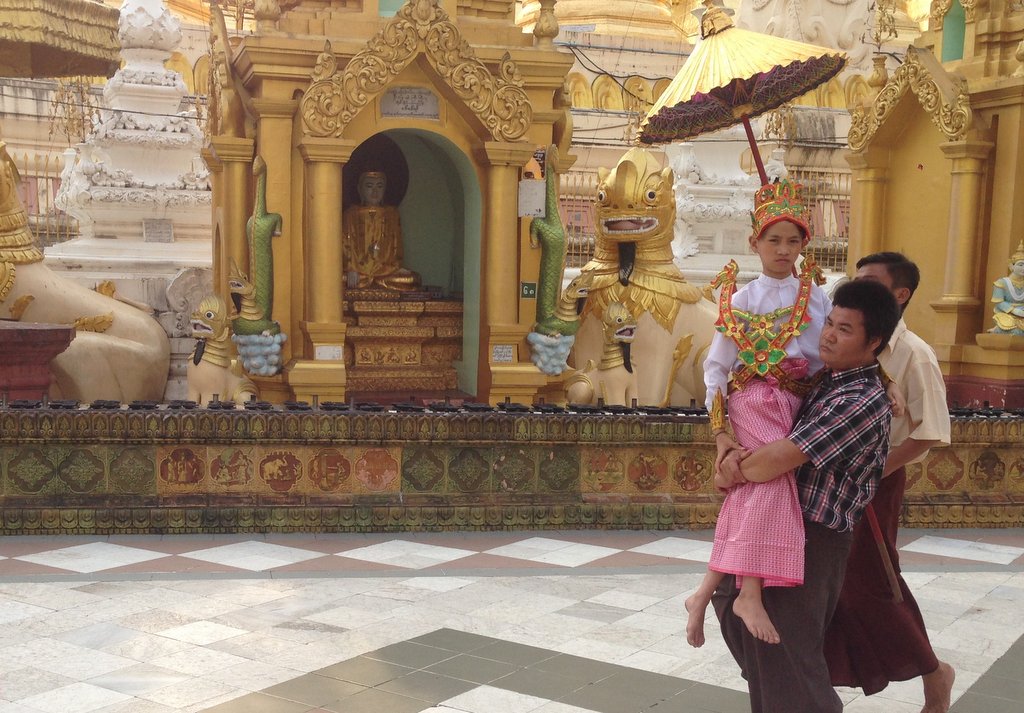
I must say, the little feller looks rather unexcited about being carried around and shaded.
This is a fascinating city. It’s more or less as I imagined it – it evokes every bit of the faded glory I had expected, although it’s always worth remembering that a certain amount of that so-called “glory” was colonial. I was also reminded that, while we are always eager to wander among the stalls in the marketplace and take the decidedly un-spiffy circular railroad, we also don’t turn up our noses at a good ‘ol pub crawl in refurbished hipster havens surrounded by scrums of expats. We want screamy fast wifi to go with our ancient culture. Can a country upgrade itself enough to attract tourists and foreign investment without selling its soul? I certainly hope so.
Yangon has a long way to go. The infrastructure needs to be built almost from scratch. Most businesses have diesel generators to deal with the regular blackouts. Untreated sewage runs in trenches next to the sidewalk. There was no trash collection to speak of that I could find. And through it all people are busting their bippies to make a living and a life, and doing it with remarkably good humor. I wish them very well.

 Eat, Bicker, Love