Now that I’m warmed up, herewith are some of the many things I love about Japan.
1. Vending machines with hot and cold liquids. Pretty much wherever you go, you can buy a can of hot coffee (which makes a very good hand warmer in the winter) or cold tea, coffee, soda, or any number of mystery drinks – out of the same machine. In the winter, there are more hot drinks than cold ones. In the summer, it’s the opposite. It’s amazing! They also sell this stuff called Calpis, but for export markets they changed the name to Calpico, presumably after someone told them that their beverage sounded like cow piss in English. Here in Japan, it’s still Calpis. Who’s gonna know? Oh, vending machines also sell this stuff they call “genki” drinks. Genki is one of those hard to translate words that means healthy, cheerful, and full of vigor. If you’re feeling logy, these genki drinks are supposed to pep you up. And no wonder, after a time I discovered that the two main ingredients are caffeine and nicotine. So you’re genki until you have a coronary.

Ah, vending machines. The blue items are cold and the red items are hot. How civilized! (I confess I resisted trying “Green Shower” tea on the top row, which sounds like it’s marketed to fetishists.
2. Google maps. They work like a charm. This is particularly important because they really don’t have street addresses in Japan. Your mail is sent to the third block of the third sector of the such and such neighborhood of your city. When we used to take a cab home from the train station, we’d tell the driver to take us to the street next to the noodle shop near the Fukudaya department store and he knew exactly what we meant. Here in Japan, Google Maps also works perfectly with the public transit systems, unlike, say Melbourne. You can find out when the bus or train comes, what the best connections are, and how much it costs. Japanese buses used to be mystery vehicles, but with Google Maps they make perfect sense. This is huge.
3. The Nishiki market in Kyoto – this may be the best food market in the world. The food is, well, perfect, and they have pretty much every good thing that the region has to offer. More than that, though, they encourage you to sample everything, they don’t seem to mind if you take pictures, and they don’t vibe you if you don’t buy anything. You could have an excellent free lunch here.
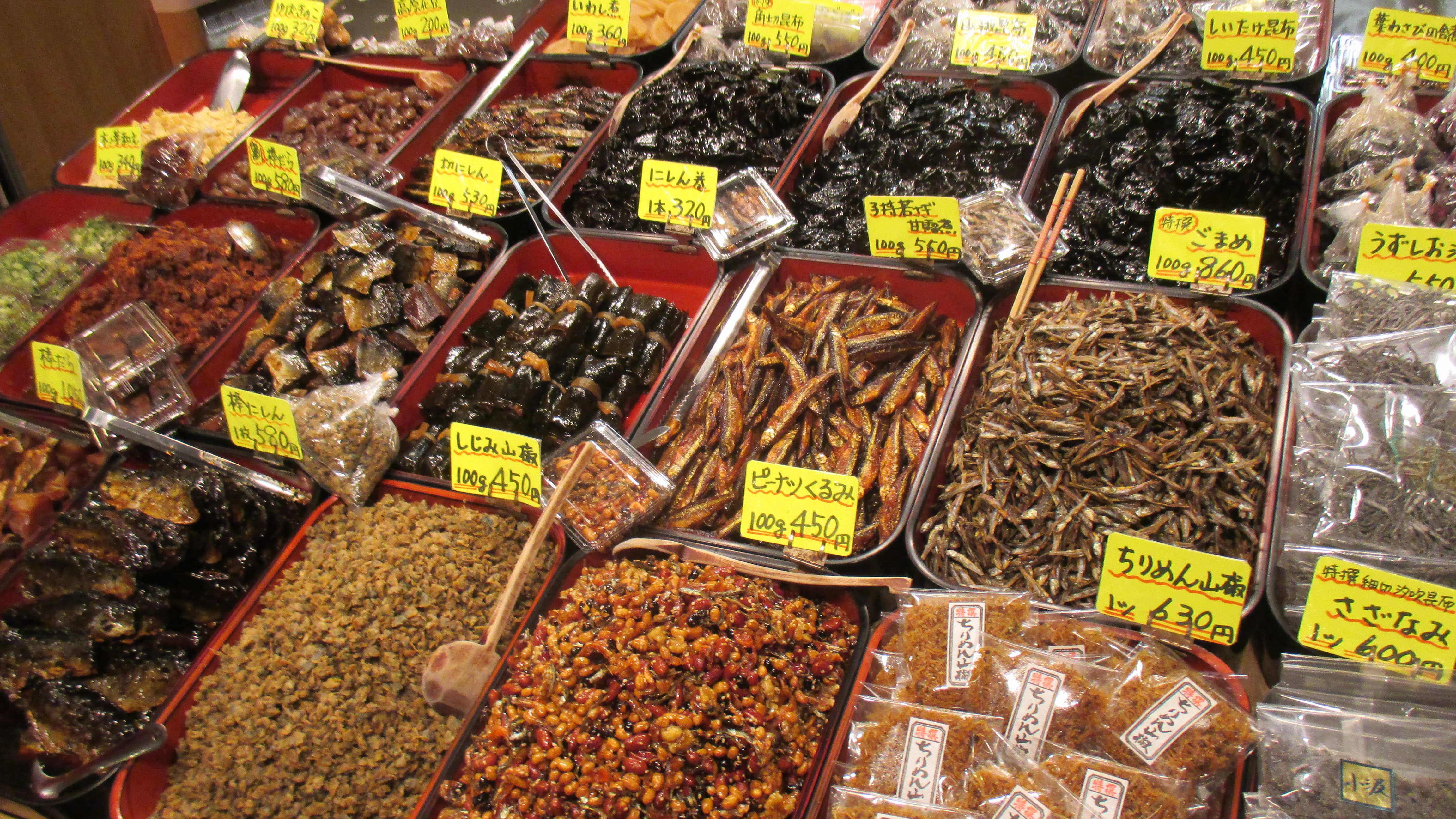
Some of the wonders on display at the Nishiki Market in Kyoto.
4. Similarly, the Tsukiji wholesale fish market in Tokyo just has to be seen. We lived in Japan for two years and visited Tokyo a dozen times and never got our act together to see Tsukiji, which will leave its funky digs in 2016 for a modern operation in the suburbs, much like the Fulton Fish Market did a few years ago. Tsukiji is the central trading post for Japan’s fish industry and it’s a wonder to behold. Apart from the famous early morning tuna auction, it moves more than half a million metric tons of fish a year and it said to be the biggest fish market in the world. And this is no tourist show. We stood and watched two guys butcher two massive tunas that the fish monger told me were worth between three and four thousand dollars each.

Two guys butchering a pair of $4,000 tunas at the Tsukiji Fish Market in Tokyo.
After gawking at all the fish, we wandered to the outer market, where there are food stalls and cookware shops. We tucked into a sashimi breakfast and I finally bought the chef’s knife of my dreams. The owner of the shop had my initials engraved in the handle, which made me tingly all over.
5. As you may have already figured out, the food is amazing almost wherever you go, and it’s not as difficult as you may think to figure out what to eat. Many places just present a plastic version of their menu in the window or a menu full of photographs, kind of like at Denny’s, except good. All you have to do is take the waitstaff outside and point at what you want. If they don’t have plastic food, just ask them what’s good and they’ll steer you in the right direction and they won’t sell you the most expensive thing – they’re crazy honest. Oh, and no tipping! I mean it. They’ll chase you down the street if you leave extra money on the table, or so I’m told.
6. Did I mention that people are honest here? The other day, as I was making my way up to Utsunomiya, the town we used to live in, the train stopped and everyone got out. Disoriented, I grabbed my shopping bag full of gifts for our old friends and scampered off the train. Another train pulled up to complete the journey, and just as I was about to board I realized that I had left my ipad on the last train. (Just writing this has produced a cold sweat.) Frantic, I had the presence of mind not to get on the train, and instead I ran upstairs to the ticket window, where I was told to check with someone back on the track I had just come from. By this time I’m beginning to leak bodily fluids (how sad that we become so attached to our technology, but whatever), and I spied a metal building that said, helpfully and incongruously, “lost and found” in English. I knocked on the door, but there was no answer, so I knocked again. And again. After what seemed like several minutes, but which was probably only thirty seconds or so, the door opened and I explained that I had left something on the train. The fellow asked me what it was and I said that it was an ipad. “Oh, he said. Here you go,” and he handed it over. Just like that. I resisted the temptation to hug him.
7. 7/11 in Japan is a great restaurant. You can get any number of dangerously yummy things at the 7/11 for a couple of bucks. There are rice balls stuffed with salmon, sour plums, and any number of other things (Although the packages are usually written in Japanese, natch, so from time to time we get a surprise). That reminds me of the time that I made a miso and jelly sandwich for lunch because I thought I’d bought peanut butter. Oops.) The 7/11 sells a divine carrot and burdock root salad, a dizzying array of pickles, sushi, steamed Chinese pork buns, a salty, umami bomb soup of root vegetables called oden, and all manner of beer and wine. You can also get a pair of gloves for $2.40 and an umbrella for 80 cents. It’s heaven on a street corner. And who says Japan is expensive??

Some of the delectable delights at 7/11.
8. Japan has now joined the modern world of banking. You can now use your ATM card to get money at the post office or the 7/11. In the old days, I think there was one branch of Citibank in Tokyo that would give you money from a U.S. account. If you traveled here and you didn’t bring cash or traveler’s checks (remember them?), you had to go to a bank and do a bank withdrawal from a credit card. Not only that, but the ATMs used to close for evenings and weekends! When we lived here, we had a Japanese bank account, but once had to hitchhike down a mountain because we ran out of money and all the ATMs were closed for the weekend. No lie.
9. The taxi drivers wear coats, ties, and white gloves. They drive with precision and care. As I said, they know where they’re going. They have a gizmo that allows them to open and close the passenger door automatically. The cabs are neat and clean and comfortable. Amazingly, the taxi rate has not changed in the twenty years we’ve been away, although it was expensive then and it’s expensive now.
10. I like bowing. It’s fun. It shows that you care. I suppose it’s just second nature – people even bow when they’re talking on the phone. Gas station attendants will run out into the street to stop traffic when you leave the station and they will bow as you go. If two cars come to an intersection at the same time and one cars yields to the other, the driver who received the courtesy will bow to the other. In his car. In what country have you ever seen car bowing? When the department stores open in the morning, an army of clerks dressed like the cast of the tv series Pan Am with neat little skirts and pill box hats line the entrance and bow in unison.
11. It’s actually a pretty easy country to visit. Janine has said that Japan may be the most accessible really, really foreign place you can think of, and I agree. People are almost always friendly and helpful, even if they don’t speak much English (and they usually don’t). One evening we even ventured into the district in Shinjuku called Golden Gai, where there are several hundred tiny little bars (some have as few as six stools). These little places are scary because they seem so intimate and unapproachable, but we thought it was worth a shot. We were in search of a quintessentially Japanese drinking experience, and what we got was a hole in the wall joint off a skinny little alley run by a friendly woman who greeted us warmly and showed Japanese professional wrestling videos all night. It was impossible to avert the eyes.
And so there you have it, friends. This was by no means an exhaustive list of things I love about Japan, just eleven that came to mind. We say farewell to Japan reluctantly. As often happens, we quickly discovered that we didn’t have nearly enough time to do the place justice, even though we’d already spent two years here. Every moment in Japan seemed full of wonder, good food, and something ridiculously foreign, even though we actually sort of understand the place.
If you haven’t been, go. You certainly won’t forget it.


 Eat, Bicker, Love